
The Landfill Methane Crisis: Why Food Scraps Don't Break Down in the Trash
A pervasive cultural myth persists regarding municipal garbage: that discarding an apple core, orange rind, or dinner scraps into a standard trash bin is environmentally harmless because it is biodegradable. In actual municipal landfill operations, this assumption proves catastrophically inaccurate. Industrial landfills are intentionally engineered, high-density containment basins designed to seal contents away from water, atmospheric exchange, and direct sunlight. Once trash is mechanically compacted under thousands of pounds of heavy crawler equipment and capped beneath daily aggregate covers, atmospheric oxygen is eliminated within hours.
Deprived of diatomic oxygen ($O_2$), organic matter cannot undergo standard biological oxidation. Instead, anaerobic methanogens dominate the biochemical landscape. These specialized microbes convert complex cellulose, starches, and proteins into volatile organic acids, carbon dioxide, and copious volumes of raw methane gas ($CH_4$). Over an empirical 100-year atmospheric window, methane traps 28 to 36 times more radiative heat within the Earth's troposphere than carbon dioxide; assessed across a concentrated 20-year timescale, its localized global warming potential surges past 80 times. Landfills represent one of the single largest anthropogenic sources of methane in North America, turning valuable biological nutrients into an escalating atmospheric hazard.
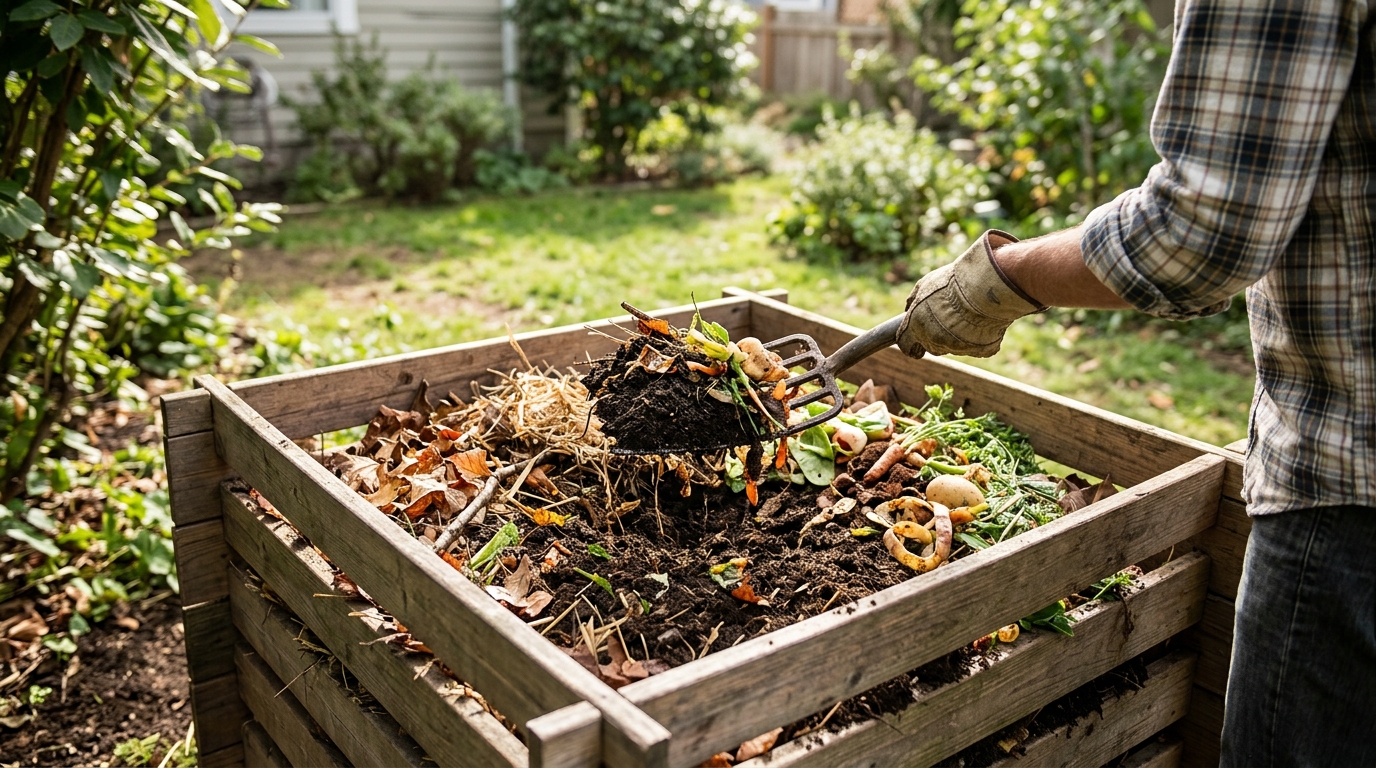
In vivid contrast stands the biological miracle of controlled aerobic composting. When organic material is blended with deliberate structure, passive airflow, and adequate hydration, aerobic bacteria—specifically staged populations of psychrophiles, mesophiles, and extreme thermophiles—alongside branching actinomycetes colonies digest organic bonds enzymatically. Rather than generating combustible methane, this aerobic metabolic cascade yields solely carbon dioxide, harmless water vapor, intense natural thermal energy, and stable, carbon-sequestering humus packed with micro-nutritional biology.
format_quote“In a landfill, an apple core is preserved in an anaerobic tomb for 20 years producing greenhouse gases. In a balanced compost pile, it converts into nutrient-dense living soil in 6 weeks.”
— WasteLift Soil Microbiology SOP #04-ORG
The Golden 3:1 Rule Explained: Carbon vs. Nitrogen Dynamics
Successful backyard composting is neither guesswork nor luck; it is applied organic stoichiometry. At the foundational microbial level, bacteria and fungi need two primary nutritional inputs to thrive, reproduce, and synthesize cell biomass: Carbon (C), which acts as their baseline caloric energy source and structural skeleton, and Nitrogen (N), which supplies amino acids, enzymes, and cellular proteins.
In professional soil science literature, the optimal biochemical target ratio for active aerobic digestion is roughly 25:1 to 30:1 of elemental Carbon to Nitrogen by dry weight. However, residential practitioners do not possess laboratory mass spectrometers. This is where the practical “Golden 3:1 Rule by Volume” serves as an operational benchmark.
3×
Carbon-Rich “Browns”
Coarse, dry, cellular plant matter that creates open interstitial air pockets, preventing compaction and anaerobic pockets.
- check_circle Dry autumn deciduous leaves
- check_circle Shredded unprinted corrugated cardboard
- check_circle Untreated wood shavings & dry sawdust
- check_circle Clean barley or wheat straw (not hay)
- check_circle Shredded brown kraft paper bags
1×
Nitrogen-Rich “Greens”
Moist, high-protein organic scraps that fuel rapid bacterial multiplication and elevate heap core temperatures.
- check_circle Kitchen vegetable trimmings & peelings
- check_circle Spent coffee grounds & unbleached filters
- check_circle Fresh green lawn clippings (dry briefly first)
- check_circle Crushed calcium-rich eggshells
- check_circle Pruned non-diseased garden plant foliage
Why volume differs from weight: Dry fallen leaves or shredded box cardboard are extremely low-density and filled with atmospheric air gaps. In contrast, fresh food peelings and spent espresso grounds are dense, water-saturated solids. Therefore, adding three buckets of light, shredded browns for every single compact bucket of kitchen greens delivers the exact chemical equilibrium required.
What happens when uncalibrated: An overabundance of wet nitrogenous greens suffocates interstitial voids, driving pile oxygen levels below the critical 5% threshold; this triggers putrefaction, produces a sharp ammonia or rotten-egg odor, and yields a slime-like sludge. Conversely, an extreme excess of dry browns leaves the microbial population starving for enzyme building blocks, causing the pile to remain completely ambient and dormant for over 12 months.
The Science of the Hot Pile: Temperature Stages & Microbial Succession
Thermal dynamics within a properly stacked compost bin mimic an ecological succession model. As microbial consortia metabolize sugars, hemicellulose, and complex lignin, their internal biochemical activity releases exothermic heat trapped by the insulating outer mantle of brown leaves.
Mesophilic Initiation (68°F to 113°F / 20°C to 45°C)
Ubiquitous soil bacteria and opportunistic fungi rapidly metabolize simple mono-saccharides, amino acids, and starches. As metabolic respiration surges, internal core temperatures rapidly elevate out of ambient parameters.
Thermophilic Pasteurization (113°F to 160°F / 45°C to 71°C)
Specialized heat-tolerant thermophilic bacteria (including Bacillus and Thermus strains) dominate the pile, breaking down tough plant cell walls. Maintaining temperatures between 135°F and 155°F for at least 3 to 5 consecutive days safely thermalizes weed seeds, destroys plant pathogens (like late blight), and denatures plant viruses.
Curing, Humification & Maturation (Ambient Cool Down)
As fuel dwindles, temperatures subside back into mesophilic territory. Actinomycetes, wood-decay fungi, beneficial nematodes, and native earthworms migrate inward, polishing stubborn polymers into crumbly, dark, sweet-smelling finished humus with balanced cation exchange capacity.
The “Never Add” List & Troubleshooting Pests and Odors
The vast majority of residential composting failures are directly attributable to poor ingredient hygiene or neglecting basic rodent deterrent protocols. Industrial compost facilities can process post-consumer restaurant meat and certified bioplastics due to high-tonnage mechanical turners; backyard units cannot safely handle these streams.
block Backyard Compost Exclusions (Strict Ban)
cancel
Meats, Poultry & Fish: Attract rodents, scavengers, and fly maggots.
cancel
Dairy, Fats & Oils: Coats pile particles, blocking microbial aeration.
cancel
Carnivore Pet Waste: Dogs/cats carry Toxoplasma gondii and roundworms.
cancel
Treated Lumber / Ash: Contains copper arsenate or volatile chemical toxins.
Standard Troubleshooting Matrix
Diagnosis: Severe nitrogen overload; excess proteins volatilizing off into gaseous ammonia ($NH_3$).
Remedy: Turn the pile thoroughly with a garden pitchfork to vent accumulated gases, and incorporate 2 to 3 full buckets of shredded dry cardboard or dry leaves immediately.
Diagnosis: Saturated anaerobic pockets due to poor bottom drainage and excess moisture.
Remedy: Insert perforated PVC pipes or turn aggressively to introduce air; cap the bin top during prolonged torrential rains and mix in coarse twigs or wood chips.
Diagnosis: Exposed surface greens or direct earth gaps at bin edges.
Remedy: Dig a 10-inch cavity into the hot center core, dump raw food scraps inside, and cover entirely with dry browns. Line bottom bin perimeters with galvanized 1/4-inch hardware cloth mesh.
Real-World Composting Dilemmas (Interactive FAQ)
Click each common household scenario to view the verified biochemical guidance.
Can citrus rinds and onion skins go into a backyard compost bin?
Are glossy magazines and colored shipping boxes safe to shred as browns?
Can I compost in the dead of winter in sub-freezing cold climates?
How do I know when my compost is fully cured and ready for garden beds?
The Modern Homeowner’s Guide to Flawless Curbside Recycling & Zero Wishcycling
The Modern Homeowner’s Guide to Flawless Curbside Recycling & Zero Wishcycling