
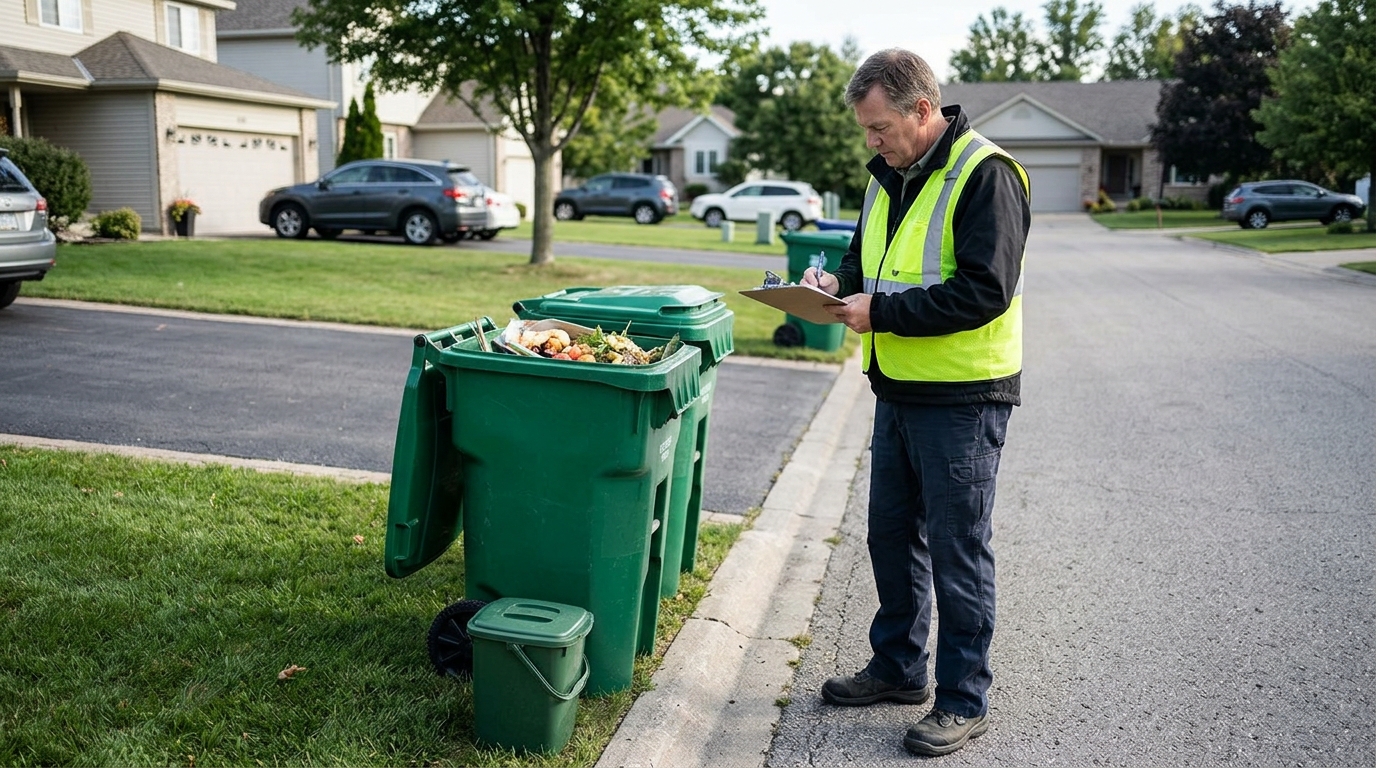
The New Era of Mandatory Organics: Why Landfill Methane Triggered Municipal Mandates
Over the last five decades, municipal solid waste policy centered almost exclusively around inert commingled recyclables—glass, corrugated cardboard, and rigid polymers. However, state regulators and the U.S. Environmental Protection Agency (EPA) have recognized that municipal landfills represent the third-largest producer of human-related methane emissions in North America. When organic matter, including post-consumer food scraps and yard trim, is compacted into anaerobic landfill cells deprived of oxygen, its decomposition breaks down biochemically into raw methane (CH₄)—a greenhouse gas with a global warming potential 84 to 86 times greater than carbon dioxide over a 20-year horizon.
This atmospheric reality catalyzed aggressive statutory frameworks nationwide, moving municipal waste programs from voluntary composting subsidies into strictly enforced, legally binding diversion mandates:
Enforces a statewide 75% reduction in organic waste landfilling relative to 2014 baselines. SB 1383 uniquely mandates jurisdictions to enact local ordinances requiring all residential households and commercial accounts to separate organic matter, empowered by route review camera audits and administrative penalties.
Requires local governments across high-density urban growth sectors to provide curbside organic source-separated collection services while establishing tiered diversion milestones for multi-family residential complexes.
The first statute to implement an outright statewide ban on putting food scraps into household trash receptacles, establishing zero-tolerance thresholds for municipal transfer stations.
Phased in mandatory citywide collection across all five boroughs, compelling single-family homes, brownstones, and residential apartment buildings to deploy dedicated locked, latching organic totes to combat urban rodent vectors while enforcing escalating fine schedules.
These legislative statutes share an essential compliance mechanism: municipalities must certify minimum contamination thresholds at industrial composting facilities or anaerobic digestors. When loads consistently exceed 3% to 5% physical contamination, industrial receiving processors levy severe penalty rejections—transferring costs back to property owners via municipal surcharges.
delete_sweep
Stream Separation Boundaries
What Actually Belongs in the Green Bin vs. What Triggers Fines
Curbside audits reveal that over 78% of residential contamination citations stem not from intentional dumping, but from "wish-cycling"—the erroneous assumption that an item marked natural, paper-based, or sanitary is safely compostable. Navigating municipal enforcement begins with cataloging acceptable bio-matter against prohibited contaminants that compromise aerobic windrow processors.
Mandatory & Accepted Inputs
- check Raw & Cooked Food Scraps: Vegetables, fruit rinds, citrus peels, stale bakery goods, coffee grounds, and loose tea leaves.
- check Animal By-Products: Meat cuts, poultry carcass bones, seafood shells, cheese rinds, and eggshells (processed safely in municipal high-heat thermophilic facilities).
- check Food-Soiled Unlined Paper: Uncoated pizza box bottoms, unbleached brown paper napkins, paper towels, and unlined parchment baking sheets.
- check Yard & Horticultural Waste: Grass clippings, deciduous leaves, garden pruning debris, small branch wood (under 4 inches diameter), and spent potting soil without synthetic perlite beads.
Strictly Prohibited Contaminants
- close Pet Excrement & Cat Litter: Fecal matter contains resistant zoonotic parasites (e.g., Toxoplasma gondii) that survive standard windrow thermal thresholds.
- close Conventional Plastic Bags & Wrap: Film plastics wrap around industrial trommel screens, inducing catastrophic mechanical halts at regional processors.
- close Waxed & Polyethylene-Coated Cartons: Ice cream tubs, milk cartons, and modern disposable coffee cups contain micro-thin plastic linings that will not decompose.
- close Treated, Painted, or Stained Lumber: CCA pressure-treated timber contains toxic copper and chromium arsenic compounds that invalidate compost soil certification.
The Truth About 'Compostable' Plastics: BPI Certification vs. Municipal Rejection
Perhaps no single issue causes more friction between eco-conscious consumers and municipal inspectors than compostable bioplastics. Consumers routinely purchase cutlery, transparent cold cups, and clamshell packaging labeled "100% Plant-Based," "PLA," or "Biodegradable," only to discover their green bin tagged with a non-collection violation notice.
The issue rests upon the critical difference between commercial aerobic digestion operating parameters and ASTM laboratory benchmarks:
The ASTM D6400 / ASTM D6868 Paradigm
ASTM D6400 testing validates that a synthetic biopolymer will break down within 180 days under tightly maintained laboratory conditions: sustained 58°C (136°F) thermal saturation, precise microbial cultures, and uninterrupted moisture. However, high-throughput commercial composting facilities typically operate on abbreviated, fast-turnaround batch schedules of only 45 to 90 days to maintain throughput volume.
When PLA (polylactic acid) polymers exit these commercial cycles, they emerge semi-fragmented into brittle micro-flakes. Furthermore, commercial trommel sorting sieves and optical sorters cannot optically distinguish a clear PLA salad bowl from petroleum-derived PET (#1) packaging at line speeds of 250 units per minute. As a result, facility sorting arms reject both into the landfill residue bunker, or processors refuse to accept PLA bioplastic products entirely.
Municipal Best Practice: Unless your municipality explicitly publishes an authorized list of BPI-certified (Biodegradable Products Institute) rigid food serviceware, never deposit rigid bioplastic cups or forks into your green organic tote. Restrict your bin liner selections strictly to certified paper bags or BPI-certified, thin ASTM D6400 translucent green kitchen scrap collection liners.
Property Manager & HOA Compliance Protocols
While single-family households face individual accountability, multi-family residential communities, condo boards, and Homeowners Associations (HOAs) bear collective liability under statutes like SB 1383 and NYC Local Law 87. Under these rules, an entire 150-unit community can incur repeated non-compliance penalties due to the careless habits of a handful of residents.
Multi-family infrastructure introduces unique logistical vulnerabilities: internal trash chutes, anonymous communal dumping corrals, and off-site tenant turnover. Implementing standard operating procedures (SOPs) shields residential communities from regulatory citations:
Never route organic food scraps through communal vertical trash chutes. Chute impacts breach thin compostable liners, coating interior chute liners with decomposing putrescible liquids that trigger building-wide odor complaints and severe pest harborage. Chute doors must be permanently placarded with bilingual compliance warnings.
Establish a secure, ventilated ground-floor organic staging station within the exterior enclosure. Deploy heavy-duty 64-gallon carts equipped with gravity-lock mechanical bars or mechanical latching lids to deter urban raccoons, rodents, and scavenging vectors.
Provide every newly signed leaseholder with a 1.5-gallon ventilated countertop food waste caddy, a starter roll of certified BPI compostable liners, and an infographic sorting chart. Incorporate municipal diversion compliance requirements as a formal addendum to the residential lease or HOA Bylaws.
Train facilities personnel to inspect curbside carts 30 minutes before municipal collection runs. If an exterior cart displays black film trash bags, staff should retain and divert that cart from the curbside pickup point to avoid route-camera detection, and log the incident for board reporting.
Automated Hauler Camera Audits & Contamination Surcharge Defense
Curbside enforcement is no longer reliant solely on code inspectors walking the streets at sunrise. Across North America, contracted municipal haulers have retrofitted automated side-loader (ASL) collection vehicles with hopper-mounted high-resolution computer vision cameras and GPS telemetry.
When the hydraulic mechanical arm hoists a green cart and inverts it into the truck hopper, an optical scanning camera captures 12 to 24 burst frames per second. Machine-learning algorithms scan the moving stream for banned items: plastic grocery bags, metal scrap, expanded polystyrene, and construction lumber. If detected, the vehicle computer automatically tags the timestamp, GPS coordinates, property address, and photo evidence, sending an instant violation record to the municipal billing department.
The Municipal Citation Escalation Schedule
Defending Against Erroneous Citations: If your household or HOA is issued an unjustified contamination penalty, municipal code provides a formal administrative appeal window (typically 14 to 21 business days). Secure the hauler's photographic inspection evidence, prove proper cart placement outside pedestrian throughways, and demonstrate that foreign debris resulted from third-party illegal dumping.
checklist
Operational Action Plan
Step-by-Step Municipal Compliance Checklist
Achieving effortless zero-infraction compliance requires simple habit changes and disciplined kitchen workflows. Follow this weekly checklist to maintain clean collection streams, eliminate odors, and pass municipal camera audits:
Deploy the "Freeze-Before-Disposal" Tactic for High-Odor Scraps
Place fish skins, poultry bones, and fatty trimmings inside a reusable silicone container or paper bag in your freezer during warm weather. Transfer frozen scraps into your curbside green cart the evening before scheduled pickup to prevent bacterial decomposition, foul odors, and fly larvae.
Establish a "Brown-to-Green" Bottom Absorption Layer
Before tossing loose wet kitchen waste into your curbside rolling cart, line the bottom with 3 to 4 inches of coarse yard clippings, shredded untreated cardboard, or fall leaves. This dry bio-barrier absorbs decomposing liquids and prevents food scraps from adhering to the container base.
Eliminate Produce Stickers, Ties & Rubber Bands
Before tossing fruit rinds, banana peels, and vegetable ends, pull off all adhesive PLU barcode stickers. These small vinyl squares resist biodegradation, slip through sorting screens, and are flagged by optical contamination scanners.
Perform Mid-Week Natural Aeration & Alkalinity Balancing
Dust the top layer of your outdoor rolling organic cart with a light coating of standard baking soda (sodium bicarbonate) or agricultural garden lime. This neutralizes acidic volatile fatty acids, deters insect pests, and prevents nuisance odors in summer heat.
Audit Exterior Carts for Tight Lid Seal & Mechanical Integrity
Inspect the lid hinges and lip seal of your green cart every month. If cracks or broken hinges allow rainwater or insects to enter, contact your municipal waste authority or franchise hauler immediately to request a no-cost cart replacement before a contamination citation occurs.
Curbside Organics Regulatory Inquiries
Authoritative answers to the most common legal, operational, and residential curbside organic waste collection challenges.
What happens if my green bin is tagged with an oops sticker?
Can I use standard plastic grocery bags to line my kitchen countertop food caddy?
Does our HOA have legal liability if residents contaminate the organic bins?
Are raw meats, poultry carcasses, and dairy allowed in municipal composting bins?
How can I prevent maggots and flies in curbside green bins during summer?
How do automated truck cameras detect contamination inside my rolling cart?
Executive Summary & Key Takeaways
Achieving effortless organics compliance across single-family households, residential portfolios, and municipal routes relies on four foundational rules:
Safe Disposal of Household Hazardous Waste: Paints, Solvents, Batteries & Automotive Fluids
A definitive chemical safety guide for identifying, storing, and safely transporting residential toxic waste to certified municipal collection facilities without environmental contamination or domestic hazards.