
Key Takeaways & Executive Overview
- check
AI Optical Penalty Triggers: Commercial collection vehicles now run top-mounted wide-angle cameras that flag loads with as little as 5% to 10% non-conforming materials as full municipal contamination. - check
Financial Impact: Average penalty surcharges range from $75 to $250 per occurrence, plus retroactive re-categorization of entire cardboard roll-offs to MSW tipping fees ($90–$140/ton). - check
Strict 48-Hour Dispute Window: Most major hauler Master Service Agreements (MSAs) waive your right to contest surcharge billing unless formal objection is submitted within 48 to 72 hours of digital invoice posting. - check
Physical Dock Mitigation: Installing eye-level pictorial matrix signage and locking rear dumpster lids reduces unauthorized third-party dumping and internal breakroom cross-contamination by up to 92%.
Anatomy of Hauler Surcharges: The Automated Camera Trap
In prior decades, hauler contamination fees required manual inspection by route supervisors or transfer station floor operators. Today, tier-one national and regional waste contractors have equipped side-loader and front-load automated trucks with high-definition, AI-powered optical recognition hopper cameras.
As the hydraulic arm elevates a commercial 8-yard dumpster above the hopper, high-speed shutter systems capture multiple angles of the discharge flow. Machine vision models immediately evaluate plastic film, polystyrene, unflattened corrugated items, and hazardous e-waste. If foreign materials exceed the contract threshold, an automated penalty event is generated directly into the vendor's billing engine.
Uncontrolled Contamination Penalty Matrix
3 High-Risk Contamination Hotspots
Eliminating contamination requires intercepting unapproved materials at their point of generation rather than relying on staging dock staff to separate commingled items.
Loading Dock Pallet & Shrink Wrap Cross-Contamination
Root Cause: Warehouse receiving teams de-palletizing freight throw low-density polyethylene (LDPE) shrink wrap into open Old Corrugated Cardboard (OCC) dumpsters. While LDPE is recyclable in dedicated balers, haulers reject cardboard loads containing film wrap because it tangles optical sorting disc screens.
Breakroom & Cafeteria Food-Soiled Cardboard
Root Cause: Janitorial staff combine cafeteria grease-stained pizza boxes and half-empty beverage cups into communal recycling bins. Organic grease saturates cellulose fibers, rendering whole dumpster bins un-pulpable at the paper mill.
Maintenance Chemical & E-Waste Leakage
Root Cause: Facility maintenance personnel disposing of aerosol lubricant cans, fluorescent ballasts, or lithium battery packs in standard general waste roll-offs during quarterly cleanup projects.
Dock Staging & Color-Coded SOPs
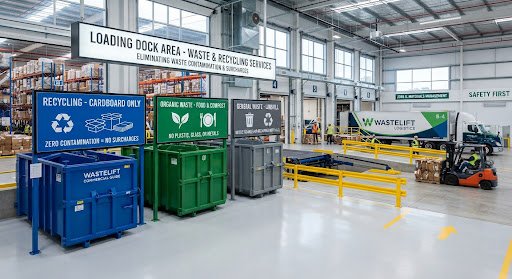
Eliminating human sorting error requires visual architecture that removes ambiguity. Standardizing industrial docks with color markers and physical access controls eliminates cross-contamination at the source.
5-Color Bin Demarcation
Blue (Clean OCC/Paper), Yellow (Clean LDPE Shrink Wrap), Green (Organic Waste), Gray (General Non-Hazardous MSW), and Red (Universal/Hazardous Waste). Floor tape must match bin lids.
Bilingual Pictorial Signage
Mount high-contrast signage exactly 60 inches from the finished floor directly above every hopper inlet. Rely on photographic examples of accepted vs. rejected items rather than text-only warnings.
Baler Pre-Inspection Log
Before tying off wire on vertical or horizontal balers, lead operators execute a 30-second surface inspection to extract stray strapping bands, wooden chunks, or thermal shipping labels.
Lockable Corrals & CCTV
Keep exterior corral gates secured with combination padlock access. 64% of contested haul contamination originates from unauthorized neighboring vendors dumping construction debris after operating hours.
The 48-Hour Hauler Surcharge Dispute Protocol
When an automated surcharge appears on your consolidated monthly statement, you have likely already forfeited your contractual right to dispute. Implementing an immediate 48-hour challenge workflow consistently claws back 70% or more of improper assessments.
Demand High-Resolution Raw Photographic Evidence
Haulers frequently append low-resolution thumbnails. Request the full uncropped, timestamped JPEG files showing GPS telemetry stamps and bin serial identifiers. Over 30% of challenged fees fail when haulers cannot prove the photo corresponds to your specific container.
Cross-Reference the Hauler's Own Scale Weight Ticket
If your recycling load was billed at a penalty flat fee but the scale ticket still logged delivery to an authorized Materials Recovery Facility (MRF) rather than a solid waste landfill, the material was processed into the circular supply stream and landfill diversion charges are void.
Invoke the Master Service Agreement (MSA) Threshold Clause
Standard enterprise waste agreements allow for de minimis contamination thresholds (typically 5%–10% by volume). Issue a formal dispute letter stating that incidental non-target material did not breach the agreed allowance and deduct the line item from payment remittance.
“Pursuant to Section 8.4 of the Commercial Service Agreement, Client formally disputes Charge Item #9842 ($185.00 Contamination Fee). Hauler has failed to demonstrate that non-conforming content exceeded the 8% volumetric contractual allowance. Client remits baseline tipping rate; please issue adjusted credit memo within 10 business days.”
Commercial Contamination FAQ
What is the legal threshold for a hauler to classify an entire dumpster as municipal solid waste? expand_more
Can haulers charge a contamination fee without providing photographic proof? expand_more
How do we prevent third-party illegal dumping in our open commercial corrals? expand_more
How often should a 100,000+ sq ft facility conduct internal waste stream audits? expand_more
Cardboard Balers vs. Open Dumpsters: Which Saves More?
Analyze capital expenditure payback models, monthly hauling pull savings, and cardboard commodity rebate tiers.