Demystifying TRUE Zero Waste (GBCI 90%+ Diversion Threshold)
Total Resource Use and Efficiency (TRUE) certification, administered by Green Business Certification Inc. (GBCI), represents the definitive international benchmark for enterprise facilities aiming to eradicate solid waste sent to landfills, incinerators, and the environment. Unlike conventional environmental programs that focus solely on reactive downstream recycling, TRUE establishes a rigorous, lifecycle-wide framework anchored in the Zero Waste International Alliance (ZWIA) definition: the conservation of all resources through responsible production, consumption, reuse, and recovery of products, packaging, and materials without burning and without discharges to land, water, or air that threaten the environment or human health.
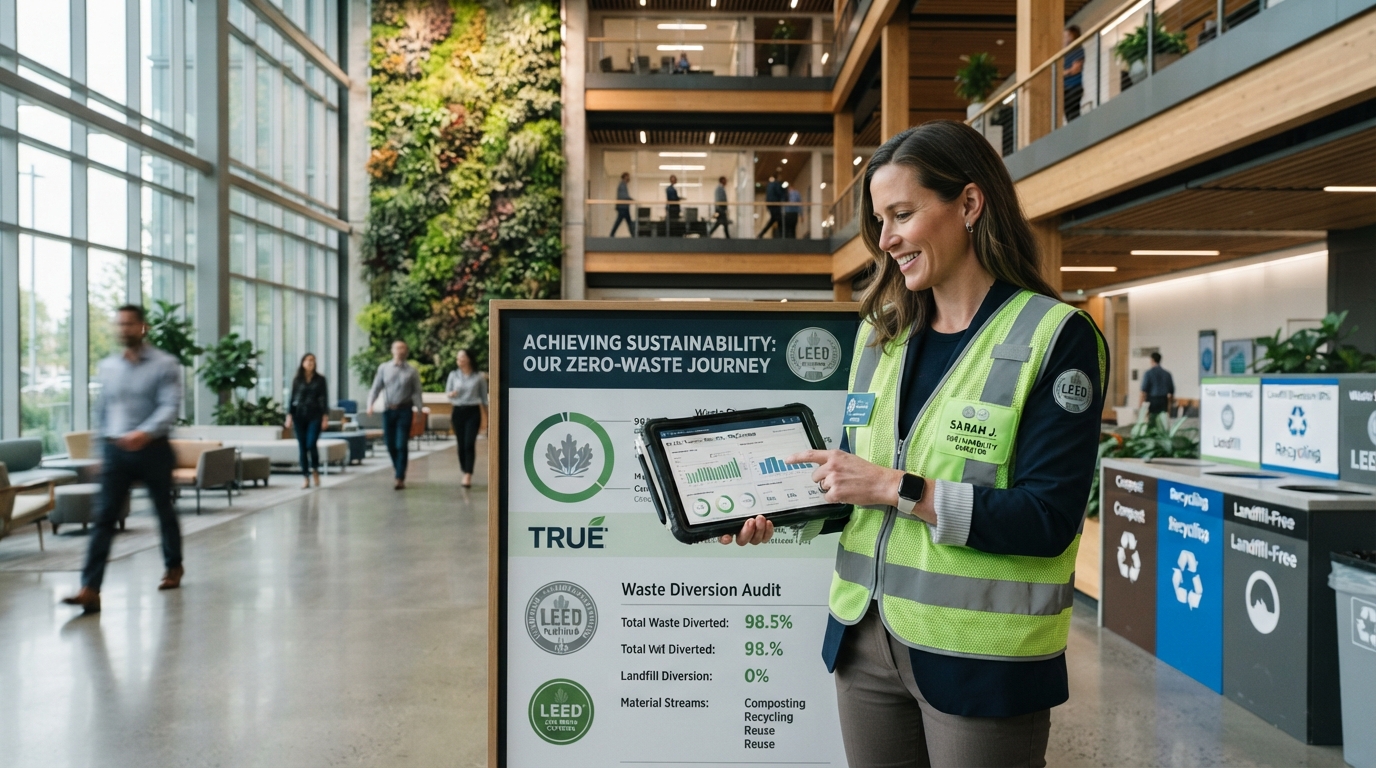
At the core of TRUE certification is the mandatory requirement that an operational facility must divert a minimum of 90 percent of all non-hazardous solid waste generated over a consecutive twelve-month baseline period. This threshold is calculated purely through diversion from landfills, waste-to-energy (WTE) incineration, and the biosphere. Facilities cannot simply incinerate non-recyclable discards and claim energy recovery credits; TRUE categorically refuses to count municipal solid waste incineration, refuse-derived fuel (RDF), or high-heat mass combustion toward the ninety percent diversion metric.
The certification architecture is governed by a 45-credit rating system spanning 15 functional categories: redesign, reduce, reuse, rebuy, compost, recycle, zero waste reporting, diversion, zero waste purchasing, leadership, training, zero waste analysis, upstream management, hazardous waste management, and closed-loop systems. A facility achieving 31 to 37 credits receives Certified status; 38 to 45 credits earns Silver; 46 to 63 credits achieves Gold; and facilities securing 64 or more credits attain Platinum distinction. For multi-tenant complexes, industrial warehouses, data centers, and corporate office parks, navigating this credit structure demands absolute data provenance, uninterrupted chains of custody, and disciplined cross-departmental coordination.
LEED v4.1 Operations and Maintenance (O+M) Waste Credits
For commercial real estate managers already committed to the U.S. Green Building Council’s LEED rating system, aligning facility protocols with TRUE Zero Waste provides a seamless operational pathway to capturing top-tier points in the Materials and Resources (MR) credit category of LEED v4.1 Operations and Maintenance (O+M). Under LEED v4.1, the MR category shifts significantly away from theoretical design intent toward continuous, measured real-time performance through the Arc platform.
The MR Prerequisite: Solid Waste Management Policy mandates that every operating facility institute an ongoing policy covering both ongoing consumables (such as paper, toner cartridges, cardboard, glass, plastics, and metals) and durable goods (including furniture, fixtures, and electronics). It also requires a comprehensive facility waste stream audit at least once every five years to characterize discards. When building teams advance to the MR Credit: Solid Waste Management - Ongoing, up to two direct points are awarded for diverting at least 50 percent (1 point) or 75 percent (2 points) of ongoing consumables from conventional disposal streams.
Critically, the GBCI has established a formal reciprocity framework: properties that successfully earn TRUE certification automatically satisfy the solid waste prerequisites and maximize the waste-related MR credits under LEED v4.1 O+M. This reciprocal streamlining prevents administrative duplication, enabling enterprise engineering departments to maintain a single unified data pipeline for third-party auditing, hauling scale tickets, monthly diversion reconciliations, and annual GBCI surveillance reviews.
Diverting Upstream: Purchasing Audits & Source Reduction
The most prevalent pitfall encountered by facility executives transitioning toward zero-waste accreditation is treating waste as an unavoidable consequence managed strictly at the loading dock. True ecological operational optimization demands that source reduction and upstream vendor procurement audits take precedence over downstream disposal. If an undesirable material never crosses your loading bay door, your operations team never incurs hauling weight, processing charges, or contamination liabilities.
Conducting an upstream purchasing audit involves scrutinizing the bill of materials across every vendor category: facilities maintenance, office administration, janitorial supplies, food and beverage operations, and shipping packaging. Facilities must formalize an Environmentally Preferable Purchasing (EPP) policy that directly limits incoming non-recyclable materials. This includes issuing strict contractual directives against non-recyclable composite films, single-use expanded polystyrene (Styrofoam) inserts, wax-coated corrugated containers, and multi-laminate sachets.
In practice, source reduction takes several high-impact configurations. Facilities implement reusable tote systems with primary logistics vendors, eliminating expendable stretch wrap and corrugated boxes entirely through closed-loop transit packaging. Janitorial teams transition from disposable aerosol cans and pre-diluted chemical jugs to centralized dilution stations utilizing reusable concentrated dispensing systems. Food service amenities replace single-use plastic utensils and disposable containers with commercial dishwashing stations and BPI-certified compostables that align exactly with the technical reception criteria of the contracted regional industrial composting facility.
Downstream Vendor Verification & Zero-Incineration Rules
Documenting the departure of recyclables from your facility compactor is only half the compliance mandate. Under GBCI TRUE criteria, facilities bear strict legal and evidential responsibility for verifying the downstream disposition of all diverted materials until they reach genuine end-market beneficial reuse, composting, or mechanical recycling processors. This requirement eliminates the dangerous blind spot where haulers collect commodities under the guise of green stewardship only to transship residues or entire contaminated loads to regional mass-burn incinerators.
The TRUE standard enforces a strict zero-incineration rule. Materials routed to thermal conversion technologies—including mass-burn waste-to-energy facilities, gasification, pyrolysis, plasma arc furnaces, and industrial kilns—are classified unambiguously as waste, not diversion. Furthermore, if your contracted single-stream recycling hauler relies on a Material Recovery Facility (MRF) with an average facility residue rate of 18 percent, that 18 percent residue cannot be quietly swept into diversion metrics. TRUE auditors mandate that processing residue percentages from downstream sorting hubs be systematically calculated and subtracted from gross facility diversion totals.
To achieve compliant downstream verification, facility managers must conduct annual downstream vendor reviews. This entails obtaining signed verification affidavits from recycling brokers, certified end-market weight tickets, and formal letters of commodity transformation. For organic streams, facilities must confirm that the industrial composter holds state and regional composting permits and that their digestion digestate or compost batches meet ASTM D6400 standards for land application rather than being deployed as alternative daily cover (ADC) at a regional municipal solid waste landfill.
Establishing the 12-Month Auditable Baseline
Acquiring TRUE accreditation requires assembling a flawless, twelve-consecutive-month dataset documenting every kilogram of material flowing through the facility boundary. GBCI audit reviewers systematically scrutinize weight reconciliation logs, scale-certified hauler receipts, bills of lading, and internal inventory adjustments to authenticate the diversion percentage across the entire rolling year.
Setting up an auditable baseline begins with a physical waste characterization study (also termed a 24-hour or 72-hour trash sort). Over a representative operational cycle, waste management specialists intercept all discarded materials across all waste generation zones: administrative cubicles, conference hubs, cafeteria prep stations, restrooms, loading docks, and mechanical plant rooms. The discarded materials are manually hand-sorted into distinct categories (such as OCC cardboard, high-density polyethylene, polyethylene terephthalate, clean mixed paper, soiled food waste, yard trimmings, pallet wood, electronic scrap, and true landfill trash) to quantify baseline volume, density, and current contamination rates.
Following the initial physical characterization, the facility must establish an unbreachable data capture mechanism. Monthly hauler invoices that only reflect dumpster volume estimates (e.g., cubic yard container pickups) must be replaced with certified scale tickets that record gross, tare, and net weights for every dedicated compactor haul and roll-off service pull. When volume-to-weight conversions are unavoidable for specific low-density streams, facility engineers must strictly apply EPA standard volume-to-weight conversion factors and formally log these calculations within the TRUE data ledger.
Employee Engagement & Contamination Defense Protocols
Even the most sophisticated vendor contracts and telemetry compactor sensors collapse if everyday occupants and cleaning crews cross-contaminate waste streams. In real-world enterprise operations, contamination at the bin level is the primary catalyst for entire recycling compactor loads being rejected at MRF tipping floors and diverted directly to landfills at punitive contamination surcharges.
Defending against contamination requires standardizing point-of-use disposal infrastructure across the entire building footprint. Best practice dictates the deployment of centralized three-stream or four-stream waste sorting stations (Compost, Clean Recycling, Specialty Packaging, and Landfill Discards) while systematically removing individual desk-side trash cans. Desk-side cans breed indiscriminate, thoughtless disposal; central stations force a conscious, deliberate sorting action. All bin openings must be color-coded and pair clear, photographic signage showing actual site-specific packaging items rather than vague generic icons.
Equally critical is empowering janitorial and custodial teams as the primary frontline champions of the zero-waste initiative. Custodial contractors must be trained to recognize contamination before consolidating streams into master roll-away carts. If a clear recycling bag contains liquid or food residuals, janitorial staff must be equipped with remediation protocols rather than simply dumping recyclables into the municipal trash compactor. Furthermore, organizational leaders must incorporate zero-waste orientation modules into new-employee onboarding and institute monthly green champion recognition programs to foster active, permanent stewardship across the workplace.
Frequently Asked Questions
How much does GBCI TRUE Zero Waste certification typically cost?
Can our facility count Waste-to-Energy (WTE) incineration toward the 90% diversion target?
How often must our facility undergo re-certification audits to maintain TRUE status?
How does MRF residue accounting impact our gross diversion calculations?
task_alt
Executive Summary: Key Takeaways
Operational Blueprint
Executive Summary: Key Takeaways
72-Hour Comprehensive Waste Audit SOP: Step-by-Step Facility Protocol
An operational standard operating procedure for environmental health & safety (EHS) directors, facility managers, and sustainability auditors to quantify waste streams, calculate contamination rates, and establish defensible diversion baselines.