Redefining "Zero-Landfill" in 2025: Beyond the 90% Diversion Standard
For over a decade, commercial facility managers relied on a blunt metric: divert 90% of discarded solid mass from municipal landfills, and your building qualified for zero-waste credentials. In 2025, that standard has fundamentally fractured. Global environmental audit bodies, major institutional landlords, and corporate shareholders have recognized that legacy Zero-Waste-to-Landfill (ZWTL) designations routinely masked egregious environmental externalization—primarily through mass thermal incineration, fuel blending, and secondary downcycling.
Under verified international consensus frameworks such as the TRUE Standard (administered by GBCI) and Zero Waste International Alliance (ZWIA) guidance, thermal processing and Waste-to-Energy (WTE) incineration are severely restricted. In true zero-waste architecture, waste burned in municipal combustors or industrial cement kilns cannot be credited toward the 90% threshold. If an office campus ships 300 tons of single-use laminate packaging and non-recyclable cafeteria bioplastics to a waste incinerator, that mass must be accounted for as residual disposal rather than sustainable diversion.
Simultaneously, regulatory pressures have converted operational waste management from an internal facilities line item into a mission-critical legal compliance mandate:
- Corporate Sustainability Due Diligence & CSRD (EU Standards): Multinational enterprises operating commercial sites in the European Union or trading with European supply chains must publish verified upstream and downstream material flow metrics under ESRS E5 (Circular Economy & Resource Use).
- SEC Climate Disclosure Directives: Scope 3 Category 5 greenhouse gas accounting (Waste Generated in Operations) now demands auditable, mass-calibrated haul documentation, replacing generic industry-average emission calculation factors.
- Municipal Commercial Landfill Prohibitions: Leading metropolitan clusters across California, Washington, New York, and Massachusetts enforce mandatory organics segregation ordinances, leveling aggressive per-diem penalties on commercial landlords whose dumpsters show recurring organic or cardboard contamination.
The Upstream Procurement Revolution: Eliminating Waste Before It Enters
The defining failure of traditional corporate recycling programs is attempting to solve a procurement failure at the loading dock. True zero-landfill operations operate on the strict axiom that the cleanest waste stream is the one that was never acquired.
In high-performing enterprise facilities, corporate procurement departments conduct comprehensive bill-of-materials audits of all operational goods entering the facility. Vendor master service agreements (MSAs) must be updated to mandate packaging take-back obligations:
- Pallet Dunnage and Secondary Freight: IT hardware suppliers, commercial office furnishers, and stationery distributors must deliver goods on reusable collapsible plastic crates, corrugated return totes, or unvarnished reusable pallets with contractual buyback clauses.
- Styrofoam and Expanded Polystyrene (EPS) Prohibitions: Contracts strictly ban EPS blocks and foam packing peanuts, requiring suppliers to transition to molded pulp cushioning or 100% post-consumer unbleached kraft paper dunnage.
- Breakroom & Hospitality De-Plasticization: Single-use plastic beverage bottles, polystyrene coffee cups, and foil-lined snack pouches are entirely eradicated. Breakrooms are converted to commercial high-temp sanitize dishwashing pods, bulk cold-brew and sparkling water tap dispensers, and BPI-certified (Biodegradable Products Institute) compostable serviceware for catered events where reusable china cannot be deployed.
Eliminating Desk-Side Bins & Engineering Centralized Sort Pods
No singular operational intervention produces a higher statistical reduction in municipal solid waste than the systematic elimination of personal, under-desk wastebaskets. When an employee retains a waste bin within arm's reach, every discarded item is classified as undifferentiated trash due to pure cognitive convenience.
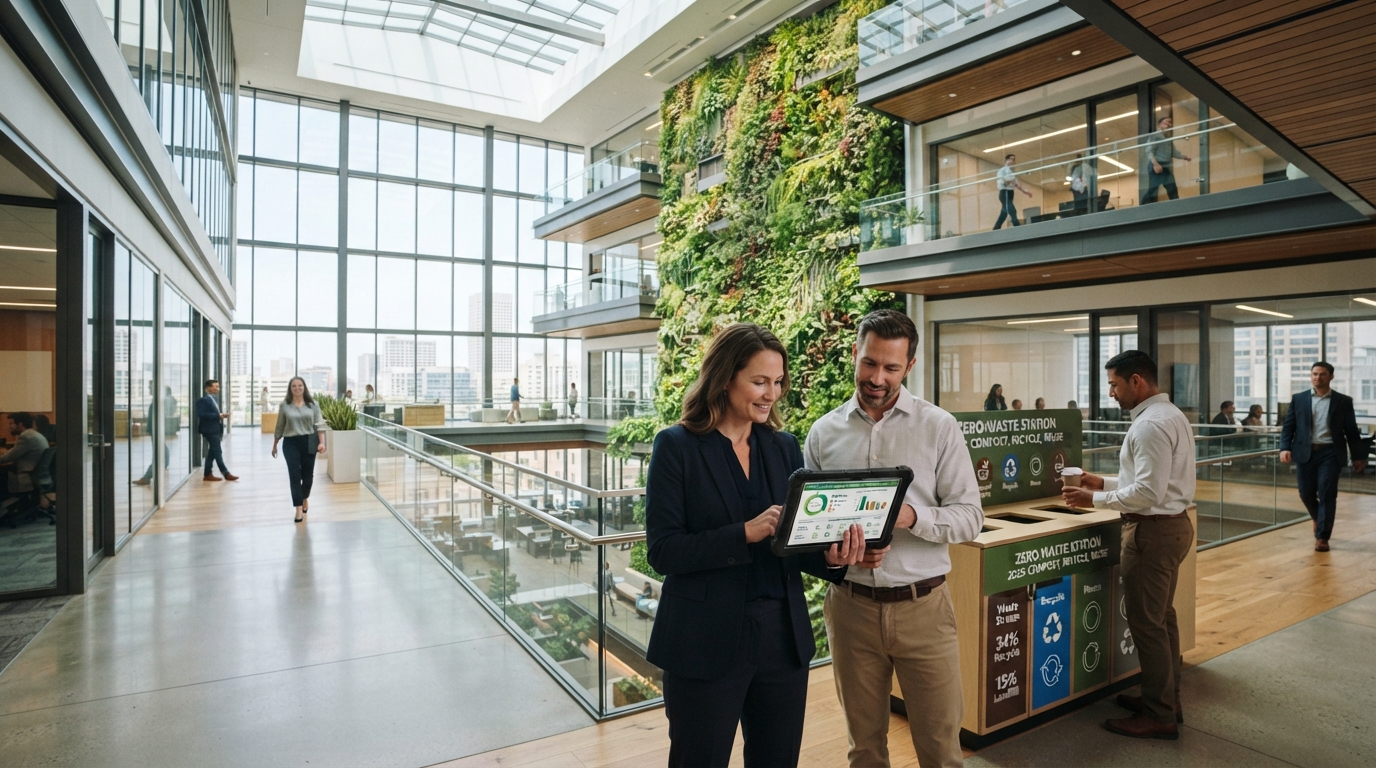
Behavioral engineering data indicates that requiring personnel to walk 40 to 60 feet to a centralized, multi-stream sorting station reduces overall office discard volume by approximately 28% while simultaneously decreasing cross-contamination rates from an industry baseline of 42% down to less than 4%. The micro-pause introduced by the walk forces mindfulness regarding product lifecycle and disposable packaging choices.
However, centralized stations fail when relying solely on graphical adhesive stickers. Enterprise station architecture requires restrictive physical apertures:
- Clean Fiber / Mixed Paper Stream: Engineered with an ultra-narrow horizontal paper slot (1.5″ x 14″) that physically blocks coffee cups, soda cans, or greasy takeaway containers from entering high-grade paper streams.
- Rigid Containers (Bottles, Cans, Plastics #1, #2, #5): Fitted with circular circular cutouts (5″ diameter) matched to beverage canisters, preventing cardboard folders or food trays from entering.
- Commercial Organics & Food Scraps: Positioned adjacent to breakroom sinks with open drop-chutes and foot-pedal lids, paired with compostable certified bio-liners.
- Residual Landfill Trash: Restricted to an intentionally small aperture accompanied by high-contrast matte charcoal coloring, subtly reinforcing residual waste as an undesirable last resort.
Janitorial & Facilities Alignment: Contractual Defenses
The most pervasive failure point in corporate sustainability happens between 10:00 PM and 2:00 AM, out of sight of daytime executives. Nighttime custodial crews, frequently evaluated solely on speed and cleanliness rather than diversion compliance, routinely consolidate carefully separated recycling, compost, and landfill bags into a single rolling tilt-truck or poly-cart to minimize trips to the exterior compactor.
Preventing this systemic operational failure requires rewriting janitorial Service Level Agreements (SLAs) with explicit legal performance standards:
- Visual Accountability via Bag Transparency: Require transparent virgin-grade clear liners for dry recycling, unpigmented clear blue liners for aluminum/plastics, and certified ASTM D6400 green bio-film liners for organic streams. Black non-transparent trash liners are legally prohibited across all floors except designated hazardous/medical disposal rooms.
- Split-Chamber Janitorial Rolling Carts: Janitorial contractors must be equipped with modern split-hopper collection carts featuring isolated dual chambers. A cart that forces night cleaners to pile multiple streams together is a guaranteed source of loading-dock cross-contamination.
- Financial Incentive Clauses: Janitorial billing should tie up to 10% of monthly contractor invoicing bonuses to contamination audit thresholds conducted at loading dock discharge bays.
Tech-Enabled Waste Telemetry: Smart Scales & AI Volumetric Audits
You cannot manage what you calculate through guesswork. Historic commercial waste reports provided by municipal waste haulers rely on visual "volume estimation" percentages (e.g., claiming a 4-yard front-load dumpster was 80% full when serviced, multiplied by an estimated density multiplier). Hauler invoices routinely overbill corporations by 25% to 40% on density assumptions while providing zero actionable floor-level diversion data.
Modern enterprise zero-landfill facilities integrate precision digital telemetry across two primary operational zones:
- IoT Sub-Floor Pod Load Cells: Strain-gauge load cells installed directly under centralized sorting station bins capture net mass accumulation in real time. Facilities directors can instantly see whether the engineering wing on Floor 4 is producing twice the paper volume of human resources, or if marketing is generating abnormal food waste on Tuesday mornings.
- AI Loading Dock Optical Cameras: High-definition computer vision cameras mounted above dock dumpsters and compactors take automated photographic snapshots whenever a lid opens or a collection truck approaches. AI models detect improper cardboard contamination in the trash bin, flag empty air pick-ups, and calculate precise cubic yard fill ratios down to the minute.
Employee Gamification, Floor Captains & Cultural Buy-In
Even the most sophisticated load-cell infrastructure will fail if daily occupants view waste diversion as an onerous regulatory chore. Establishing enduring institutional hygiene requires proactive peer accountability and transparent data visualization throughout the workplace.
Forward-thinking enterprises appoint designated Green Champions or Floor Captains across business units. These individuals receive specialized 90-minute training on local municipal diversion regulations, regional MRF (Material Recovery Facility) sorting capabilities, and proper packaging disposal. Floor captains conduct bi-weekly spot checks of centralized sorting pods and serve as immediate peer resources for confusing packaging items.
Furthermore, real-time diversion telemetry feeds directly into internal corporate communication channels. Integrating live diversion percentages onto corporate Slack/Teams channels and high-visibility digital display screens in central elevator lobbies fosters friendly inter-departmental competition. When an entire floor is publicly recognized for maintaining a 96% diversion purity rating for three consecutive quarters, zero-waste compliance transforms into corporate culture.