The Psychology of Breakroom Sorting & The Death of Desk-Side Bins
For decades, commercial property managers equipped individual work stations with personal waste bins. While well-intentioned for convenience, modern waste audits prove that desk-side bins represent the single largest systemic vulnerability in commercial building diversion. When an employee is seated at their desk, the friction of decision-making is zero: an apple core, a greasy takeout container, confidential paper drafts, and plastic cutlery are tossed indiscriminately into the closest container.
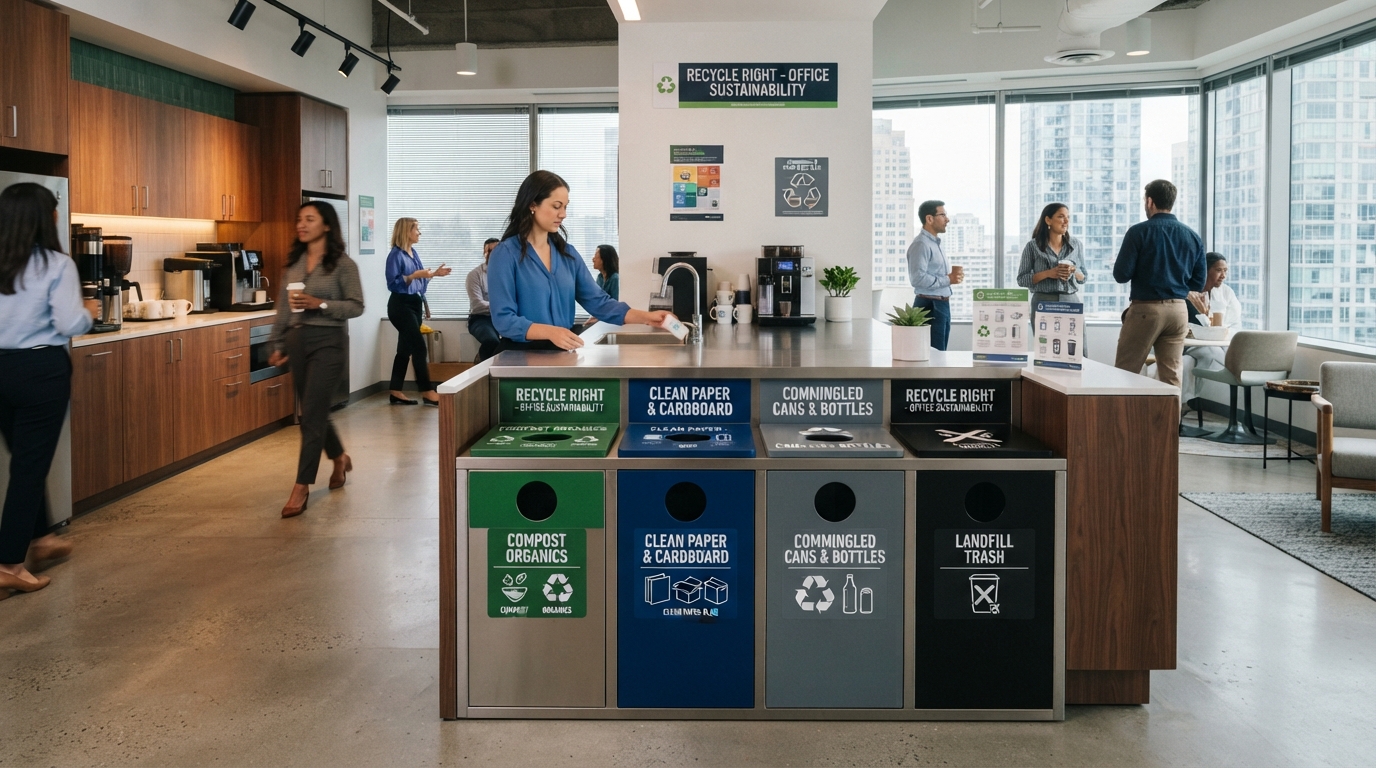
By shifting to a centralized station model, facilities introduce a brief cognitive threshold. As an employee stands, walks 40 to 60 feet toward a multi-stream hub in a pantry or core corridor, their mental mode switches from passive production to deliberate disposal. When presented with distinct, well-lit sorting choices side by side, participation rates increase dramatically. Furthermore, custodial teams no longer expend hundreds of cumulative hours manually tipping individual desk cans, reclaiming critical labor hours for building maintenance and sanitization.
Commercial facility studies demonstrate that removing personal deskside bins reduces overall municipal solid waste generation by 22% and drops contamination in dry recycling streams from an average of 41% down to below 8%.
Standardizing the 4 Streams: Strict Color Hierarchy & Cognitive Mapping
Stream confusion occurs when floor 4 uses blue for general trash while floor 12 uses blue for mixed paper. In a multi-tenant commercial tower, visual ambiguity leads to fatal stream compromise. Facilities must enforce an immutable four-part visual hierarchy based on EPA recommendations and ISO-aligned environmental color codes:
Emerald Green
Food scraps, coffee grounds, unbleached napkins, certified compostable BPI food ware. Never include conventional plastics, dairy packaging with foil liners, or petroleum waxes.
Deep Cobalt Blue
Envelopes, dry printing stock, brochures, clean catalogs, flattened clean cardboard boxes. Strict prohibition on hot beverage paper cups lined with polyethylene.
Steel / Slate Gray
Rinsed aluminum soda cans, clean beverage glass bottles, rigid plastic containers stamped #1 through #5. Completely free of residual food matter or flexible film wraps.
Matte Black / Charcoal
Non-recyclable film, chip bags, contaminated foil wrappers, standard polyethylene disposable hot cups, single-use condiments, and mixed material packaging.
Aperture Engineering & Restrictive Openings
The shape of a trash aperture acts as the front-line mechanical gatekeeper of compliance. Humans are inherently tactile creatures governed by sub-second kinetic reflexes. When every bin lid features an identical open cavity, individuals will drop mixed objects into the easiest target without reading signage.
By deploying form-matched aperture restrictors, you create physical friction against mistakes:
- Narrow Slotted Aperture (1.5″ x 12″): Dedicated strictly for clean paper. It mechanically repels crumpled fast-food bags, beverage cups, and aluminum cans.
- Beveled Circular Aperture (4.5″ diameter): Engineered for bottles and cans. Discourages broad square lunch trays or paper ream discards.
- Rubber Flap Hinged Drop (Compost): Provides a clear tactile distinction while sealing odors, signaling that only soft organics and food debris belong inside.
- Broad Open Mouth (Landfill): Positioned as the final default station for items that fail to fit into the specialized geometric apertures.
High-Visibility Visual Pictograms & Signage Placement
Industry terminology is a prime cause of office sorting errors. Phrases such as "Single Stream Co-Mingled," "Rigid Polystyrene," or "Cellulosic Fibers" make sense to a waste hauler but fail miserably in an executive breakroom.
All tenant-facing graphics must deploy realistic photographic representations rather than abstract stylized line drawings. Display real-world corporate breakroom items: the specific local cold-brew can brand, the locally catered salad clamshell, and the actual coffee mug supplied by the office.
Large stream name in high-contrast sans-serif font readable from 15 feet away.
Direct 3-item visual checklist: Accepted (Green Check) vs Prohibited (Red Slash).
Scannable portal for employees to check bizarre or ambiguous item classifications.
Custodial Partner Integration & Color-Coded Liners
The most meticulously designed sorting station is utterly rendered pointless if the night janitorial staff empties all four streams into a single rolling 96-gallon black roll-cart. This occurs far more frequently than building owners realize, often driven by inadequate shift time allocation or a lack of linguistic parity in training materials.
To guarantee downstream stream integrity:
Transparent Virgin Poly Liners for Recyclables: Haulers and MRF inspectors require visual confirmation of contents. Never permit opaque or black liners in blue or gray receptacles.
Certified ASTM D6400 Bio-Liners for Organics: Ensure that compost liners break down cleanly at municipal industrial composting operations without shedding microplastics.
Multi-Compartment Custodial Carts: Janitors must be furnished with split-chamber tipping carts that physically prevent cross-stream consolidation during floor sweeps.
Tenant Engagement, Auditing & Gamification
Achieving sustained 90%+ stream purity requires institutional accountability. Leading corporate properties institute quarterly "waste characterization days," during which representative 24-hour hauls are sorted by weight and purity in front of tenants. Publishing floor-by-floor diversion leaderboards in elevators and digital tenant apps taps into friendly corporate rivalry, lifting compliance across even the most recalcitrant corporate departments.
assignment_turned_in
Executive Summary: Key Takeaways
Executive Summary: Key Takeaways
1
2
3
4
5
Frequently Asked Operational Questions
How far should employees have to walk to reach a centralized sorting station?
Should we keep paper shredding consoles separate from mixed paper stations?
How do we prevent coffee cup contamination in the paper stream?
What are the minimum requirements to earn LEED v4.1 waste performance points?
Food Recovery & Donation Guidelines for Commercial Kitchens
Legal protections under the Bill Emerson Good Samaritan Act, cold-chain handoff documentation, and building relationships with regional food recovery organizations.