
The Invisible Hazard: Why Lithium-Ion Cells Cause 5,000+ Waste Fires Annually
Over the past decade, municipal solid waste authorities across North America have reported an exponential surge in heavy industrial fires. The Environmental Protection Agency (EPA) and solid waste federations document that upwards of 5,000 thermal events spark inside waste collection vehicles and Material Recovery Facilities (MRFs) each year. The culprit is rarely flammable solvents or paint thinners; in more than 75% of investigated incidents, the ignition source is a discarded lithium-based power cell embedded within everyday domestic appliances.
The mechanism of failure inside a rear-loading municipal waste truck is swift and violent. Modern hydraulic refuse packers exert between 25 and 35 tons of compaction force. When an obsolete smartphone, high-output cordless drill pack, or rechargeable disposable vape is crushed within the hopper, its micro-thin polymeric separator—often measuring less than 15 microns thick—is instantly punctured.
Mechanical compaction ruptures the internal separator → Positive (Cathode) and Negative (Anode) make direct physical contact → Unrestricted internal dead-short generates local temperatures exceeding 1,200°F (650°C) within 450 milliseconds → Flaming organic electrolyte sprays into compressed cardboard, dry newsprint, and shredded plastics, creating uncontrollable cargo-hold blazes.
“A lithium-ion battery in a curbside trash bin is not just waste—it is a pressurized incendiary device waiting for mechanical compaction.”
Drivers must regularly perform emergency load dumps directly onto residential asphalt to avoid complete cabin incineration. When these cells enter automated single-stream recycling sorting plants, high-speed ballistic separators and rotating star screens repeatedly strike loose batteries, igniting conveyor belts and inflicting millions of dollars in infrastructure losses annually.
The Anatomy of Thermal Runaway: Chemistry of the Swollen Battery (“Spicy Pillow”)
To manage battery waste responsibly, homeowners must understand the underlying chemistry of failure. Commercial lithium-ion chemistries—primarily Lithium Cobalt Oxide (LiCoO2 or LCO) found in phones, and Nickel Manganese Cobalt Oxide (NMC) engineered into power tools and mobility devices—contain volatile liquid carbonate solvents acting as the electrolyte medium.
When a cell suffers manufacturing imperfections, sustained overcharging, physical drops, or prolonged thermal stress, parasite side-reactions trigger electrolyte breakdown. The chemical decomposition releases oxygen gas, which rapidly oxidizes the organic solvent. As internal pressures escalate, the sealed flexible aluminum pouch expands into what engineers and technicians colloquially term a “spicy pillow.”
notification_important
Physical Danger Identifiers
- Bulging or Separating Casing: Screen pop-out or trackpad lifting.
- Distinctive Chemical Odor: Sweet, acetone-like, or metallic scents.
- Audible Disturbance: Faint hissing, popping, or crackling sounds.
- Spontaneous Surface Heat: Cell remains warm hours after unplugging.
shield
Off-Gas Chemical Composition
Thermal runaway releases a dense, highly toxic gas plume containing carbon monoxide (CO), hydrogen cyanide (HCN), toxic hydrofluoric acid (HF), and explosive concentrations of hydrogen (H2) and ethylene. Inhalation in enclosed spaces can lead to severe pulmonary injury.
Emergency Protocol for Swollen or Overheating Batteries
- Disconnect Electrical Current Immediately: If plugged into an AC wall charger or power bank, turn off the wall breaker or unplug using an insulated dry implement. Do not pull the charging cable by hand if the cell is smoking.
- Never Puncture, Pierce, or Compress: Attempting to relieve pressure by puncturing an expanded pouch introduces atmospheric oxygen, initiating immediate chemical deflagration.
- Submerge in Non-Conductive Inert Media: Place the compromised unit into a non-flammable container filled with coarse dry sand, vermiculite, or an airtight PyroBubbles® fire-suppression compound. If unavailable, use a heavy-duty fiberglass fireproof LiPo safety envelope.
- Relocate Outdoors Clear of All Structures: Transport the safe container outdoors to an open area with at least 15 feet of clearance from parked vehicles, wooden decks, dry brush, and structural walls. Monitor for 24 hours prior to arranging hazardous transit.
The DOT Terminal Taping Protocol: Preparing Batteries for Safe Transit
Even “depleted” batteries contain substantial residual electrochemical energy. When multiple spent batteries are accumulated loosely within a drawer, bag, or collection vessel, their exposed positive and negative contacts can easily bridge against metal keys, paperclips, or neighboring battery housings. This forms a low-resistance short circuit, generating pinpoint thermal blooms that ignite packaging materials.
The U.S. Department of Transportation (DOT) and Pipeline and Hazardous Materials Safety Administration (PHMSA) under 49 CFR § 173.185 mandate specific terminal protection protocols for all lithium-ion cells transported by highway, rail, or air.
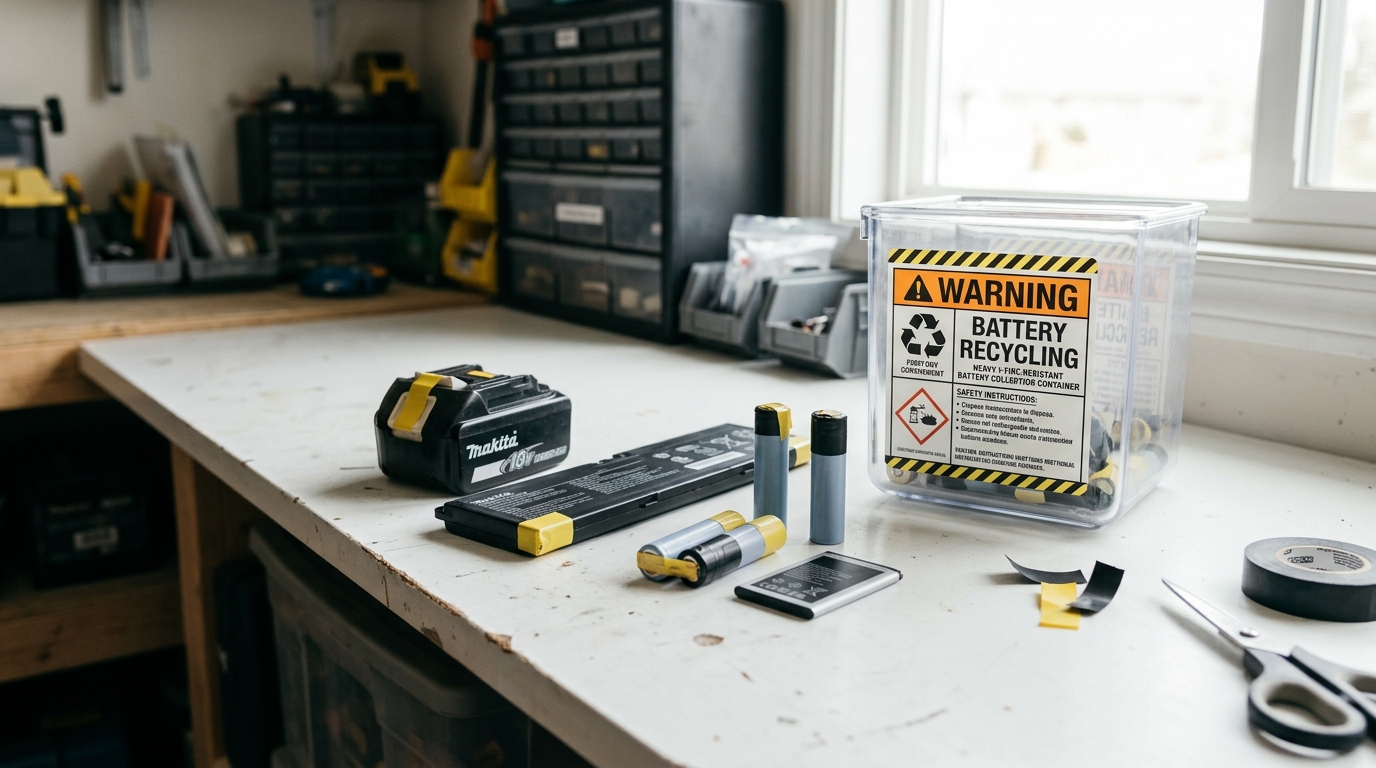
check_circle Approved Insulation Methods
- Vinyl Electrical Tape: High dielectric breakdown resistance; wraps firmly around contacts.
- Clear Polypropylene Packing Tape: Non-conductive; securely seals battery edges.
- Individual Zip-Top Bagging: One cell per bag guarantees complete electrical isolation.
cancel Prohibited Materials & Practices
- Masking Tape / Painter’s Tape: Porous paper absorbs moisture and rubs off easily.
- Metallic Duct Tape: Contains aluminum fillers or fibers that can conduct electrical arcs.
- Bulk Co-Mingling: Dumping bare 18650 cylindrical cells together into coffee cans or plastic bags.
For power tool battery clusters (such as 18V or 20V slide packs), the internal terminals are recessed inside narrow plastic slots. Use terminal caps if supplied by the manufacturer, or fold non-conductive electrical tape firmly into the slot crevices using an insulated edge like a plastic gift card.
Authorized Drop-Off Networks vs. Municipal HHW Programs
Finding the correct disposal destination depends directly on the battery’s physical health, capacity rating, and chemistry. Household drop-off options generally divide into two major operational branches: retail collection kiosks and specialized municipal depots.
store Retail Take-Back Networks (Call2Recycle)
Major retail partners—including Home Depot, Lowe’s, Best Buy, and Staples—host Call2Recycle drop boxes in front lobbies. These programs accept undamaged rechargeable lithium-ion cells up to 300 watt-hours (Wh) or 11 lbs (5 kg) per battery.
Crucial Restriction: Retail kiosk boxes strictly prohibit damaged, defective, or recalled (DDR) batteries, e-bike batteries exceeding size thresholds, or leaking units due to unmonitored retail fire codes.
local_shipping Municipal Household Hazardous Waste (HHW) Facilities
For swollen cells, damaged laptop packs, large electric scooter batteries, or high-capacity lawn equipment packs, municipal HHW collection stations are the only compliant outlet. These facilities feature hazardous material handling gear, certified vermiculite packaging, and DOT special permits for DDR transit.
The Closed-Loop Circular Future: Once collected, spent lithium cells do not enter blast furnaces. Modern North American hydrometallurgical recycling facilities (such as Redwood Materials and Li-Cycle) shred batteries in inert submerged baths. They achieve 95%+ recovery efficiencies, extracting high-purity battery-grade lithium carbonate, nickel sulfate, and cobalt sulfate directly back into domestic zero-emission vehicle supply chains.
Real-World Battery Dilemmas (Interactive FAQ)
Answers to nuanced safety questions vetted by hazardous materials compliance officers.
Can I tape standard alkaline (AA/AAA) batteries in the same bag as lithium cells?
My phone battery is swollen. Can I put it in the freezer to calm the swelling?
What should I do with disposable single-use vapes and e-cigarettes?
What type of fire extinguisher is required if a lithium battery catches fire?
fact_check
Essential Battery Protocols (Key Takeaways)
Essential Battery Protocols (Key Takeaways)
Zero Curbside Tolerance
Never place rechargeable lithium-ion cells in curbside waste or recycling bins. Compaction sparks truck blazes.
Terminal Taping is Mandatory
Insulate metal terminals with vinyl electrical tape or individual zip-top bags to prevent spontaneous arcing.
Treat Swelling Like Ordnance
Never pierce a bloated pouch. Submerge in coarse dry sand or a fireproof bag and move 15+ feet outdoors immediately.
Recognize Chemistry Codes
Distinguish standard alkaline from high-energy Li-ion, Li-Po, and Li-metal. Inspect labels before storage.
Utilize Verified Drop-Off Infrastructure
Route undamaged cells (<300 Wh) to Call2Recycle retail partners (Home Depot, Best Buy). Escort swollen or heavy DDR packs directly to municipal HHW depots.
Backyard Composting 101: The Golden 3:1 Brown-to-Green Ratio
How to build an odor-free, pest-resistant tumbler or compost pile using nitrogen greens (kitchen scraps) and carbon browns (dry leaves, cardboard) with fast decomposition.