The Regulatory & Statutory Framework
The primary hurdle voiced by executive chefs and commercial procurement teams when evaluating food donation has historically been the perception of civil or criminal tort liability. Under federal jurisprudence, this fear is largely unfounded. Enacted in 1996 and substantially strengthened through modern bipartisan amendments, the Bill Emerson Good Samaritan Food Donation Act (42 U.S.C. § 1791) creates an expansive federal statutory liability shield for food donors and recipient 501(c)(3) non-profit distribution charities.
The Food Donation Improvement Act expanded Emerson Act protections by extending civil liability shields directly to qualified food businesses donating directly to food-insecure individuals (direct giving models) when monitored under registered food safety handlers. Furthermore, it codifies protection against state and municipal ordinances that attempt to arbitrarily penalize safe surplus salvage.
To date, not a single documented legal claim has been successfully adjudicated against a commercial kitchen, grocery operator, or hospitality enterprise donating seemingly wholesome surplus food in compliance with local food safety codes.
Safe Food Donation Hierarchy & Eligible Surplus Streams
Not every kitchen excess qualifies for human consumption salvage. Establishing clear upstream demarcation between edible recovery, animal feed processing, industrial composting, and municipal anaerobic digestion ensures kitchen crews do not spend manual labor packing degraded inventory.
- • Unserved Hot-Line Reserve: Food prepared and retained in temperature-controlled back-of-house warmers (>135°F), never served to customer tables or self-service lines.
- • Chilled Prepared Entrees: Batch-cooked dishes cooled in blast chillers following strictly recorded standard operating procedures.
- • Pre-Cut & Whole Produce: Whole, unblemished agricultural items, raw vegetable prep trim with intact cell walls, and sealed pre-cut greens.
- • Shelf-Stable Dry Pantry: Intact commercial grade bulk grains, canned pulses, pasta, flour, spices, and non-perishables past code date if organoleptically intact.
- • Customer-Accessible Buffets: Any food exposed to open customer contact, sneeze-guard self-service troughs, or table-side service vessels.
- • Re-Plated Leftovers: Plate scrapings or half-consumed side items. (Route immediately to organics bin / compost).
- • Swelled / Dented Cans: Commercial cans displaying micro-punctures, seam crimping, or botulism-indicative lid convexity.
- • Unknown Temperature History: Any high-risk TCS food (Time/Temperature Control for Safety) lacking written cold/hot holding logs.
Time and Temperature Cold-Chain Compliance
The operational linchpin of an audit-proof kitchen recovery program is continuous temperature stewardship under the FDA Food Code Section 3-501.14 (Cooling). Pathogen multiplication within the danger zone (41°F to 135°F / 5°C to 57°C) represents the single greatest public health vulnerability during rescue handoffs.
135°F down to 70°F
Must be achieved in strictly ≤ 2 hours. Utilize blast chillers, ice-water paddles, or shallow hotel pans (<2 inches depth) in walk-in units.
70°F down to ≤ 41°F
Remaining cooling window to hit 41°F or lower must complete within an additional 4 hours (Total cumulative time ≤ 6 hours).
Every food-grade staging container (e.g., poly Cambro, foil pans, vacuum vacuum-sealed liners) must receive an indelible industrial adhesive label detailing:
Operational Vetting of 501(c)(3) Food Rescue Organizations
Commercial culinary kitchens cannot simply give food to ad-hoc volunteers without verifying organizational legitimacy. To sustain federal tax exemptions and statutory protections, distribution partners must maintain authenticated non-profit standing and food-handler compliance.
Retain on file current IRS 501(c)(3) Letter of Determination confirming non-operating charity classification.
Partner must operate active reefer vans or verified insulated passive bulk Cambro boxes maintaining ≤41°F.
Every dispatch must feature driver counter-signatures documenting receiving temperature and container counts.
Staff Training, Kitchen Prep Stations & Cross-Contamination Prevention
Operational failure occurs when kitchen line cooks view food donation as an ambiguous afterthought. Facilities with world-class diversion metrics treat rescue packing with identical rigor to culinary plating stations.
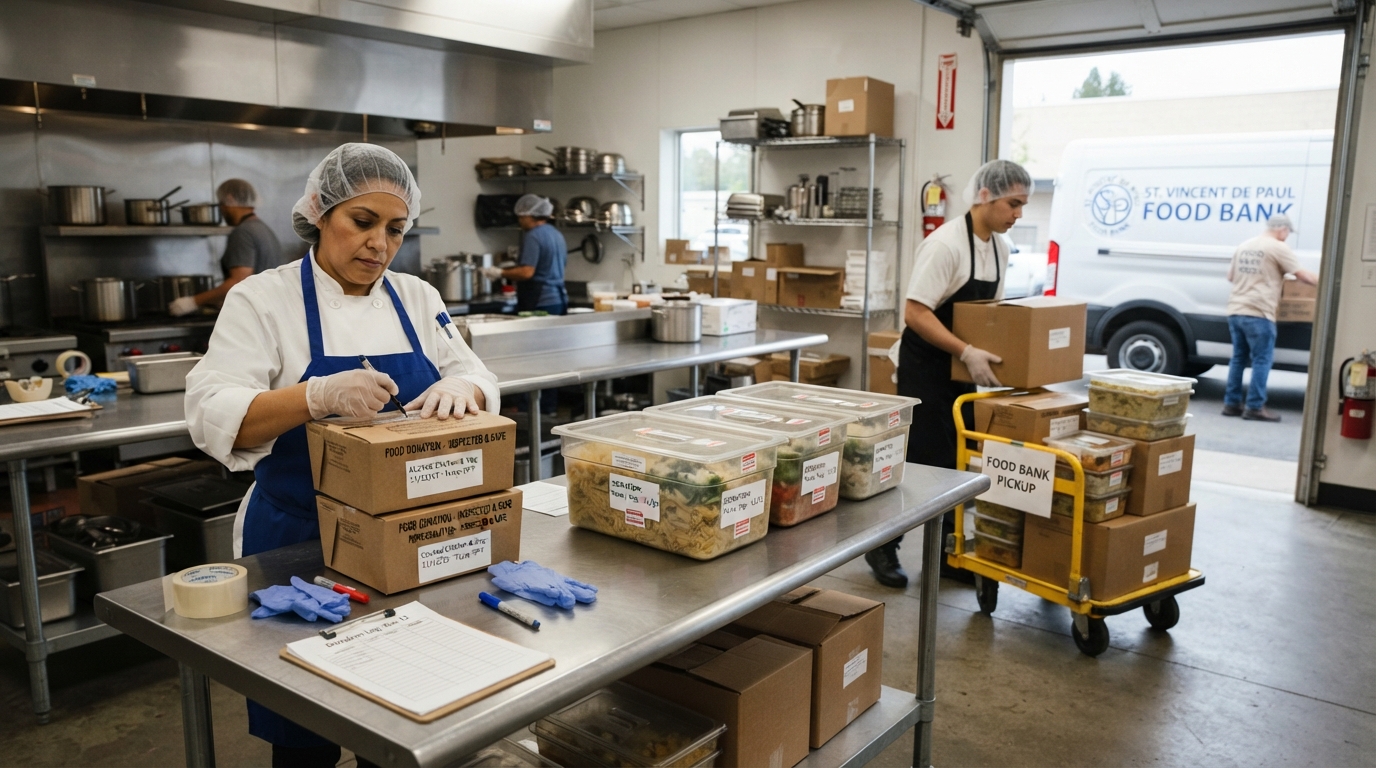
Designate a specific stainless-steel prep table adjacent to the blast chillers and dry store loading exit. Equip this dedicated station exclusively with:
Tax Deduction Valuation & State Regulatory Alignment
In addition to environmental stewardship and landfill diversion credits, proactive surplus donation offers substantial corporate tax advantages. Under Internal Revenue Code (IRC) Section 170(e)(3), commercial businesses donating edible inventory to accredited non-profits can claim an enhanced general business tax write-off.
The enhanced deduction allows qualifying corporate entities to deduct:
1. Cost basis of the inventory + 50% of the mark-up to fair market value (FMV).
2. Twice the cost basis of the donated inventory.
*Subject to maximum aggregate corporate deduction limits capped at 15% to 20% of net commercial taxable income depending on corporate classification (C-Corp vs S-Corp pass-through).
In jurisdictions enacting organics disposal bans, food donation is not merely discretionary—it is an enforced municipal statute. Tier 1 (supermarkets, food distributors) and Tier 2 (hotels with >200 rooms, commercial commissaries >20,000 sq ft, hospitals) commercial edible food generators must maintain formal contracts with rescue partners and divert a verified 20% of edible surplus or face administrative fines up to $10,000 per violation.
Executive Summary: Key Takeaways
1
2
3
4
5
Frequently Asked Questions: Commercial Food Recovery
Can a restaurant or hotel be sued if someone falls ill from donated surplus food?
What specific documentation is required to claim the Section 170(e)(3) tax deduction?
Are prepared foods that sat on an unmonitored buffet eligible for donation?
How long must commercial kitchens retain food recovery donation logs?
Medical & Sharps Waste Management in Commercial Offices & Clinics
Proper color-coded biohazard disposal bins, mail-back sharps container protocols, and staff safety regulations for commercial wellness suites and corporate occupational clinics.