
A complete back-of-house operational protocol for managing commercial food waste, eliminating fruit flies, vector attraction, and hauler surcharge risks.
For commercial kitchens, corporate dining centers, and multi-unit hospitality operators, the pivot to source-separated organics is no longer just a corporate sustainability benchmark—it is a strict regulatory threshold with punishing financial liabilities. Mislabeled toters, improper leachate containment, and sluggish dock rotations quickly trigger municipal public-health citations, structural fly infestations, and crippling hauler contamination surcharges. Achieving a zero-complaint commercial composting workflow demands replacing makeshift scrap storage with an engineering-grade custodial workflow capable of suppressing biological putrefaction from the prep table to the loading dock compactor.
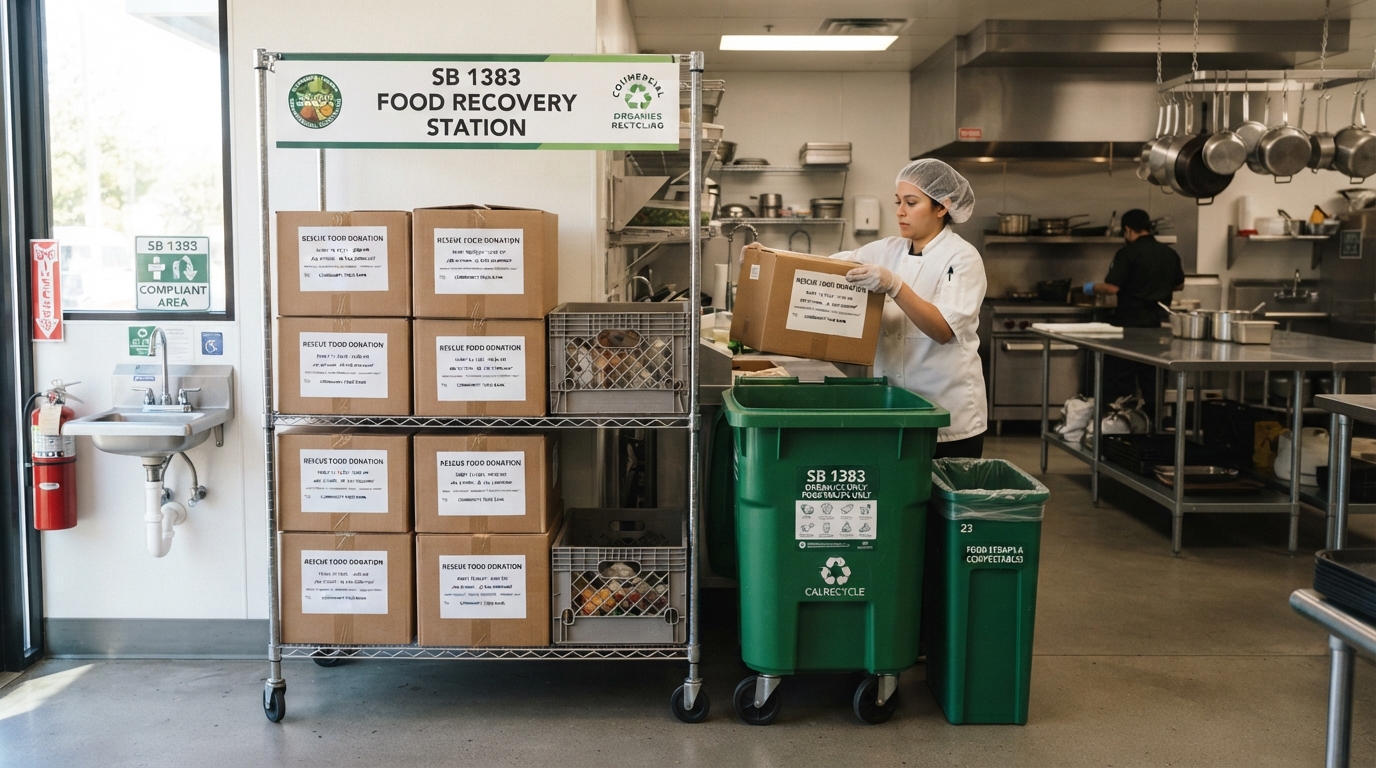
The Biology of Anaerobic Decomposition in Commercial Food Waste
The fundamental origin of foul odor in commercial food scraps is microbial suffocation. Fresh pre-consumer and post-consumer food discards possess a high moisture threshold, typically exceeding 70% water content by mass. When dense masses of trimmings, cooked grains, and animal proteins are compacted inside standard 64-gallon toters without aeration, available pore oxygen is exhausted within 18 to 24 hours. Once the interstitial oxygen drops below 5%, aerobic microbes yield to facultative and obligate anaerobic bacteria.
These anaerobic agents metabolize proteins and simple carbohydrates through acidogenesis and methanogenesis, synthesizing volatile organic acids (VOAs)—including butyric acid, with its characteristic rancid butter odor, and valeric acid. Simultaneously, sulfate-reducing bacteria act upon sulfur-rich animal tissues and cruciferous vegetables, releasing hydrogen sulfide (H₂S), which smells distinctly of rotten eggs, alongside volatile mercaptans. Left unchecked for 48 hours in ambient dock temperatures above 72°F (22°C), internal bin temperatures catalyze enzymatic degradation, producing sharp off-gassing that attracts scavenger vectors from over two miles away.
The Thermal Threshold of Putrefactive Volatilization
Field data demonstrates that volatile gas emissions scale exponentially rather than linearly with temperature increases. When an outdoor organics toter sits on an asphalt dock exposed to direct sunlight, its internal microclimate often spikes to 105°F (40.5°C). At this threshold, methanogenic colonies double every four hours, accelerating liquid liquefaction into anaerobic sludge that eats through baseline garbage liners and pools across floor drains.
Odor Mitigation via the Carbon-to-Nitrogen Balancing Principle
Standard municipal composting targets an ideal Carbon-to-Nitrogen (C:N) ratio of 25:1 to 30:1. In sharp contrast, commercial back-of-house culinary waste presents a severely inverted, nitrogen-saturated ratio fluctuating between 10:1 and 15:1. This intense nitrogen load—derived from animal trimmings, shellfish remnants, dairy residues, and cruciferous botanicals—forces rapid ammonia release during unbuffered decomposition.
Commercial facilities cannot conduct full thermophilic windrow turning in their kitchen staging corridors, but operations teams must introduce a functional "carbon blanket" mechanism. Incorporating kiln-dried untreated pine sawdust, pelletized recycled bio-char, or shredded dry double-wall corrugated cardboard directly into the collection vessel acts as both an odor scrub and a biological vapor sink.
For every 4 inches of dense, wet pre-consumer kitchen scraps deposited into a collection toter, custodial leads must mandate the dispersal of a 1-inch layer of dry, coarse carbon material. This continuous layering restricts passive vapor transmission, isolates free surface nitrogen ions, captures free moisture before it cascades downward into leachate basins, and preserves an aerobic boundary layer on the bin surface.
Furthermore, employing certified Biodegradable Products Institute (BPI) liners composed of polybutylene adipate terephthalate (PBAT) and plant starches offers distinct barrier properties. Unlike conventional low-density polyethylene, heavy-gauge commercial compost liners allow subtle moisture vapor transpiration while maintaining tear resistance against shellfish exoskeletons, eliminating the vacuum tear dynamics common during tipping.
Eliminating Vector Attraction at the Loading Dock
The loading dock represents the most vulnerable operational interface in any hospitality or enterprise commercial campus. The presence of common vinegar flies (Drosophila melanogaster), flesh flies (Sarcophagidae), brown Norway rats (Rattus norvegicus), and urban gulls at the waste dock does not merely indicate an aesthetic lapse—it constitutes an immediate failure of physical vector barriers that can trigger health department operating suspensions.
Sealed Gasketed Toters and Magnetic Closures
Standard two-wheeled utility carts feature injection-molded drop lids with uneven tolerances exceeding 0.25 inches—a gap more than sufficient for adult flies and juvenile rodents to breach. Industrial organics operations require specialized 64-gallon or 96-gallon toters equipped with co-extruded hollow EPDM rubber perimeter gaskets and positive-locking heavy steel latch handles. When closed, these latches exert downward pressure on the rim, eliminating vapor leaks that lure foraging pests.
For exterior automated roll-off compactors handling organic sludges, facilities must install magnetic hydraulic lid dampeners. These systems automatically pull access panels flush against silicone door gaskets whenever compactor ram cycles terminate, preventing workers from propping chutes open during high-volume post-dinner tray returns.
Daily Low-Moisture Ozone Washdown Sequences
Dock floors and toter skirts cannot be sanitized with hot water rinses alone; plain water merely spreads organic lipids across floor textures, creating a nutrient-rich bacterial film. Maintenance rotations must deploy aqueous ozone washdown nozzles operating at 1.5 to 2.5 parts per million (PPM). Ozone rapidly oxidizes volatile protein residues and dissolves grease jackets without creating hazardous chemical runoffs that violate municipal wastewater pre-treatment discharge limits.
Kitchen Prep Station Infrastructure & Cleaning Rotations
Point-of-generation sorting determines whether a composting program succeeds or devolves into a pest-ridden hazard. Large, unwieldy 32-gallon trash cans stationed beside line cooks encourage staff to throw contaminated plastic food wraps alongside wet organics, while their heavy mass makes frequent emptying impractical during peak kitchen hours.
The optimal ergonomic configuration utilizes color-coded 5-gallon food scrap buckets mounted on stainless-steel cantilever prep racks directly beneath butcher blocks. These bright green buckets hold an average of 25 to 30 pounds of matter—an ideal single-person lifting limit that prevents musculoskeletal strain.
- check_circle 90-Minute Emptying Rule: Small prep vessels must be rotated to staging walk-ins or refrigerated toter depots every 90 minutes, eliminating the dwell time required for fruit fly egg gestation (which requires 24 hours).
- check_circle Bilingual Graphic Matrix: Mount non-verbal, photograph-driven sorting diagrams at eye level above each chopping station, explicitly distinguishing produce tags and packaging stickers from compostable scraps.
- check_circle End-of-Shift Detergent Submersion: All 5-gallon collection buckets must undergo a three-compartment sink degreasing, quaternary ammonium sanitation, and complete air drying upside-down on wire carts.
Outdoor Compactor & Dumpster Maintenance
Once organics transition past the back exit door, the scale of containment shifts from individual vessels to large centralized containment systems. Self-contained liquid-tight compactors or heavy-duty external dumpster enclosures must be engineered to prevent ground-water contamination and environmental odor migration to neighboring tenants.
Bio-Enzymatic Vapor Injection Networks
Masking sprays that rely on synthetic floral fragrances fail quickly against massive anaerobic organic loads. Commercial compactor enclosures require automated high-pressure bio-enzymatic misting systems. Programmed via digital cycle timers, these nozzles inject microscopic droplets of non-pathogenic bacterial spores and complex enzymes directly into the headspace of the container hopper every 12 minutes. These specialized enzymes digest lipid vapors, volatile fatty acids, and mercaptans on contact, converting offensive gaseous plumes into harmless carbon dioxide and water vapor before they drift past facility boundaries.
Concrete Pad Containment Berms and Interceptor Traps
Municipal stormwater runoff regulations strictly prohibit liquid organic leachate from entering unmonitored storm drains. All exterior dumpsters and compactor mounting skids must be situated atop a dedicated, sealed epoxy-coated concrete pad with a 4-inch raised perimeter containment berm.
The low point of the sloped berm must channel wash water directly into an approved commercial grease interceptor tied into the sanitary sewer, never the municipal storm culvert. Daily visual audits must verify that drainage grates remain free from loose solids, and that drain valves maintain positive sealing during non-wash cycles.
Hauler Contamination Tolerances & Municipal Surcharges
Operating an in-house organics collection system without strict quality control invites catastrophic budgetary penalties. Regional industrial composting facilities operate advanced sorting trommels and grinding hammermills, but they cannot effectively extract thin linear low-density polyethylene (LLDPE) cling wrap, plastic condiment ramekins, or nitrile gloves without incurring heavy operational downtime.
Consequently, waste haulers enforce stringent contamination thresholds—frequently set at less than 1% to 2% non-compostable matter by volume. If a commercial driver inspects an organics toter via onboard optical cameras and identifies rogue single-use plastics or uncertified packaging, standard contracts permit immediate reclassification of the entire organic load as standard municipal solid waste (MSW).
When an organics container is flagged for contamination, the operating facility is typically hit with three compounding fees:
To insulate the organization from these recurrent overhead losses, procurement teams must enforce a sole-source purchasing requirement for BPI-certified or ASTM D6400-compliant compostable serviceware. Any front-of-house to-go packaging must be verified independently before deployment across vendor lines.
Dock Sanitation Tip: High-Tension Perimeter Foam Seals & Enzymatic Washdowns
Inspect your loading dock door's bottom rubber sweep once every thirty days. If sunlight is visible through the floor gap when the overhead door is seated, insect vectors can enter freely. Install dual-bulb UV vector attraction lights 10 feet inside the interior vestibule (away from direct outdoor sightlines) paired with a twice-weekly floor drain foaming regimen using non-corrosive bio-enzymatic cultures. This breaks the surface scum barrier where drain fly larvae thrive.
Frequently Asked Questions
How often should commercial organic waste bins be hauled during hot summer months?
Are certified compostable plastics accepted by all industrial commercial composting facilities?
What bio-enzymatic sprays work best for eliminating fruit fly breeding cycles?
How can restaurant and hospitality teams prevent liquid leachate leakage in bin corridors?
fact_check
EXECUTIVE SUMMARY
5 Core Rules for Kitchen Managers & Custodial Directors
5 Core Rules for Kitchen Managers & Custodial Directors
1
2
3
4
5
5 Red Flags in Commercial Waste Service Contracts
Protect your margins by uncovering unbundled environmental surcharges, predatory 36-month automatic rollover clauses, and unverified distance-based fuel multipliers.