The Economic Tipping Point: Hauling Pull Fees vs. Capital Baler Assets
In conventional third-party warehousing and distribution hubs, loose corrugated cardboard is commonly funneled into 30-to-40-yard open-top roll-off containers or high-volume standard commercial dumpsters. This legacy workflow introduces massive operational deadweight. Uncompressed corrugated packaging occupies tremendous volume while offering nominal mass—typically settling around 60 to 90 pounds per cubic yard. Consequently, facility operators routinely subsidize the transport of trapped air.
When a commercial site generates beyond 5 tons of scrap cardboard per month (roughly 120–150 standard gaylord equivalents), the recurring ledger costs of container pulls, municipal landfill tipping charges, and equipment surcharges rapidly outpace the amortized lease or capital expenditure of a heavy-duty vertical downstroke baler.
trending_down
Open-Top Logistics Sinks
Haulers bill flat per-pull fees ($250–$650) plus weight disposal charges. Cardboard density inside loose compactors rarely surpasses 110 lbs/yd³, resulting in frequent, premature pulls that drain warehouse net operating margin.
trending_up
On-Site Baler Value Capture
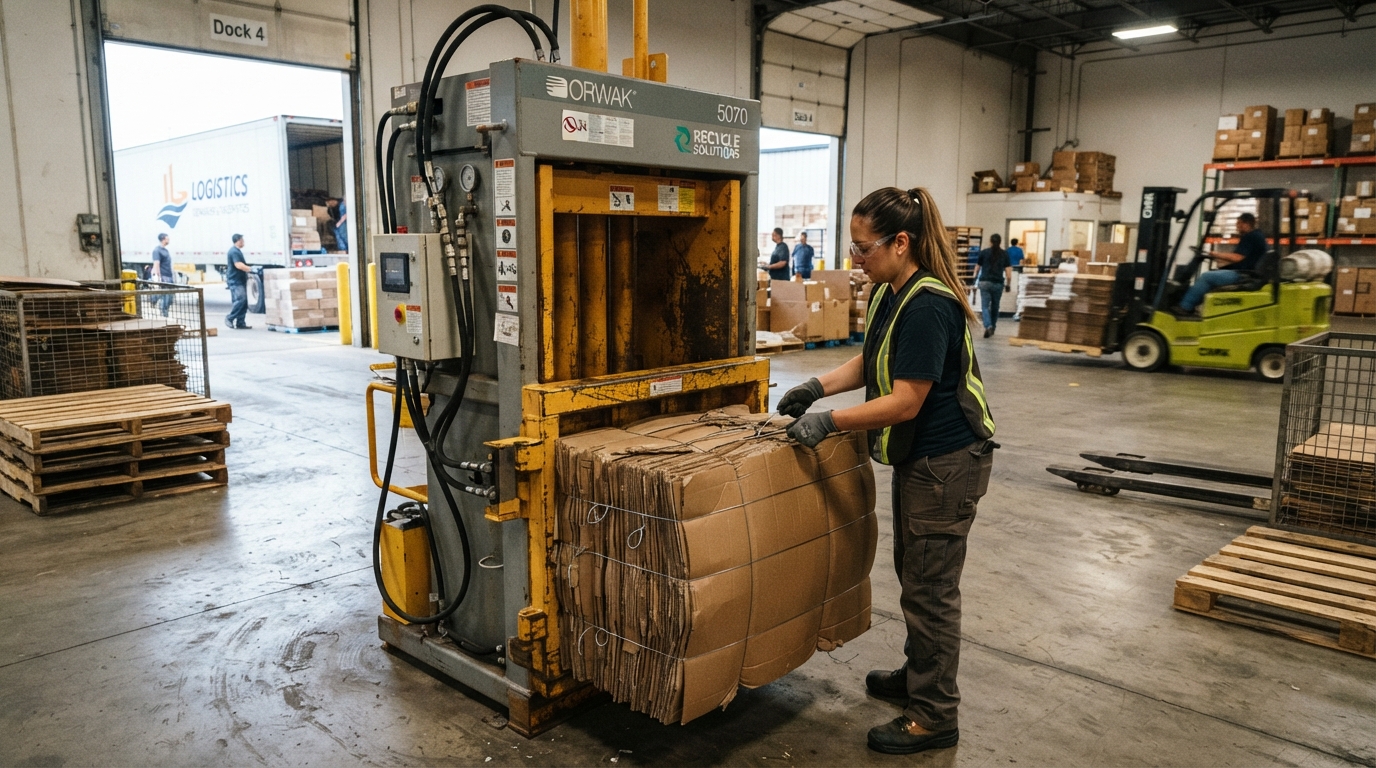
Hydraulic consolidation elevates packaging density past 1,000 lbs per finished block. Haul frequencies plunge by up to 88%, transforming waste management from an unavoidable liability line item into a documented commodity revenue center.
Engineering Mill-Sized 60-Inch Bales (>1,000 lbs) for Top-Tier OCC #11 Rebates
The international scrap paper secondary market operates under strict specifications governed by the Institute of Scrap Recycling Industries (ISRI). The standard benchmark for commercial cardboard is ISRI Grade #11: Old Corrugated Containers (OCC). Domestic paper mills and export processing centers mandate precise mechanical parameters to authorize peak-tier commodity rebates.
Compact, undersized balers (producing 30-inch or 48-inch blocks under 600 lbs) require regional intermediate sorting facilities to cut the ties and re-bale the stock into 60-inch modules. This secondary handling introduces penalty dockage fees ranging from $30 to $55 per ton. To skip middleman processing and secure direct-to-mill contracts, logistics centers must standardize on industrial 60-inch downstroke units capable of generating bales exceeding 1,000 lbs (454 kg).
ISRI OCC #11 Target Dimensions & Loading Densities
Contamination Control: Preventing Inbound Mill Downgrades & Rejections
Rebate value is exceptionally volatile when outthrow tolerances are breached. Mills permit a maximum non-paper outthrow limit of 1% and total prohibited material thresholds under 0.5%. Receiving docks deploy core-moisture probes and infrared automated fiber scanners. If a single bale within a 40-bale truckload breaches these allowances, the entire shipment may be downgraded to mixed paper (a 60–80% pricing discount) or rejected outright, with the shipper bearing round-trip demurrage and demurrage storage fees.
Common in cold-storage produce handling. Wax cannot be repulped in water-based hydro-pulpers, leaving sticky residues on mill forming wires. Immediate disqualifier for OCC #11 classification.
Cardboard stored outside or loaded in damp weather absorbs humidity rapidly. High core moisture triggers microbial fiber rot, creates catastrophic storage collapse hazards, and triggers automatic weight-deduction penalties.
High-density plastic banding and excessive un-separated stretch wrap gum up industrial shredder mandrels. Must be sliced and diverted to LDPE film balers prior to compaction.
Fragile molded styrofoam disintegrates under 50,000 lbs of hydraulic ram force, distributing static beads throughout the bale core that ruin finished paper batch consistency.
Operator Safety, OSHA Lockout/Tagout, & ANSI Z245.5 Compliance
Vertical balers exert between 30,000 and 65,000 pounds of hydraulic force. Improper operational workflows, tampered safety circuits, or careless manual tie-off procedures represent catastrophic crush and pinch-point hazards. The American National Standards Institute explicitly governs baling equipment under ANSI Z245.5 (Baling Equipment – Safety Requirements).
OSHA 29 CFR 1910.147 (LOTO) Compliance
Technicians must physically isolate electrical disconnect switches and depressurize hydraulic accumulators before any manual clearing of jam points behind the platen. Never depend solely on the keyed control switch or emergency stop button during maintenance operations.
Dual-Channel Safety Interlocks
Tamper-resistant magnetic or mechanical tongue switches must instantly break the pilot circuit whenever the loading door gate rises above 1/2 inch. Under no circumstances should operators override interlock wiring to expedite continuous hand-feeding.
Wire-Tying Ergonomics & PPE Protocol
Operators must wear ANSI-rated safety goggles with side shields and puncture-resistant leather work gloves when feeding baling wire through floor platen channels. The recoiling tension of severed wire strands is an overlooked source of severe facial and optical lacerations.
Preventive Maintenance Checklist: Ensuring Hydraulic Uptime & Longevity
Unplanned baler downtime forces immediate regression to loose disposal hauling, triggering costly surcharge rollbacks. Facility managers should mandate the following routine checklist:
Inspect loading door safety interlocks. Remove stray cardboard slivers lodged behind the platen slide track. Verify the emergency stop knob latches cleanly and resets smoothly.
Examine hydraulic fluid levels in the sight glass while the ram is fully retracted. Look for weeping along cylinder rod seals, hose fittings, and directional valve bodies.
Grease platen guide shoes and door hinges. Test hydraulic operating pressure using an inline gauge (typically 2,000 to 2,400 PSI nominal relief valve threshold). Check limit switch trip engagement heights.
Execute a comprehensive fluid flush with ISO VG 46 hydraulic oil. Replace spin-on suction strainers and return-line filters. Calibrate motor starter contacts and verify anchor bolt torques to concrete slab.
Frequently Asked Questions: Operations, Procurement, & Mill Rejections
What happens when a mill rejects an inbound OCC shipment?
Is leasing or outright capital purchase more viable for a single warehouse?
Can wire-tied bales be safely stored outside on open staging docks?
assignment_turned_in
Core Operational Directives for Warehouse Leadership
Core Operational Directives for Warehouse Leadership
1
2
3
4
Commercial Chemical & Hazardous Disposal: RCRA Protocols & Compliance
RCRA manifesting, solvent storage safety, universal waste compliance, and spill-containment verification for labs, factories, and light industrial hubs.