
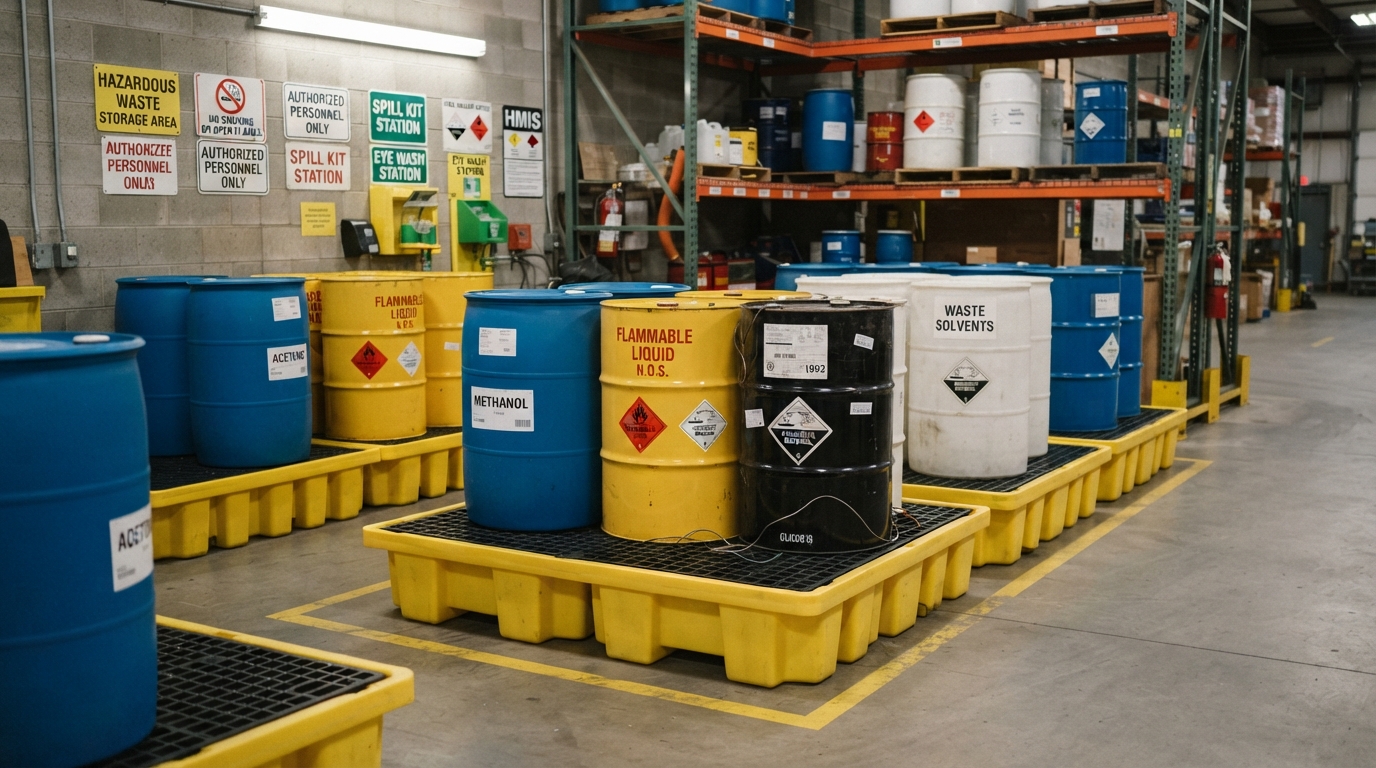
Statutory Authority & The EPA Containment Rule
Industrial hazardous liquid management in the United States is anchored by federal legislation enforced under the Resource Conservation and Recovery Act (RCRA). Specifically, Title 40 of the Code of Federal Regulations, Part 264, Subpart I (§ 264.175), sets forth unbending containment system standards for container storage areas. For commercial facilities handling hazardous waste—whether operating as Large Quantity Generators (LQGs) or permitted Treatment, Storage, and Disposal Facilities (TSDFs)—secondary containment is not merely an operational luxury; it is a federal statutory requirement.
To satisfy the Environmental Protection Agency’s minimum containment benchmark, every chemical and hazardous waste storage pad must demonstrate:
- Base Impermeability: A underlying base that is free of cracks or gaps and sufficiently impervious to contain leaks, spills, and accumulated precipitation until the collected material is detected and remediated.
- Elevation & Drainage Design: The containment floor must be sloped or the containers elevated on heavy-duty non-slip poly/steel grates to prevent standing drums from coming into persistent physical contact with leaked liquids.
- Sump Volumetric Integrity: A dedicated collection basin capable of retaining the codified statutory volume thresholds without overflowing under hydraulic load.
- Run-on Prevention: Run-on into the containment system must be prevented unless the collection system has excess capacity beyond the codified requirements.
Failing to maintain continuous, certified secondary containment exposes corporate entities to severe enforcement actions. In addition to RCRA violations, facilities that store petroleum-based hazardous solvents or dielectric fluids risk cross-jurisdictional non-compliance under the EPA’s Spill Prevention, Control, and Countermeasure (SPCC) rule (40 CFR Part 112), bringing mandatory reporting orders and facility-wide compliance consent decrees.
Sump Capacity Calculation: The 10% vs. 100% Rule
The single most scrutinized technical parameter during an EPA or state DEQ inspection is the containment sump volume. The federal containment rule establishes an unequivocal formula: the secondary containment system must possess sufficient capacity to contain at least 10% of the total cumulative volume of all containers stored, OR 100% of the volume of the largest single container stored in the area, whichever is greater.
When staging an isolated 55-gallon container, 10% of total volume is 5.5 gallons, but 100% of the largest unit is 55 gallons. The 100% rule governs; the sump must hold at least 55 net gallons.
Four 55-gallon drums equal 220 gallons total volume. 10% of 220 gallons equals 22 gallons. 100% of the single largest drum is 55 gallons. Consequently, 55 gallons is the absolute minimum, yet certified pallets are built to 66+ gallons to account for drum displacement.
For mass staging arrangements—such as chemical accumulation aisles holding twenty 55-gallon drums (1,100 gallons total volume)—the 10% rule overtakes the single-vessel rule. Ten percent of 1,100 gallons is 110 gallons, whereas the largest drum remains 55 gallons. Thus, the containment deck or concrete curb trenching must provide an uncompromised retention volume of at least 110 gallons.
Material Engineering: Polyethylene vs. Steel Containment
Choosing between high-density polyethylene (HDPE) and heavy-gauge carbon or stainless steel containment pallets is a critical material engineering decision governed by chemical compatibility, fire codes, and electrical static dissipation standards.
Virgin High-Density Polyethylene (HDPE)
HDPE is chemically inert across virtually all aggressive acids, caustic bases (sodium hydroxide), and oxidizing salts. It is entirely corrosion-proof, lightweight for forklift repositioning, and UV-stabilized for harsh environments. However, HDPE will deform or melt under intense structural fire conditions, making it unsuitable for bulk NFPA Class IA flammable solvent storage unless supplemented by automated fire suppression Deluge systems.
Heavy-Gauge Welded Steel (Galvanized & Coated)
Built from 12-to-14 gauge hot-rolled carbon steel or 304/316 stainless steel, metal containment platforms offer unmatched heat resilience and structural strength for high-temperature solvents, acetone, xylene, and toluene. Crucially, conductive steel pallets facilitate OSHA and NFPA 30 electrostatic grounding and bonding. By attaching grounding cables directly to the steel containment frame, static electrical potential that could ignite solvent vapors during dispensing operations is safely dissipated.
Weather Protection & Outdoor Storage
Positioning hazardous waste drum containment outdoors introduces intense meteorological variables. Under EPA 40 CFR § 264.175(c), if an outdoor container storage system is not protected by an overhead roof or enclosure, the containment system must have additional volumetric capacity sufficient to contain run-on or precipitation from at least a 25-year, 24-hour storm event.
Accumulated rainwater inside a containment basin rapidly compromises compliance by reducing net sump capacity below legal thresholds. Facilities must implement:
- Covered Hard-Top Containment Units: Roll-top polyethylene huts or louvered steel shelters that shed vertical rainfall completely before water enters the sump.
- Gravity Drain Valves with Manual Locks: Drain ports equipped with quarter-turn brass ball valves kept strictly locked in the closed position during normal operation.
- Pre-Discharge Testing Protocol: Sump water must undergo organoleptic check (sheen/odor) and portable pH/VOC testing before being discharged into municipal storm drains. Contaminated runoff must be pumped into hazmat recovery totes for manifest treatment.
Operational Walkthroughs & Weekly Inspection Logs
Containment hardware is only as effective as the procedural governance supporting it. Pursuant to 40 CFR § 265.174, hazardous waste generators must conduct weekly inspections of container storage areas looking for leaks, structural deterioration, and container corrosion.
Confirm removable non-slip floor grates are seated firmly on inner sump pillars without warping, bowing, or crack fissures caused by forklift overload.
Inspect bottom sumps using flashlight mirrors or dip sticks. Any observed liquid must be pumped out promptly to preserve mandatory containment volume.
Verify 2-inch and 3/4-inch threaded bungs are tightly torqued. Ensure approved pressure-vacuum relief vents are clear of residue to prevent drum pressurization.
Log inspection date, inspector signature, observed deficiencies, and corrective maintenance records. Store logs on-site for a minimum of 3 full operating years.
Spill Response Preparedness & Emergency Stationing
Secondary containment forms the primary engineering defense against catastrophic environmental release, but immediate human intervention protocols dictate ultimate life-safety outcomes. Storage staging zones must maintain dedicated emergency support hardware within direct line-of-sight.
ANSI Z358.1 mandates an emergency eyewash and deluge shower reachable within a 10-second unobstructed walking path (~55 feet) from hazardous chemical dispensing sumps.
Minimum 55-gallon overpack drum containing polypropylene absorbent socks, pillows, pads, hazmat neutralizer, and heavy-gauge disposal bags positioned adjacent to exit gates.
Drum bung wrenches, manual pumps, and siphon rods must be fabricated from non-ferrous, non-sparking copper-beryllium or aluminum-bronze alloys in flammable storage suites.
Physical yellow SDS binders paired with scanned QR tags mounted at eye level at the room entrance for instant access by emergency hazardous response crews.
Regulatory Frequently Asked Questions
Does outdoor secondary containment need extra sump capacity for rainfall?
Can acids and flammables share the same secondary containment pallet?
How quickly must accumulated liquid be pumped or removed from a containment sump?
What are the civil penalty amounts for EPA secondary containment violations?
assignment_turned_in
Executive Summary: Key Takeaways
EHS Operational Benchmarks for Secondary Containment
EHS Operational Benchmarks for Secondary Containment
1
2
3
4
5
Calculating Your True Landfill Diversion Rate (Step-by-Step Formula)
How ESG leads calculate exact weight-based diversion percentages across recycling, compost, and hazardous waste streams, correcting for uncompacted volume estimation errors.