Facilities that run an unannounced, disciplined 24-hour waste sort uncover an average of 34% recoverable fiber and rigid polymers trapped in standard compaction compactors. This manual outlines zero-fluff field mechanics to measure, isolate, and monetize what your building throws away.
Pre-Audit Preparation and Essential Field Safety Gear
A successful audit hinges entirely on mechanical preparation before the first bag is pierced. When commercial waste is handled manually, biological and physical hazards escalate immediately. Standard light janitorial latex gloves provide zero barrier resistance against broken beverage glass, wire staples, pallet nails, or splintered composite pens.
Every audit team member must be issued personal protective equipment engineered to ANSI A4 puncture thresholds. Assemble the following inventory inside a clean staging zone—ideally a well-ventilated, weather-protected loading bay or receiving dock—48 hours prior to sorting day:
Puncture-Resistant Nitrile-Coated Kevlar Gloves: ANSI cut level 3/puncture level 4 minimum. Standard domestic rubber gloves are strictly non-compliant.
Indirectly Vented Goggles & Heavy PVC Aprons: Shields operators from rogue aerosolization, pressurized liquid squirts from partially closed beverage bottles, and liquid food leachate.
Industrial Polyethylene Sorting Tarps (12×16 ft): A heavy-duty clean sorting surface protects dock concrete from organic grease staining and ensures every fragmented particle is swept cleanly into its target tally.
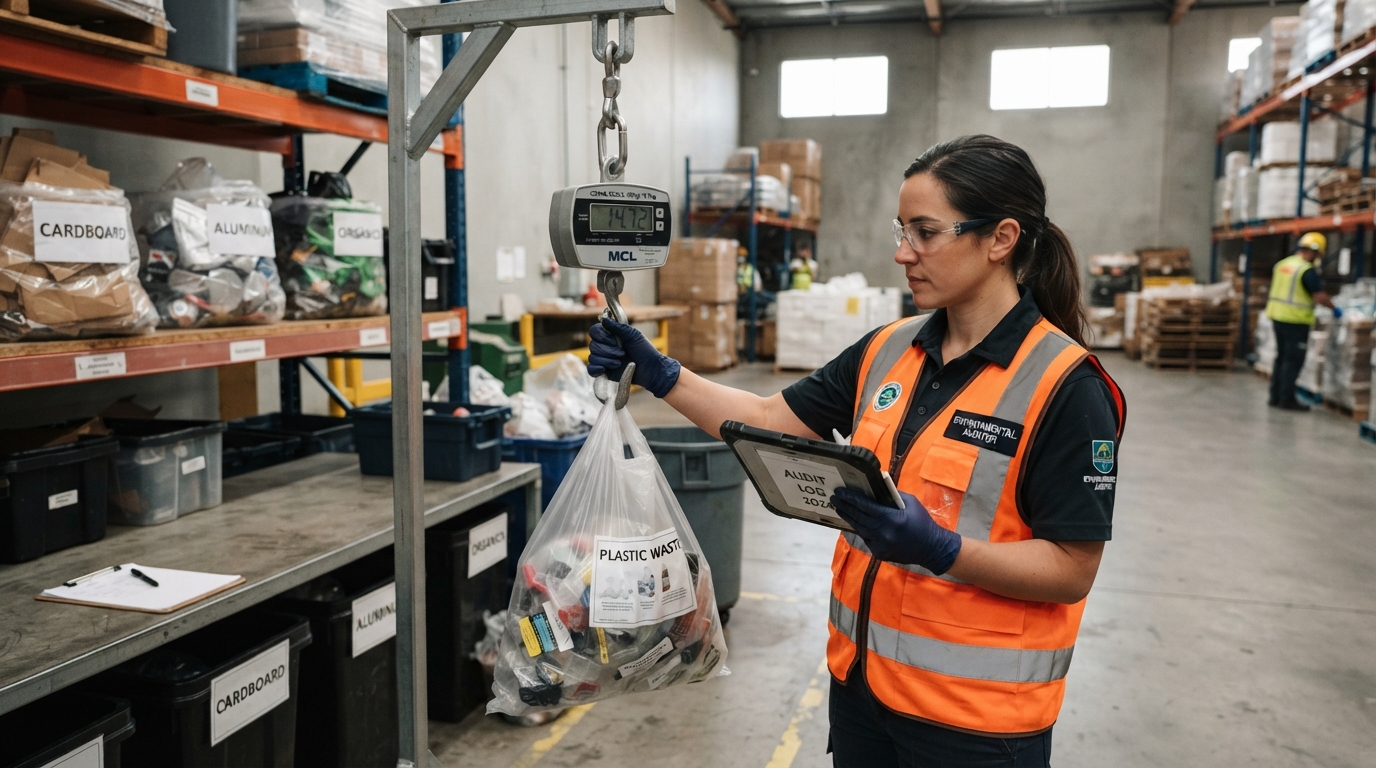
Color-Coded 5-Gallon Buckets & Calibrated Hanging Scales: Pre-weighed buckets labeled with their empty tare weight, paired with a dual-hook calibrated digital crane scale suspended from an overhead dock arm or rolling gantry.
Securing a Representative 24-Hour Sample
Data integrity collapses if the sampled refuse is atypical. Never audit on a Monday morning (which reflects weekend cleanup backlogs) or a Friday evening (which suffers from early worker attrition). Target an ordinary Tuesday or Wednesday operating window spanning exactly 24 consecutive operating hours.
Coordinate discreetly with night-shift custodial management. Housekeeping staff should not alter their day-to-day routines, nor should building occupants be notified prematurely; an announcement prompts artificial behavior modification, causing occupants to hold or clean their recycling during the audit window.
Zonal Color-Tagging Protocol
Provide the custodial team with colored duct tape or heavy-duty vinyl zip-tie tags. Every bag removed during normal pull intervals must be tagged at the cinch neck according to its department source:
Primary generator of post-consumer food solids, beverage containers, disposable cutlery, and compostable packaging.
High concentrations of high-grade white ledger paper, thermal receipts, single-use pod capsules, and shipping mailers.
Industrial secondary packaging, OCC corrugated baling waste, LDPE pallet shrink-stretch films, and strapped banding.
Aerosols, oily wipes, scrap cabling, mechanical gaskets, and regulated packaging residuals requiring separation.
The Sorting and Categorization Protocol
Establish a physical assembly line across the master poly tarp. Two operators act as "Pickers," one operator as the "Weigher / Hook Lead," and one operator acts strictly as the "Data Recorder" with dry hands and waterproof logging sheets.
Bags are weighed whole to record the Gross Bag Weight before slicing along the side seam with a protected safety box cutter. Refuse must be systematically segregated into six core standardized commodity streams:
Stream A: Old Corrugated Cardboard (OCC)
Clean double-faced and single-wall kraft corrugated fiber. Must be free of greasy pizza saturations, plastic strapping, and hot-melt wax coatings that invalidate mill repulping lines.
Stream B: De-Inked Mixed Office Paper (SOP)
Bright white office printing sheets, shredded confidential paper inside paper liners, company stationery, magazines, and envelopes without bubble laminate interiors.
Stream C: Rigid Polymers (#1 PET, #2 HDPE, #5 PP)
Clean plastic soda bottles, translucent milk jugs, industrial chemical jugs (triple-rinsed), and polypropylene takeout clamshells. Check for RIC symbols molded into container bases.
Stream D: Flexible Polyethylene Films (LDPE / LLDPE)
Stretch pallet wrap, clean air-pillows from received parcels, clear bundling film, and grocery style liners. These must never enter single-stream mechanical recycling bins due to MRF trommel jamming.
Stream E: Organic & Compostable Substrates
Pre- and post-consumer kitchen prep trimmings, coffee grounds, tea bags, leftover cafeteria food, paper hand towels from breakrooms, and BPI-certified plant-based serviceware.
Stream F: True Landfill Residuals
Non-recyclable multi-material pouches (metallic foil snack bags), dirty wax-lined paper coffee cups, soiled facial tissues, latex gloves, thermal carbon receipts, and composite polystyrene foam packaging.
Data Recording and Root Contamination Analysis
Tare calculation is the linchpin of valid data. Every five-gallon collection bucket carries an inherent structural mass (typically between 1.8 to 2.2 lbs). Failing to tare each reading compounds errors across dozens of weigh-ins, distorting diversion rates by up to 18 percent.
For each zone, record: Net Weight = Gross Measured Weight - Container Tare Weight. Once tallies are populated, focus your analytical lens on "The High-Impact Culprits"—materials that either ruin commodity resale values or represent preventable spending:
Calculating Diversion Potential and Financial Waste
Data alone rarely motivates an executive steering committee; you must translate captured mass into hard bottom-line currency. Two standard formulas establish your operational baseline:
A standard unoptimized enterprise facility typically presents a baseline diversion between 14% and 22%. By implementing targeted stream segregation, facilities reliably push above 65%.
Next, correlate your measured diversion deficit against your hauler's service invoice. Most commercial hauling agreements bill through three isolated vectors:
- Tipping & Tonnage Surcharges: Landfill tipping fees range from $65 to $145+ per ton. Diverting dense wet organics immediately pares down gross container payload weights.
- Compactor Lift Pull Rates: If your 30-yard compactor contains 35% uncompressed cardboard cartons, you are paying $250 to $450 per pull simply to haul trapped air.
- Contamination Rejection Fines: Municipal haulers impose punitive penalty fees—often $150 to $300 per contaminated bin—when non-conforming items exceed 10% volume.
Converting Audit Data into an Actionable 30-Day Plan
An audit is a diagnostic instrument, not an end state. Within seven days of finalizing the spreadsheet tallies, deploy a clear 30-day corrective roadmap:
Right-Bin Co-Location & Desk-Side Removal
Eliminate solo trash cans. Every landfill receptacle must be permanently paired with a dedicated recycling and compost bin. Strip out personal under-desk trash bins in favor of centralized communal stations to force conscious disposal.
Visual Pictorial Signage at Eye Level
Replace ambiguous text placards ("Recycle Here") with 3D high-resolution photographs of exact items sold in your company cafeteria. Clearly display what is prohibited with high-contrast red diagonal crosses.
Custodial Alignment & Clear Liners
Switch exclusively to translucent, clear recycling liners. Janitorial staff can instantly verify contamination before tipping station bags into outdoor dumpsters, eliminating mixed hauling contamination penalties.
Right-Sizing Hauling Schedules
Audit haul invoices against actual dumpster fill levels. If diverted mass cuts landfill volume by 40%, immediately downgrade your weekly pickup frequency from three pulls to two pulls, banking immediate ongoing cash savings.
Frequently Asked Questions
Operational nuances and compliance questions frequently raised by environmental directors and plant operations teams.
How often should an enterprise facility conduct an internal waste audit?
Do you need an external third-party consultant to certify audit data for LEED points?
What is the protocol for handling biohazard or bathroom waste during sorting?
How do you present audit findings to C-suite executives to secure equipment budget?
assignment_turned_in
Key Takeaways • Waste Audit Protocol
Fast Execution Summary for Facility Leaders
Safe Handling & Disposal of Commercial Electronics & Lithium Batteries
Essential protocols for IT asset disposition (ITAD), terminal tape insulating for lithium-ion storage, certified data destruction certificates, and thermal runaway prevention.