
Across modern third-party logistics (3PL) networks, automated fulfillment hubs, and ambient cross-dock terminals, pristine low-density polyethylene (LDPE) and linear low-density polyethylene (LLDPE) stretch wrap constitutes an estimated 20% to 30% of total loose solid waste volume. When treated as unsegregated municipal solid waste, uncompacted elastic films consume thousands of cubic yards of dumpster space, inflating open-top and self-contained compactor haul frequencies. By decoupling clean pallet wrap from general waste streams and treating it as a purified raw polymer, facility operators eliminate thousands of dollars in monthly tipping charges while extracting premium Grade A commodity scrap rebates.
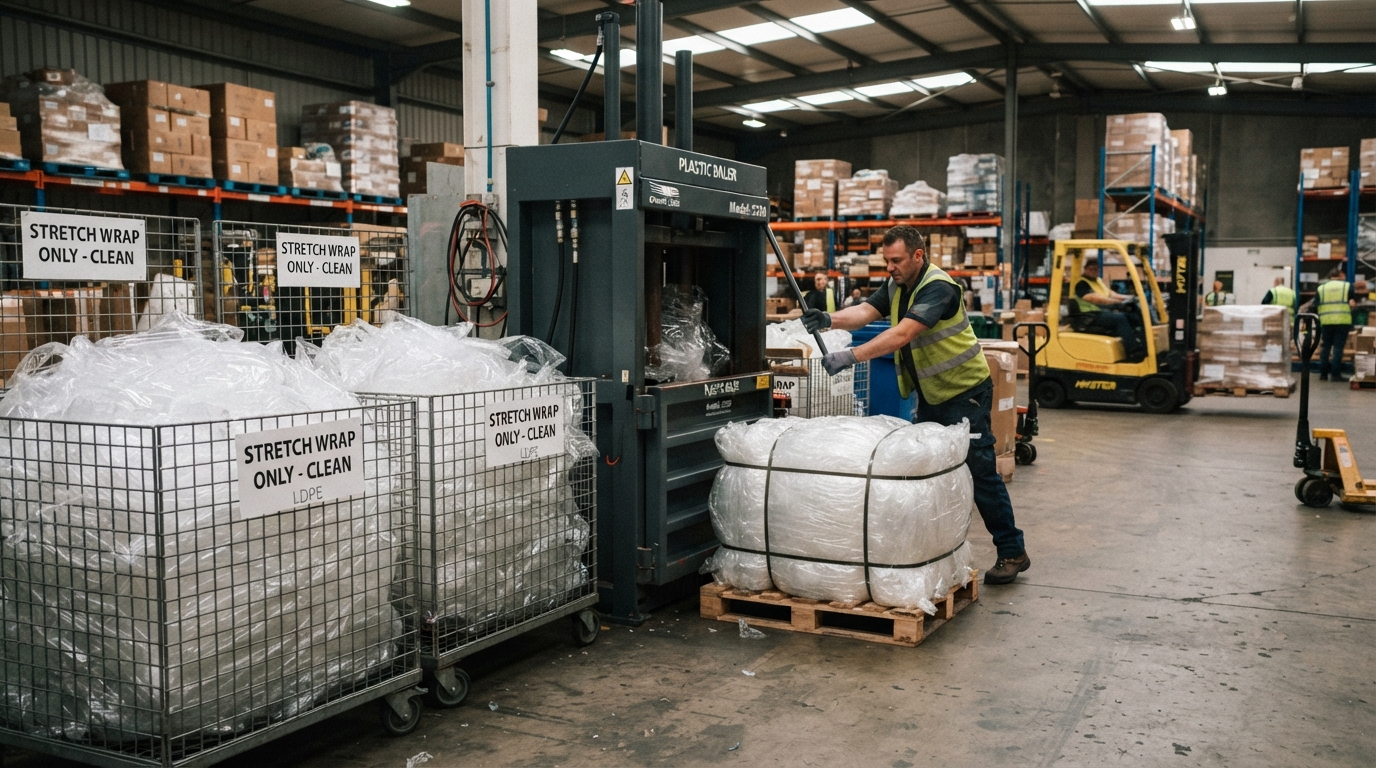
The Polymer Science of Warehouse Films: LDPE vs. LLDPE vs. Polypropylene Strapping
Effective industrial film diversion demands absolute polymer segregation at the unpackaging station. The vast majority of clear pallet stretch wrap is manufactured from Linear Low-Density Polyethylene (LLDPE, Resin Identification Code #4) or conventional Low-Density Polyethylene (LDPE). These polyolefin formulations are engineered with extended branch polymers that offer extreme tensile elongation, puncture resistance, and elastic recovery under tension. When recovered in clean condition, domestic pelletizers and circular film-to-film recyclers can readily melt, filter, and re-extrude these materials into high-purity post-consumer recycled (PCR) pellets.
The operational breakdown occurs when warehouse workers treat all flexible clear plastics interchangeably. Blown films (often characterized by high haze and exceptional tear resistance) and cast films (recognized by superior optical clarity and smooth, quiet unwind dynamics) are both chemically compatible for high-yield reprocessing. However, the introduction of non-polyolefin wrap introduces severe thermal and mechanical degradation during extrusion.
Non-Compatible Cross-Contaminants: The Chemistry of Rejection
The presence of Polyvinyl Chloride (PVC) cling films, common in certain imported food cargo or localized secondary packaging, introduces chlorine into the melt phase. At standard LDPE extrusion temperatures (190°C to 230°C), PVC degrades into highly corrosive hydrochloric acid gas, destroying extruder barrels and causing immediate rejection of entire trailer loads. Similarly, polypropylene (PP, Resin #5) woven strapping, PET green banding, and expanded polystyrene edge protectors introduce distinct melt flow indexes (MFI) that yield brittle inclusions in downstream blown agricultural films or commercial trash liners.
Color-tinted stretch films (UV-inhibiting black wrap, security opaque white, and tinted inventory-lot wraps) introduce carbon black and concentrated color masterbatches that disqualify a bale from Grade A classification. While colored film possesses secondary market value in agricultural sheeting and composite decking cores, co-mingling tinted wrap with crystal clear stretch wrap instantly downgrades the entire lot to Grade B or mixed color film pricing, resulting in a substantial discount per net ton.
The Critical Danger of Film Contamination in Standard Compactor Hauls
Logistics managers frequently question why their municipal hauler or single-stream recycling provider penalizes loose plastic film placed inside common commingled recycling dumpsters. In automated Material Recovery Facilities (MRFs), flexible films represent the single most destructive operational contaminant. Because loose stretch wrap possesses negligible rigidity, it bypasses ballistic screens and star screens, immediately wrapping itself around rotating steel shafts, discs, and sorting trommels.
Once bound, the plastic wrap friction-melts around bearing seals, creating severe fire hazards and forcing facility operators to initiate full mechanical shutdowns multiple times daily so maintenance technicians can physically slice bound film out with utility knives. Consequently, municipal haulers enforce stringent audit programs. Single-stream containers containing more than trace quantities of pallet wrap incur severe contamination surcharges or are completely rerouted directly to landfills as expensive dry solid waste.
Even when discarded into stationary landfill compactors, loose stretch wrap causes catastrophic mechanical downtime. Highly elastic film enters compactor ram guide tracks, migrating behind hydraulic wipers and entangling structural cylinder pins. At the disposal landfill, loose plastic caught in heavy Caterpillar compactor wheels wraps axle seals, causing hydraulic fluid leaks and immense municipal fleet downtime. Segregating stretch wrap at the warehouse source is thus both an environmental necessity and an imperative to safeguard regional logistics infrastructure.
In-Aisle Collection & Staging Infrastructure
The single greatest barrier to sustainable commodity film recovery is ergonomic failure on the warehouse floor. If a receiving clerk or reach truck operator must walk more than 20 paces to dispose of stripped pallet wrap, the material will inevitably end up crumpled into the nearest general trash bin or trampled across high-traffic transit aisles. Implementing an industrial-grade segregation program requires deploying dedicated, color-coded collection points directly at pallet breakdown stations.
Hardware Architecture: Mobile Wire Racks & Clear Poly Liners
Best-in-class distribution facilities install high-capacity, heavy-gauge wire bag frames mounted on low-profile industrial casters. These frames accommodate 55-gallon to 96-gallon ventilated clear plastic collection bags. The use of clear bags is critical for visual auditing: receiving supervisors can immediately inspect the contents from across the aisle, instantly detecting stray corrugated scrap, shipping documents, plastic bottles, or polypropylene strapping before the bag is tied off and transported to the baler.
At high-velocity inbound de-palletizing zones, stationary frame holders are anchored directly to racking uprights at eye level. Standard operating procedure mandates that inbound handlers execute a standardized "peel-and-twist" motion: rather than allowing loose wrap to drag on concrete floors where it picks up fine silica dust, forklift tire grease, and wood splinters, the operator strips the wrap upward and drops it directly into the staging ring. Maintaining pristine dry surfaces is mandatory; a single contact point with wet floor scrubbers or grease will degrade an entire 1,000-pound baled assembly.
The Tape and Shipping Label Removal Rule for Grade A Film Pricing
Reclaimers classify scrap film based on the Association of Plastic Recyclers (APR) Model Bale Specifications. While standard paper shipping labels and barcode stickers represent acceptable contamination up to 2% by total bale weight, packing tape formulated with aggressive rubber-based adhesives or acrylic solvent adhesives will discolor clean re-extruded pellets and plug melt-blown screens. Train your receiving line to swiftly slice around dense taped clusters rather than attempting to peel them off. The 5 seconds spent excising high-tack tape areas directly protects your top-tier Grade A commodity price.
Film Baling Mechanics & Mill-Ready Bale Specifications
Transforming loose, voluminous plastic film into a monetizable commodity requires mechanical densification. Loose pallet wrap has a bulk density of less than 30 pounds per cubic yard; in this state, shipping costs far exceed the material's market worth. Baled stretch wrap, however, achieves high spatial density, enabling facilities to achieve maximum gross freight payloads on 53-foot dry vans.
Vertical Downstroke Balers vs. Horizontal Extrusion Units
Distribution centers processing between 100 and 500 pallets per day typically utilize a standard 60-inch vertical hydraulic downstroke baler (such as a 10 HP motor unit producing 50,000 to 65,000 pounds of hydraulic ram force). Unlike corrugated cardboard (OCC), which displays moderate spring-back and structural friction against baler chamber walls, LDPE film exhibits extreme elastic memory. When the hydraulic platen retracts, unconstrained plastic film vigorously rebounds upward.
To achieve mill-ready specifications, operators must employ balers equipped with aggressive internal dog-tooth retaining dogs that lock compressed film beneath each stroke. The target standard for domestic pelletizers and international reclaimers is a mill-sized bale weighing between 800 and 1,100 pounds, with exact outer dimensions of 60 inches wide by 30 inches deep by 48 inches high.
Tying mechanics are equally critical. Due to the high internal expansion pressures of compacted LLDPE, four to five high-tensile 14-gauge galvanized baling wires or 1/2-inch woven polyester cords must be securely threaded through the platen channels and hand-tensioned before opening the discharge door. Annealed black wire should generally be avoided; oxidation or rust flaking from non-galvanized wire introduces metal scale contamination into water flotation wash systems at plastics reprocessing plants.
Commodity Marketing & Direct-to-Processor Sale
Once densified into standardized bales, warehouse stretch wrap leaves the jurisdiction of solid waste management and enters the global secondary raw material trade. Bales should never be sold through local scrap peddlers who pay pennies on the dollar for loose consolidate. To maximize revenue, enterprise logistics operators must accumulate full truckload (FTL) quantities and transact directly with national plastics reclaimers, composite decking manufacturers (such as Trex Company and TimberTech), or secondary compounders.
A standard 53-foot dry van can accommodate 38 to 44 mill-size bales when double-stacked on their rolling faces or stood vertically depending on safety dock procedures. This achieves a net commodity shipping payload of 38,000 to 42,000 pounds (approx. 19 to 21 short tons). End-market processors will not contract for partial truckloads (LTL) without deducting severe freight equalization penalties that wipe out operational margin.
Grade A Clear Film commands the highest tier pricing on regional commodity indices, consistently trading at a healthy premium over Grade B mixed colored film or post-consumer grocery sack bundles. The primary domestic buyers demand an audit trail confirming that the bales are 95%+ optically clear stretch film, zero moisture ingress, and free of moisture condensation, gravel, strapping tape, and biological food residue.
Calculating Waste Haul Savings & Commodity Rebate ROI
The financial justification for dedicated stretch wrap baling rests on a two-pronged financial mechanism: the direct elimination of waste compactor hauling expenses paired with the net receipt of plastic commodity rebates.
Consider a typical regional consumer goods distribution center processing 1,200 incoming and cross-docked pallets daily. Each wrapped pallet carries an average of 1.1 pounds of LLDPE stretch film. At full operating cadence, this facility generates approximately 1,320 pounds of clean scrap film per working day, totaling 16.5 tons of plastic per month. When disposed of via an on-site 40-yard self-contained trash compactor, this voluminous, low-density plastic rapidly fills the chamber, requiring approximately 3 compactor pulls per week at an average haul and disposal fee of $650 per cycle—representing an annual expenditure exceeding $101,000 purely in compactor service.
By diverting that 16.5 monthly tons into an on-site baler, the trash compactor haul frequency plummets from 3 pulls per week to approximately 1 pull per week, instantly recapturing over $67,000 per year in avoided solid waste hauling fees. Simultaneously, the 16.5 tons of segregated Grade A film converts into roughly 33 mill-sized bales per month.
Depending on historical market cycles, clean LDPE/LLDPE scrap film trades between $300 and $520 per ton FOB warehouse dock. At an average conservative index of $380 per ton, the facility realizes an additional $75,240 in pure top-line commodity rebate revenue annually. Combined with waste haul reduction, the total economic swing exceeds $142,000 annually against a one-time capital investment of roughly $16,000 to $24,000 for a commercial-grade vertical baler and staging infrastructure.
Frequently Asked Questions
Operational clarifications for industrial logistics supervisors and material managers.
Can distribution centers bale colored or black tinted stretch film together with clear film?
What happens if barcode shipping labels and packing tape remain stuck to the stretch wrap?
How many bales of LDPE stretch wrap are required to schedule a carrier pickup?
Does wet or outdoor-stored stretch film lose its market value with commodity mills?
fact_check
Executive Blueprint
5 Key Operational Steps for Plant & Warehouse Managers
5 Key Operational Steps for Plant & Warehouse Managers
1
2
3
4
5
How to Stop Commercial Haulers from Overfilling & Penalty Gouging
Proven tactics to dispute automated camera overage charges, install tamper-proof corral locks, and negotiate fair terms around container lid closure definitions.