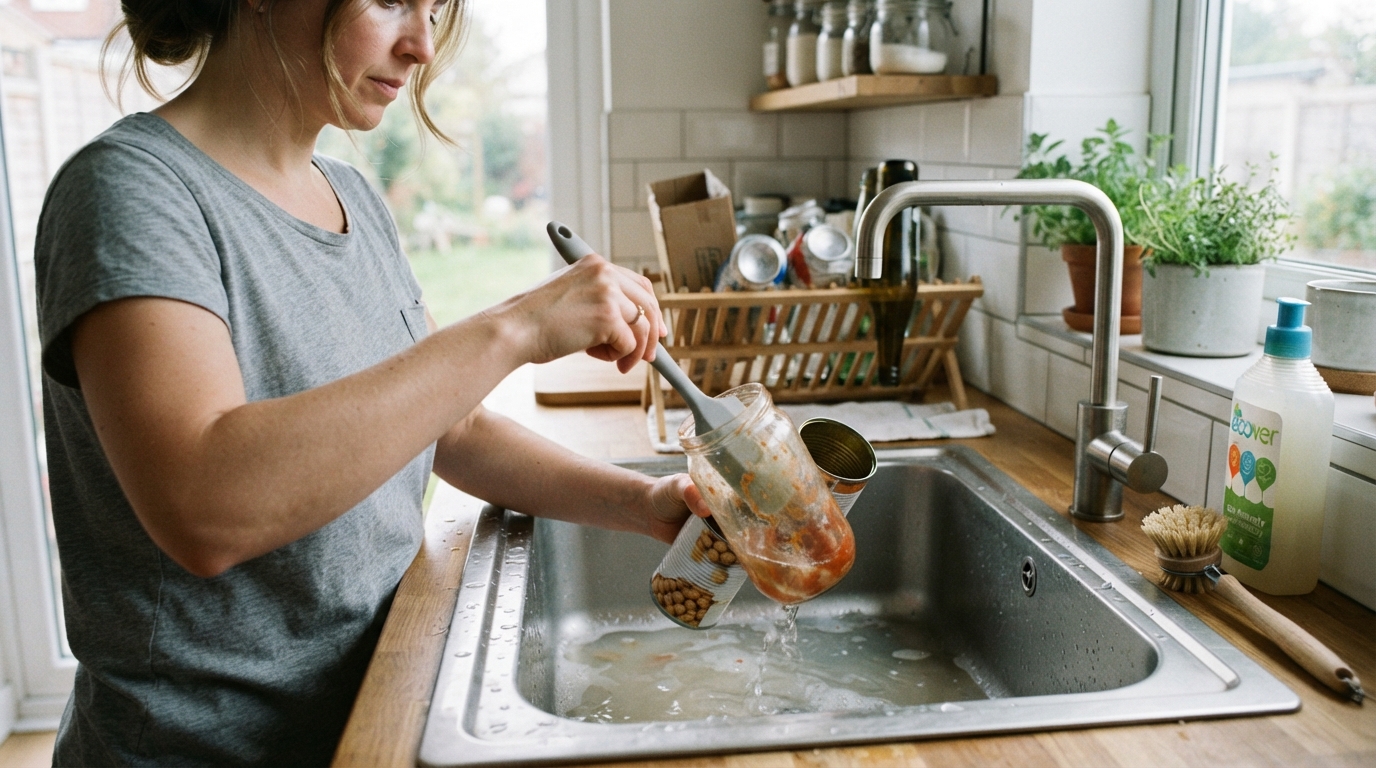
Across modern curbside recycling programs, municipal logistics coordinators face two deeply counterproductive behavioral extremes. On one side stands the hyper-conscientious resident who runs empty mayonnaise jars, tuna cans, and salad dressing bottles through two-hour sanitizing dishwasher cycles. On the opposite side stands the hurried consumer who tosses half-empty jars of marinara sauce, chunky salsa, or oily peanut butter directly into the single-stream recycling cart, assuming that high-tech downstream facilities possess magical cleaning wands.
Both behaviors create severe operational distortions. Running dishwashers to sterilize garbage burns scarce potable municipal water, expends grid electricity, and produces upstream carbon emissions that completely cancel out the environmental value of secondary material recovery. Conversely, dumping wet organic residues into commingled collection turns high-speed mechanical sorting machinery into sticky maintenance nightmares and contaminates thousands of pounds of otherwise pristine paper fiber. Understanding the true operational line between "scrape clean" and "laboratory sterile" is the foundation of practical environmental stewardship.
“Recycling machinery does not demand sterile dishware. It demands containers that are structurally empty and dry enough that they do not leak liquids onto paper bales or blind the infrared eyes of our optical sorting arrays.”
The Operational Spectrum: Spotless vs. "Good Enough" at the MRF
To comprehend why dishwashing your recycling is unnecessary, one must understand how a modern Materials Recovery Facility (MRF) processes curbside freight. MRFs are not pristine industrial laboratories; they are high-throughput bulk processing plants engineered to process between 30 and 60 tons of mixed solid materials per hour. When a haul truck tips its multi-ton payload onto the facility's raw tipping floor, materials are fed onto vibratory conveyor belts moving at speeds of up to 400 feet per minute.
At these velocities, items are separated based on physical geometry, density, ballistic bouncing trajectories, magnetic induction, and spectroscopic reflectance. High-speed spinning disc screens elevate flexible cardboard and paper upwards onto higher tiers while letting rigid, heavy three-dimensional containers (jars, cans, bottles) tumble downward. Near-infrared (NIR) optical sensors scan passing plastic containers in milliseconds, firing microsecond bursts of compressed air to knock designated resins across separation dividers.
When an optical sorter targets an empty PET mayonnaise jar, its infrared camera reads the molecular reflectance of the plastic polymer, not the micro-thin transparent film of oil on its interior wall. However, if that same container arrives containing a half-cup of heavy, coagulated condiment, two operational breakdowns occur:
-
warning
Ballistic trajectory distortion: The excessive dead weight alters the flight path calculated by mechanical screens and pneumatic ejectors. What should behave like a lightweight rigid container becomes a heavy projectile that fails to clear sorting chutes or ends up erroneously dumped into the fiber deck.
-
warning
Sensor lens blinding: Loose liquids and semi-solid pastes fly out during violent conveyor tumbling, splattering across the protective optical glass of NIR cameras and pneumatic air nozzles. A smeared optical lens can shut down an entire sorting line for emergency solvent cleaning, costing thousands of dollars in lost operational throughput.
In short, facilities do not need your containers to be spotless. They require containers to be structurally empty—free from sloshing liquids, bulk food chunks, and viscous pools that can leak, smear, or distort mechanical handling.
According to the Association of Plastic Recyclers (APR) and ISRI standards, a container is considered acceptable when bulk food residue has been mechanically removed with a utensil and any remaining surface coating is dry enough that it will not transfer wet liquid to dry paper products under compaction.
How Food Residue Destroys Recyclable Paper Bales
The most catastrophic casualty of unrinsed food containers in single-stream recycling is never the container itself—it is the surrounding paper and cardboard stream. In single-stream automated recycling trucks, curbside bins are emptied into a single hopper where a hydraulic compactor blade crushes the mix at pressures exceeding 1,500 pounds per square inch to maximize vehicle route payload.
When an unrinsed pasta sauce jar or salad dressing bottle is squeezed against dry corrugated boxes or mixed office paper under thousands of pounds of hydraulic force, remaining sauces, oils, and dressings burst outwards. The liquid food saturates adjacent dry fibers within seconds. While glass, aluminum, and rigid plastics are largely impervious to food stains, paper relies entirely on delicate chemical hydrogen bonding for its structural integrity.
The Chemistry of Repulping and Lipid Interference
When paper mills receive 1,500-pound bales of recycled Old Corrugated Cardboard (OCC) or mixed paper, they introduce the bales into massive industrial hydrapulpers—essentially giant commercial blenders filled with warm water. The hydrapulper hydrates the dried cellulose fibers, untangling them into an aqueous slurry so they can be screened, washed, and rolled into new packaging linerboard.
Hydrophobic lipids—such as vegetable oils, butter fats, and animal greases—are completely insoluble in water. When paper pulp containing oil residues passes through drying cylinders, the non-polar grease molecules coat the cellulose fibers with a microscopic oil monolayer. This lipid coating acts as a barrier, preventing adjacent cellulose strands from forming hydrogen bonds. The immediate consequence is structural collapse: the resulting paper exhibits low tensile burst strength, localized thinning, greasy translucent blotches, and catastrophic sheet tears during high-speed rolling.
Under modern mill quality specifications, secondary fiber bales with contamination levels exceeding 1.0% to 1.5% are routinely failed during receiving dock inspections. When a mill rejects a 20-ton shipment of paper bales, the entire load cannot be re-sorted cost-effectively; it is promptly diverted to a local municipal landfill or industrial incinerator. A single half-full jar of pasta sauce can ultimately condemn hundreds of pounds of otherwise recyclable cardboard.
Thermal Processing Realities: Smelting Temperatures vs. Polymer Washing Systems
Why are recycling facilities so strict about food residue on plastic containers while relatively forgiving of light dried films on metal soup cans? The answer lies in the fundamentally different thermodynamic pathways used to reclaim various materials at the secondary processing level.
Metals: Thermal Vaporization
Aluminum beverage cans and tin-coated steel food cans enter industrial secondary remelt furnaces operating between 1,400°F (760°C) for aluminum and up to 2,800°F (1,540°C) for blast steel furnaces. At these immense temperatures, any dried food traces, thin sugar coatings, or paper labels instantly pyrolyze—vaporizing into harmless carbon gases that are captured by high-efficiency industrial baghouse scrubbers. Organic residues cannot survive thermal smelting and have zero impact on the purity of the recovered molten metal.
Plastics: Chemical Caustic Washing
Plastics (PET, HDPE, PP) cannot tolerate extreme smelting heat without melting into unrecoverable charred slag. Instead, baled plastics are shredded into thumbnail-sized flakes and submerged in hot aqueous chemical baths containing 1% to 2% sodium hydroxide at 185°F (85°C). Heavy animal greases and sticky edible oils saponify within these wash baths, consuming expensive detergent surfactants, fouling density float-sink tanks, and embedding permanent odor molecules into the porous polymer matrix.
Consequently, a steel black-bean can with a light, dry starch film is acceptable in your curbside bin because furnace heat easily neutralizes it. In contrast, an oily plastic peanut butter jar or greasy takeout tub directly inflates chemical recycling costs and compromises the transparency and grade of post-consumer plastic pellets.
The Peanut Butter Dilemma: The Spatula Protocol for Viscous Emulsions
Ask any MRF operator what residential container causes the most frustration, and the universal answer is peanut butter, almond butter, or hazelnut chocolate spread. These dense culinary spreads are non-Newtonian emulsions consisting of over 50% hydrophobic fats, finely ground plant proteins, and minimal water content. When cold, their adhesive viscosity resists hydraulic rinsing. Filling an empty peanut butter jar with cold tap water and shaking it accomplishes virtually nothing—it yields a cloudy splash of water while leaving 90% of the thick fatty paste cemented to the plastic walls.
Attempting to wash such jars under running hot water wastes tremendous amounts of energy and municipal water. To reclaim valuable #1 PET jars without wasting household utilities, WasteLift engineers established the verified Three-Step Spatula Protocol:
Mechanical Spatula Sweep
Deploy a long, flexible narrow silicone spatula to execute two complete 360-degree sweeps down the sidewalls and across the bottom curves of the jar. This purely mechanical swipe recovers up to two ounces of perfectly edible spread and removes 85% to 90% of the bulk lipid mass in under ten seconds.
Greywater Soak (No Fresh Tap Water)
Never run fresh tap water. Instead, scoop a quarter-cup of warm, soapy water from your evening dishwashing basin directly into the scraped jar. Allow it to sit on your sink counter for 10 minutes while the surfactants break down lipid surface tension.
Capped Vigorous Agitation
Screw the jar's lid back on securely, shake vigorously for five seconds to let the soapy greywater emulsify any clinging residue, dump the cloudy water down the drain, and toss the translucent container into your recycling cart.
Water Conservation vs. Clean Recycling: The Ecological Trade-off
One of the most profound oversights in modern environmental education is the failure to conduct full Life Cycle Assessments (LCAs) on household recycling habits. Environmental systems engineers have calculated the exact energetic and carbon break-even points for rinsing food packaging. The results reveal an inescapable trade-off: washing recyclables under a running hot water faucet frequently creates more ecological damage than landfilling the container entirely.
A typical residential kitchen faucet delivers between 1.5 and 2.2 gallons of water per minute. If a resident runs hot tap water (heated to 120°F / 49°C) for 60 seconds to scrub a rigid food tub, the household consumes approximately 1.8 gallons of potable water and around 0.25 kWh of natural gas or electrical water-heating energy.
For a 30-gram clear PET fruit tub, the greenhouse gas emissions generated by producing that hot rinse water completely erase the carbon emissions saved by substituting virgin polymer with recycled material. In drought-stressed regions such as the American Southwest, Southern California, or Southern Europe, expending multi-gallon quantities of potable culinary water to rinse scrap packaging is an indefensible resource allocation.
The 5-Second Cold Water Benchmark
To preserve positive carbon and energy math, tap water rinsing should never exceed 3 to 5 seconds per item, and it should always utilize cold water or leftover dishwashing basin water. If an item requires extensive hot water scrubbing to look presentable, scrape what you can and discard it in municipal trash rather than depleting regional potable aquifers.
Bacterial Mold and Worker Safety on Manual Sorter Lines
Beyond machinery mechanics and paper bale physics, there is an urgent human health dimension to container preparation. Despite increasing automation, virtually every modern MRF relies on manual sorting technicians stationed along high-speed presort conveyors. These workers handle up to 40 items per minute with heavy puncture-resistant gloves.
When residents deposit unwashed dairy cartons, baby food jars, or raw meat packaging into curbside carts, these items sit sealed inside warm plastic bins for days or weeks. Under summer heat, microbial decomposition accelerates exponentially. Spores of opportunistic molds—such as Aspergillus niger, Penicillium, and toxic fungal mycotoxins—colonize residual food films.
When these containers are crushed inside haul trucks and dumped onto facility sorting belts, dense clouds of mold spores and volatile organic sulfur compounds are released directly into the breathing zones of sorting staff. A quick mechanical scrape and cold water swirl neutralizes microbial growth vectors, preventing toxic mold hazards and ensuring humane, sanitary conditions for essential sanitation workers.
Frequently Asked Questions (Real-World Sorting Dilemmas)
Do jars and cans need to be run through the dishwasher before recycling?
What happens if a greasy pasta sauce jar goes into single-stream recycling?
Do I need to soak and remove paper labels on steel or aluminum cans?
Should pizza boxes with grease stains be recycled or composted?
verified_user
Key Takeaways
5 Actionable Rules for Optimal Curbside Preparation
Key Takeaways
5 Actionable Rules for Optimal Curbside Preparation
1
2
3
4
5
Expired Medications: Safe Drug Take-Back Days & Pharmacy Kiosks
Protecting municipal water supplies: why flushing pills is dangerous, pharmacy drop-box locations, and household mixing protocols for non-controlled drugs.