
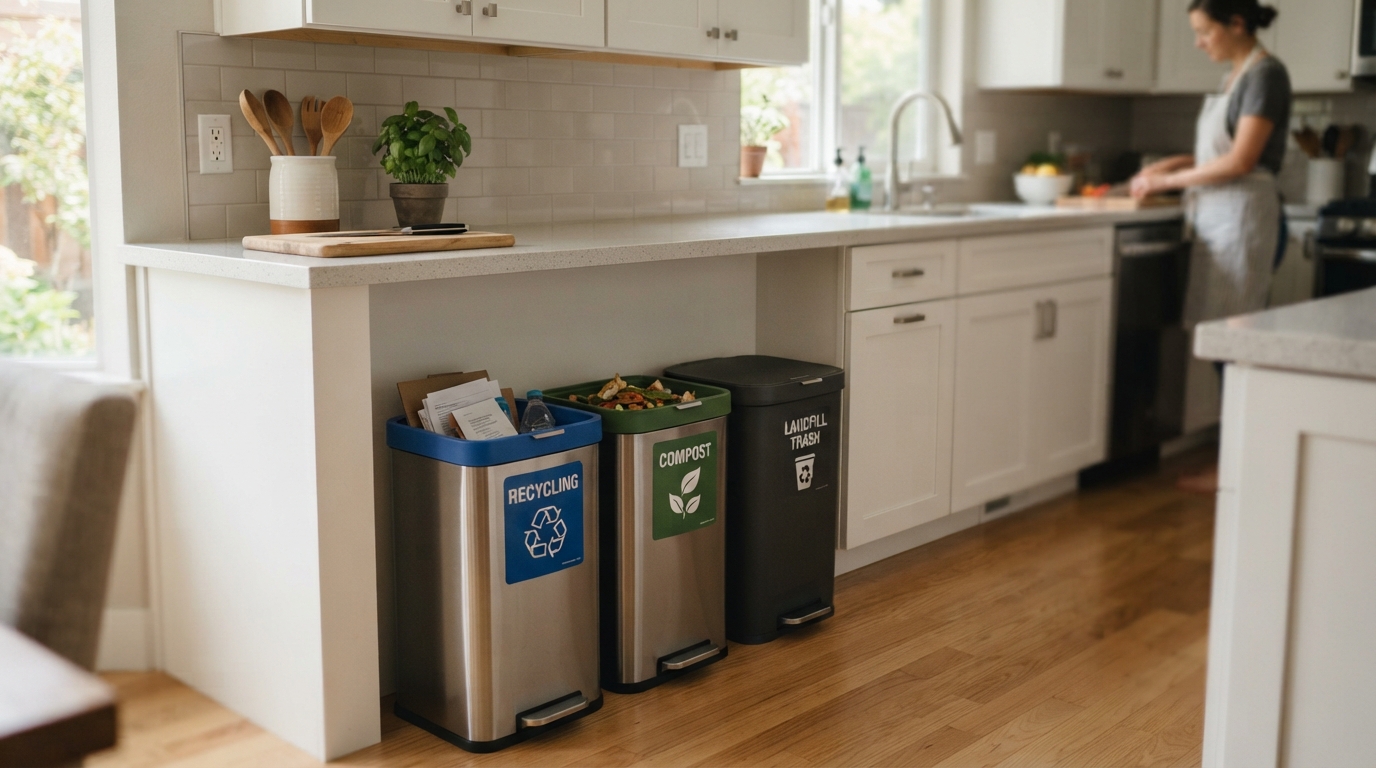
In over eighty percent of single-family residences, the kitchen garbage can represents an architectural failure point. Traditionally hidden beneath a deep sink basin or stuffed into a distant walk-in pantry, the single 13-gallon plastic tall-kitchen receptacle functions as a black hole. When family members chop vegetables, peel garlic cloves, or open deliveries of packaged ingredients, disposal triage takes place under immediate kinetic pressure. If sorting requires opening secondary cabinet doors, kneeling with oily fingers, or carrying drippy vegetable skins across hardwood floors, convenience invariably triumphs over conservation. Every discarded material collapses into the lowest common denominator: the landfill trash.
Municipal waste audits consistently verify that 60% to 75% of the aggregate volume entering municipal landfills consists of compostable food scraps and highly recoverable rigid fibers. Transforming residential diversion does not require punitive discipline or exhaustive lectures at the dinner table. It requires applying professional industrial ergonomics directly to the domestic environment. By aligning physical bin placement with human motion vectors and adopting universally recognized visual chromodynamics, families effortlessly eliminate cross-contamination and convert sustainable disposal into an instinctive habit.
“Household contamination is rarely an ideological failure; it is an ergonomic mismatch. If the landfill bin is three steps closer than the compost caddy, the landfill will always win the battle of daily convenience.”
The Psychology of Kitchen Sorting: Why Proximity Dictates Contamination Rates
Human factors engineers who study workplace ergonomics recognize a fundamental behavioral truth: human decision-making adheres to the principle of least mechanical resistance. In cognitive psychology, disposal actions are classified as low-involvement background habits. When an individual finishes peeling an orange, trimming chicken breasts, or emptying a carton of broth, the neurological cortex executes a sub-second cost-benefit assessment. If separating the cardboard carton from its cap requires traversing the kitchen, or if scraping sticky melon rinds requires manually lifting an unventilated lid, the cognitive load triggers an immediate default reaction.
This ergonomic phenomenon produces two distinct residential pathologies:
Convenience Default Bias
When the general garbage container is the largest receptacle and occupies the central physical footprint of the room, family members dump recyclable containers and organic waste directly into it because it demands zero perceptual pause. The bin acts as an uncurated catch-all, permanently locking valuable raw materials out of circular supply chains.
Impulsive Wishcycling
When residents have an uncurated blue recycling bin positioned conveniently, but lack immediate clarity regarding dirty wax-coated takeout cartons, greasy pizza box inserts, or thin plastic salad wrappers, they default to wishful optimism. Under the well-meaning belief that downstream municipal sensors will sort it out, they introduce adhesives, non-recyclable polymers, and food grease into the paper fiber stream, degrading entire commercial bales at the Materials Recovery Facility (MRF).
The solution is establishing absolute spatial parity. When all three streams—blue (recycling), green (organics), and black/gray (landfill)—are co-located side by side with identical foot-pedal mechanics or seamless under-counter pull-out access, the friction differential disappears. Choosing the green compost bin requires exactly the same physical effort as choosing the landfill bin, allowing intuitive visual cues to guide the hand without cognitive resistance.
The Universal Curbside Triad: Blue, Green, and Black/Gray Demystified
Standardization across environments is the foundation of high-compliance ergonomics. When the internal kitchen color coding precisely mirrors the exterior municipal collection carts—and reflects the color guidelines mandated by regional solid waste authorities—children and adult household members transfer sorting instincts seamlessly between domestic rooms, schools, and offices.
Blue Stream: Clean Fibers & Rigid Packaging
Core Materials: Flattened corrugated cardboard, cereal and pasta pantry boxes, aluminum beverage cans, tin food cans, clear glass jars, rigid PET (#1) water/seltzer bottles, and HDPE (#2) milk and detergent jugs.
The Mechanical Baseline: Blue materials undergo automated mechanical separation via disk screens, optical infrared scanners, and eddy-current magnets. Wet residue, oily salad dressing stains, and unemptied liquids destroy post-consumer paper fiber bonds and stick to optical glass lenses.
The Kitchen Rule: Empty, scrape, and dry. Recyclables do not require soap dishwashing, but they must be free of free-standing puddles and heavy sauces. Never place materials inside plastic garbage bags.
Green Stream: Clean Organics & Food Scraps
Core Materials: Raw vegetable peelings, fruit cores and citrus rinds, spent coffee grounds and paper filters, loose tea leaves, eggshells, nut shells, stale bread crusts, and uncoated food-soiled paper napkins. In jurisdictions with advanced industrial compost digesters, clean animal bones and meat trimmings are also accepted.
The Biological Baseline: Organics are processed in aerobic windrows or anaerobic digesters that rely on delicate thermal microbial balance. Synthetic plastic wraps, polyester tea bags, and elastomeric produce stickers will not decompose, contaminating tons of finished agricultural topsoil.
The Kitchen Rule: 100% biodegradable biomass only. Peel off miniature fruit PLU stickers before discarding peels into the caddy.
Black / Gray Stream: Residual Landfill Trash
Core Materials: Multi-material snack chip pouches, thin cling film and plastic sandwich bags, wax-lined paper cups, broken ceramic dishware, hygiene wipes, disposable facial tissues, and heavily adhesive plastic tape.
The Volume Inversion Mandate: In a correctly calibrated kitchen 3-bin configuration, the landfill receptacle does not need to accommodate 13 gallons. By diverting fibers and compostables, genuine landfill trash accounts for less than 25% of total household mass.
The Kitchen Rule: Keep the landfill container intentionally smaller (7 to 8 gallons). A compact bin forces residents to pause and question whether a bulky item genuinely belongs in the landfill or if it was misplaced out of habit.
Countertop Organic Stations: Eliminating Odor, Fruit Flies, and Anaerobic Decay
The most formidable barrier preventing residential households from adopting comprehensive 3-bin systems is fear of smell, fungal slime, and fruit fly infestations (Drosophila melanogaster). When organic management is improperly executed—such as sealing moist food scraps inside an airtight plastic bucket under a warm sink—trouble follows quickly.
Foul odors do not stem from decomposition itself; they stem from anaerobic decomposition. When bacteria consume food scraps in an oxygen-deprived container, they vent sulfurous gases, volatile organic acids, and noxious cadaverine. By contrast, aerobic decomposition occurring in the presence of continuous airflow produces virtually zero offensive odor, yielding only a faint earthy petrichor.
The Aerated Carbon-Lid Countertop Vessel
Deploy an 1.3 to 1.8 gallon stainless steel or powder-coated ceramic countertop compost pail equipped with a perforated lid and replaceable activated charcoal disk filter. The micro-perforations allow water vapor to escape—preventing soggy anaerobic slurry at the bottom of the pail—while the charcoal lattice adsorbs volatile aromatic esters, stopping flies from detecting volatile food sugars.
The Brown Shield Lining Method
Never drop wet melon rinds, tomato cores, or juicy fruit trimmings onto bare metal or leave them sitting exposed at the top of the pail. Always lay a "brown shield" on the bottom of the container—such as two unbleached paper towels or shredded corrugated cardboard strips—and cap each heavy food addition with dry coffee grounds or a torn strip of clean paper egg carton. This carbon barrier balances the nitrogen-rich food waste and prevents fruit flies from landing to deposit eggs.
The Freezer Intercept Protocol for Animal Proteins
In municipalities that accept meat trimmings, seafood shells, and chicken bones in the green cart, keeping these high-nitrogen animal proteins at 72°F during hot summer months creates an immediate odor hazard within 36 hours. The operational countermeasure is the Freezer Intercept Protocol: keep a dedicated silicone pouch or stainless steel rectangular tray in the freezer door labeled "Compost: Fish & Bones." Deposit animal scraps directly into the freezer vessel. On municipal curbside roll-out morning, dump the frozen block straight into the large green cart. Odor and maggot vectors are 100% neutralized.
Training Kids and Guests: Visual Iconography vs. Confusing Text Labels
A waste sorting station functions like an interactive interface. Even the most structurally elegant three-bin cabinetry installation will suffer 40% contamination if household occupants must decipher ambiguous, text-dense placards while holding dirty kitchen spoons.
Visual cognition research demonstrates that the human optical system processes high-contrast photographic icons in under 13 milliseconds—thousands of times faster than it reads descriptive bullet points. When training household members, children, and visiting dinner guests, adhere to four foundational signage rules:
-
check_circle
Use High-Contrast Photographic Cutouts: Replace abstract triangular arrows and generic line silhouettes with high-resolution, vinyl-laminated photos showing the exact household goods your family consumes: the specific brand of oat milk carton, sparkling water aluminum can, and egg container.
-
check_circle
Position Signage at 24-Inch Child Sightlines: Children are natural environmental enthusiasts, yet bin lids on 30-inch tall step cans sit entirely above their primary horizontal field of view. Mount auxiliary sorting stickers on the vertical front panel of each container between 18 and 24 inches from the floor, making waste disposal an accessible sensory learning exercise.
-
check_circle
Implement the “When in Doubt, Quarantine” Basket: Rather than reprimanding a family member or guest for wishcycling an unfamiliar package, place a shallow wire quarantine basket directly on top of the blue recycling lid. If someone is uncertain whether an item is curbside acceptable, it rests in the quarantine tray until verified with the municipal waste app.
-
check_circle
The Social Gathering Party Shield: When hosting weekend gatherings, guests inadvertently cross-contaminate bins while chatting. Before guests arrive, pull the gray landfill bin to the front-right position and affix temporary labels directly above each opening highlighting party-specific disposables: “BEER & SELTZER CANS HERE (BLUE)” and “SOILED PAPER NAPKINS HERE (GREEN).”
Weekly Maintenance SOP: Bag Choice, Bin Disinfection, and Cart Roll-Out
Systemic operational friction quickly returns if the physical bins become grimy, sticky, or difficult to extract. Establishing a rapid, 10-minute weekly rhythm keeps hardware looking like showroom appliances while guaranteeing compliance with commercial hauling trucks.
Liner Protocols by Material Stream
- Blue Recycling Can: Never line your interior recycling bin with a plastic trash bag unless you intend to empty the contents loose into the outdoor curbside cart. Commingled recycling must always tumble into municipal collection trucks completely unbagged.
- Green Organics Can: Utilize certified BPI-compostable vegetable-starch liners (only if verified by your city hauler) or folded double-ply brown paper grocery bags. Paper bags provide outstanding structural integrity and absorb moisture cleanly.
- Black / Gray Landfill Can: Line with standard high-density polyethylene bags with reinforced drawstrings to contain unrecyclable residual dust, vacuum sweepings, and non-recyclable wraps.
The 5-Minute Sunday Cleaning SOP
Keep a dedicated spray bottle filled with a non-toxic mixture of 50% distilled white vinegar, 50% water, and 10 drops of organic tea tree oil under the sink. Every Sunday evening before rolling curbside carts out to the street:
- Empty all three indoor canisters into their respective curbside carts.
- Mist the interior stainless or polymer walls of each bin with the vinegar disinfectant spray.
- Wipe clean with a microfiber cloth; let air dry with lids propped open for 3 minutes.
- Place a fresh sheet of newspaper or a paper towel sheet in the base of each bin beneath the liners to catch accidental liquid droplets.
- Inspect the countertop charcoal filter pad; replace every 90 days or rinse under warm water if dust accumulated.
Frequently Asked Questions (FAQ)
How do I prevent fruit flies and sour fermentation odors during the summer?
What capacity ratio should each bin have in a typical 4-person kitchen?
Are BPI-certified green bio-plastic bags truly acceptable everywhere?
How can I prevent well-meaning dinner guests from contaminating clean recycling?
verified_user
Key Takeaways
5 Actionable Rules for Kitchen Sorting Mastery
Key Takeaways
5 Actionable Rules for Kitchen Sorting Mastery
1
2
3
4
5
Glass Bottles vs. Pyrex & Windows: Why Cookware Ruin Glass Batches
The critical chemical melting difference between container glass (cullet) and borosilicate baking dishes or mirrors in single-stream recycling.