
Multi-family apartment buildings and condominium high-rises represent the single greatest operational bottleneck in modern urban municipal diversion. While single-family residential neighborhoods regularly achieve recycling diversion rates upwards of 45% to 60% through personalized bin accountability and curbside enforcement tags, multi-tenant properties chronically languish between 12% and 22%. Even more alarming for property managers and HOA boards, multi-family commingled recycling loads routinely exhibit contamination rates exceeding 35%, triggering punitive commercial hauling surcharges and municipal non-compliance penalties that silently erode net operating income (NOI).
This failure is neither inherent nor insurmountable; rather, it is the direct consequence of obsolete mid-century architectural choices, impersonal communal enclosures that foster psychological diffusion of responsibility, and confusing, text-dense regulatory signage. Reversing this trajectory requires treating waste diversion as a structured internal logistics operation. By re-engineering central drop zones, eliminating gravity chute friction, institutionalizing turnover protocol during move-in surges, and activating peer-driven resident networks, property managers can transform multi-family waste rooms from dirty liability centers into streamlined circular hubs.This failure is neither inherent nor insurmountable; rather, it is the direct consequence of obsolete mid-century architectural choices, impersonal communal enclosures that foster psychological diffusion of responsibility, and confusing, text-dense regulatory signage. Reversing this trajectory requires treating waste diversion as a structured internal logistics operation. By re-engineering central drop zones, eliminating gravity chute friction, institutionalizing turnover protocol during move-in surges, and activating peer-driven resident networks, property managers can transform multi-family waste rooms from dirty liability centers into streamlined circular hubs.
“When waste disposal is invisible, contamination is inevitable. Achieving zero-waste compliance in high-density housing requires stripping away anonymity and making proper resource recovery the path of absolute least resistance.”
The Multi-Family Chute Crisis: Why Vertical Chutes Destroy Recycling Rates
For over six decades, the gravity trash chute has stood as the hallmark of high-rise living convenience. Engineered with 18-to-24-inch fire-rated galvanized steel shafts piercing every residential floor, these mechanical flues were conceived under a singular mid-century paradigm: make domestic refuse disappear instantly. While remarkably efficient for moving unsorted municipal solid waste into basement compactors, the mechanical chute is fundamentally incompatible with modern circular economy sorting requirements.
The Sensory Black Hole and Psychological Detachment
The primary behavioral defect of vertical chutes is sensory detachment. The moment a resident pushes an opaque, tied plastic bag through the spring-loaded hopper door and hears it plummet twelve stories, their cognitive relationship with that material terminates. There is zero visual feedback, zero personal accountability, and zero awareness of the downstream sorting disaster awaiting building maintenance technicians at the collection base.
When landlords attempt to repurpose single-shaft chutes by designating alternating "recycling hours" or installing motorized electro-pneumatic diverter flaps with keypad buttons on each floor, operational failure is practically guaranteed. Diverter mechanisms suffer chronic mechanical failure caused by cardboard corners jamming the deflector throat. Worse, hurried tenants invariably press whichever button unlocks the hopper first, dropping tied grocery bags filled with dirty food containers into the recycling cycle without a second thought.
Impact Fragmentation and Downstream Contamination
Even when well-intentioned residents deposit clean recyclables down a dedicated chute, the terminal velocity achieved during a multi-floor descent creates severe material degradation. Glass beverage bottles shatter into microscopic shards upon hitting the basement hopper floor or bin lip. These razor-sharp fragments embed deeply into cardboard fibers and loose mixed paper. Once paper pulp lines at Materials Recovery Facilities (MRFs) become laden with glass micro-particles, paper reclaim mills reject the entire multi-ton payload, diverting thousands of pounds of otherwise salvageable fiber into local landfills.
Forward-thinking multi-family property managers are systematically deactivating trash chutes by bolting hopper doors with keyed tamper-proof plates. Former trash closets are converted into clean, illuminated floor-level sorting stations, or decommissioned entirely while directing all building materials to a central, high-visibility ground-level Eco-Room. Facilities implementing this transition routinely observe an immediate 40% reduction in contamination within the first 60 days.
Designing an Intuitive Staging Room: Color Coding, Spatial Layout, and Signage
When residents are expected to walk their sorted discards to a communal ground-floor, basement, or loading dock room, the physical architecture and spatial design of that staging room govern behavior. A dimly lit, foul-smelling enclosure hidden behind heavy steel doors near maintenance mechanicals reinforces the perception that waste management is dirty, unpleasant, and inconsequential. Conversely, an illuminated, well-ventilated, and clean staging room commands respect and induces careful sorting compliance.
Ergonomic Spatial Layout & The Sorting Gauntlet
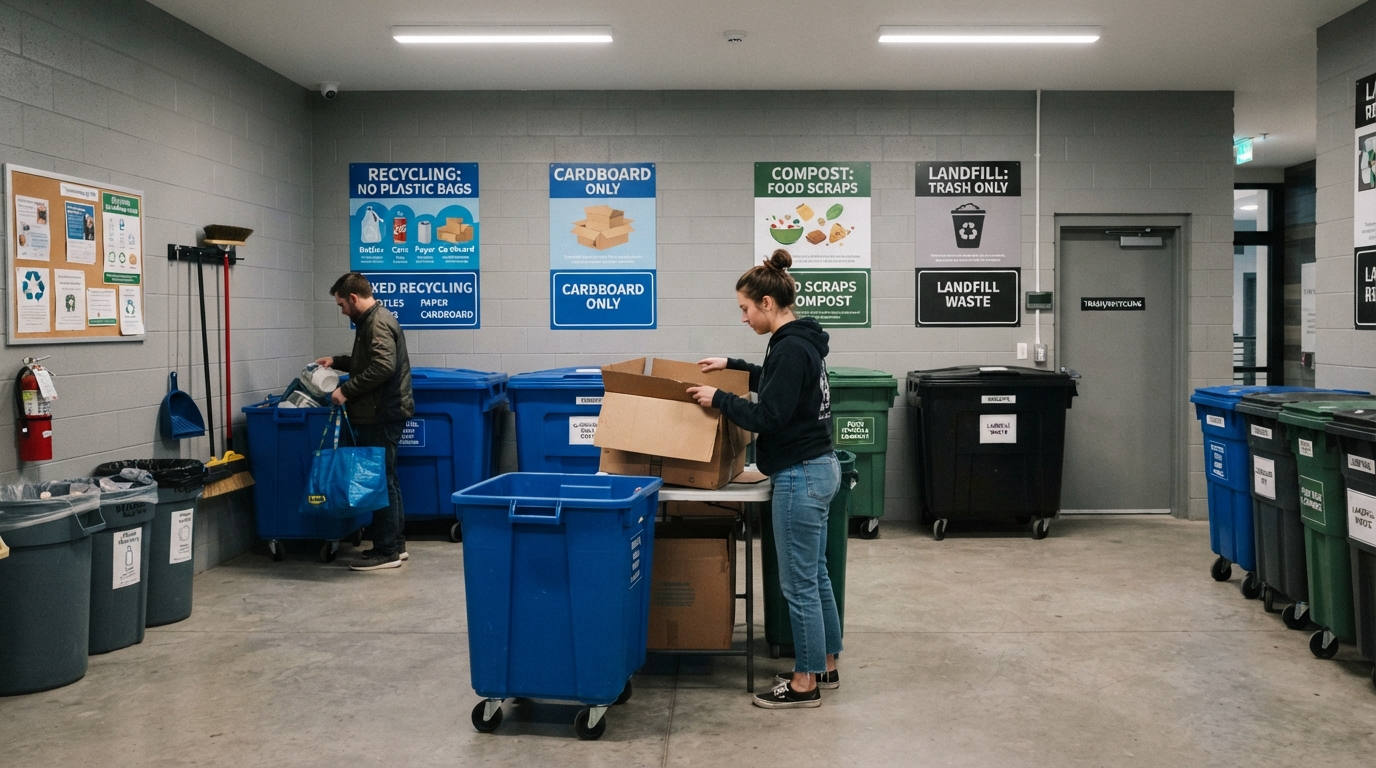
Staging rooms must be engineered to prevent cross-contamination through intuitive spatial choreography. The layout should follow a unidirectional traffic flow that guides the resident sequentially past distinct, well-segregated collection zones:
- check_circle
Zone 1: The Corrugated Cardboard Staging Counter: Positioned immediately near the entrance door to handle bulky delivery packaging before tenants enter cart aisles. - check_circle
Zone 2: Commingled Containers & Clean Fibers: Clearly spaced rolling toters with restrictive cart lids that prevent the insertion of large black plastic bags. - check_circle
Zone 3: Food Scraps & Organics Toters: Heavy-duty, hermetically sealed carts equipped with foot-pedal lid openers to eliminate tactile aversion. - check_circle
Zone 4: Residual Landfill Dumpster: Positioned furthest back in the room, ending the sorting journey so recyclables and compost are evaluated first.
Standardized Industrial Color Coding & Pictorial Signage
Multi-family communities encompass diverse demographic backgrounds and language fluencies. Laminated sheets featuring paragraphs of municipal regulatory text or fine-print legal warnings fail universally because residents make disposal decisions in under 3 seconds. High-performance properties standardize across unmistakable visual markers:
Dedicated to clean rigid plastic bottles/jugs (#1, #2, #5), metal aluminum/steel cans, and clean flattened fiber containers. Must feature direct photographic images of approved items with strict red slashes over plastic grocery bags.
Exclusive to raw food scraps, coffee grounds, and BPI-certified compostable liner bags. Clear graphic callouts highlighting zero tolerance for plastic utensils, pet waste, or plastic packaging.
Reserved strictly for non-recyclable domestic items: dirty takeout wrappers, chip bags, bathroom toiletries, and non-compostable packaging. Kept physically separated from clean fiber carts.
All signage must be mounted at universal eye level (56 to 62 inches from finished floor) directly on the wall behind the corresponding bins, with matching durable decal stickers adhered to the bin lids themselves. Signage should highlight no more than 4 to 5 core accepted items alongside clear photographic callouts of the "Top 3 Forbidden Tanglers": flexible plastic shopping bags, greasy pizza boxes, and rechargeable batteries.
Managing the Move-In / Move-Out Avalanche: Bulky Waste and Cardboard Surges
The regular operational rhythm of an apartment community is violently disrupted during seasonal lease turnovers. During peak turnover windows—particularly end-of-month intervals and the major university turn periods of August and September—waste volumes spike by upwards of 400%. The two predominant categories behind this crisis are Old Corrugated Containers (OCC) from e-commerce delivery and abandoned bulky items such as mattresses, particle-board desks, and broken electronics.
The Volumetric Hazard of Unflattened Cardboard
A single intact 24x18x18-inch moving box consumes nearly five cubic feet of dumpster space while contributing less than two pounds of actual mass. When arriving tenants fail to break down shipping cartons, an 8-yard commercial front-load recycling dumpster fills to overflowing within hours, despite carrying only 15% of its allowable weight capacity. Subsequent tenants, finding the bin choked with cardboard domes, pile their loose refuse onto the floor, blocking access and creating severe life-safety and fire egress hazards.
To eliminate cardboard bridging, property managers must install a dedicated Breakdown Station in high-traffic packaging intake zones (such as next to mail lockers or inside loading docks). Outfitting this station with a stainless steel breakdown worktable, wall-mounted safety-sheathed utility knives, and heavy-duty vertical wire cage toters encourages residents to flatten boxes immediately upon parcel collection. Flattened cardboard stacked vertically in slotted toters achieves up to a 500% density improvement over loose unflattened boxes.
Mitigating Bulky Item Abandonment
Abandonment of mattresses, upholstered couches, and obsolete flat-screen televisions stems from logistics friction. Tenants attempting to vacate on tight deadlines discover that municipal curbside bulk pickup requires multi-day advance reservations or municipal permits. Faced with steep moving-truck hourly fees, they dump bulky furniture into the communal trash enclosure under cover of night.
Progressive multi-family properties neutralize bulky dumping through structured operational frameworks:
- check_circle Striped Yellow Departure Bays: Designate a high-visibility, 10×12-foot staging footprint on the loading dock floor painted with yellow diagonal epoxy striping, clearly labeled “Scheduled Bulky Departure – Resident App Reservation Required.”
- check_circle Quarterly Flat-Rate Roll-Off Sweeps: Contract with commercial haulers for scheduled 30-yard open-top roll-off dumpsters placed on property during peak turnover weekends, funded via small common maintenance allocations.
- check_circle Circular Donation Alliances: Partner with local charity fleets (such as Habitat ReStore, Goodwill, or local housing shelters) to establish quarterly on-site donation collection pods for functional furniture and usable household wares.
Overcoming Tenant Apathy: Resident Onboarding and Contamination Audits
Engineering ideal staging enclosures and procuring color-coded carts will achieve little if tenants lack individual engagement. In a high-density community, tenants easily succumb to the "bystander effect": assuming someone else will correctly sort the waste, or concluding that their individual effort is negated by a negligent neighbor. Building institutional zero-waste compliance requires establishing consistent onboarding protocols and transparent feedback loops.
The Move-In Welcome Sorting Kit
Behavioral patterns are formed within the first seventy-two hours of occupancy. When a new resident signs their lease, property managers should furnish a physical "Eco-Onboarding Kit" rather than burying waste guidelines in a 60-page PDF handbook. This kit must include:
- check_circle
A durable, branded 3-compartment folding tote bag (Fibers, Containers, Landfill) designed for easy carrying from the unit to the staging room. - check_circle
A laminated, magnetic sorting cheat-sheet designed to live on the resident’s refrigerator, detailing accepted materials and exact room locations. - check_circle
An explicit acknowledgment form stipulating contamination fee pass-through bylaws and bulk disposal procedures.
Public Waste Scorecards & The Floor Champion Model
Rather than relying on punitive private warnings, properties achieve superior compliance through transparent collective accountability. Facilities should publish a monthly "Community Logistics Scorecard" displayed on lobby informational displays, elevator screens, and resident portal dashboards. The scorecard reports exact monthly diversion rates, municipal landfill weight totals, and specific contamination surcharges deducted from the building's maintenance fund.
Pairing this data with a volunteer "Floor Champion" network transforms passive management into active community stewardship. Floor Champions act as peer contacts on each residential corridor, conducting casual weekly two-minute visual spot-checks of common sorting spaces, distributing welcome totes to incoming neighbors, and celebrating building diversion milestones at annual HOA assemblies.
Municipal Mandates and Property Management ROI: Avoiding Surcharges
Many property executives treat waste management as an unavoidable, fixed overhead utility expense. In operational reality, waste hauling is a highly volatile operational expenditure directly tied to building net operating income (NOI) and overall capitalization value. Across North America, municipal regulations and commercial haulers have aggressively shifted from passive collection to automated fee enforcement.
AI-Equipped Hauler Scanners and Instant Penalties
Major national waste haulers have retrofitted commercial front-load collection fleets with optical hopper cameras and AI machine-vision algorithms. As the hydraulic lift tips a multi-family recycling dumpster into the truck hopper, optical sensors scan the falling contents in real-time. If the algorithm detects plastic trash bags, construction debris, or food contamination above a calibrated threshold, high-resolution cameras capture time-stamped visual evidence, geo-tag the incident, and automatically assess a contamination surcharge ranging from $175 to $450 per contaminated lift on the monthly property invoice.
The Direct Fiduciary Math of Clean Streams
Consider a standard 250-unit residential multi-family complex generating forty cubic yards of waste per week across four 8-yard dumpsters. Chronic recycling contamination that converts two recycling pulls per week into penalized solid-waste rates results in over $36,000 in unnecessary annual hauling surcharges. By investing approximately $4,500 in heavy-duty bilingual signage, breakdown counters, resident onboarding totes, and floor-level audit protocols, the property completely eliminates recurring penalties while lowering hauling haul frequencies through improved cardboard compaction.
At a standard commercial real estate capitalization rate of 5.5%, generating $36,000 in annualized utility operational savings immediately adds more than $654,000 in capitalized building asset valuation. Implementing institutional multi-family zero-waste protocols is not merely an environmental exercise—it represents essential fiduciary risk mitigation.
Frequently Asked Questions (FAQ)
How can property managers prevent plastic trash bags in recycling dumpsters?
Is it legal for landlords to pass hauling contamination surcharges to tenants?
What is the recommended ratio of recycling carts to trash dumpsters in high-rises?
How should high-density apartment communities manage resident food waste composting?
verified_user
Key Takeaways
5 Operational Imperatives for Multi-Family Zero-Waste Compliance
Key Takeaways
5 Operational Imperatives for Multi-Family Zero-Waste Compliance
1
2
3
4
5
Cardboard Boxes & Amazon Mailers: Bubble Padded vs. Paper Padded
Flattening shipping boxes, peeling adhesive shipping labels, and separating plastic bubble liners from paper envelopes for curbside acceptance.