The Standard Diversion Formula & The Weight vs. Volume Deception
In corporate ESG declarations and municipal permit renewals, few metrics are as frequently misrepresented as the facility diversion rate. Waste collection haulers routinely furnish commercial accounts with monthly "Diversion Summary Reports" calculated entirely on cubic yard container volume conversions rather than direct gravimetric measurement.
Because uncompacted cardboard occupies immense volumetric space relative to its true mass, and wet organic food residual is exponentially denser than loose municipal solid waste (MSW), volumetric estimates typically artificially inflate your perceived environmental performance by 22% to 41%. To satisfy ISO 14001, GBCI TRUE Zero Waste certification, or SEC Scope 3 emissions screening, your diversion accounting must rely solely on calibrated scale mass tickets.
Where Total Waste Generated Mass = Diverted Mass + Landfilled Mass + Incinerated Mass. All inputs must utilize identical mass units (either pounds or metric tons), audited directly from certified weigh scale manifests.
Defining Waste Streams for Credible Calculation
A reliable baseline calculation begins at the dock doors with systematic categorization of all post-industrial and commercial residual streams. When auditing an operating campus, items cannot simply be grouped into "trash" and "single-stream." Every discrete discharge vector requires individual weight documentation:
Baled Old Corrugated Cardboard (OCC 11), Kraft packaging, and sorting sorted office paper (SOP). Quantified via mill invoice receipts or certified dock scale slips.
Commercial kitchen food prep trimmings, cafeteria post-consumer scraps, coffee grounds, and BPI-certified compostable packaging routed to anaerobic digestion or composting.
Broken GMA heat-treated pallets returned to core rebuilders or chipped offsite for bio-mulch. Counted as direct mechanical reuse or material recycling.
R2 or e-Stewards certified processing tickets for circuit assemblies, server hardware, and battery chemistries, handled completely distinct from trash roll-offs.
The Residual Baseline: True residual Municipal Solid Waste (MSW) constitutes everything sent to standard roll-off compactors or transfer trailers bound directly for Subtitle D landfills. It must not be mixed with hazardous waste streams, which are regulated under separate RCRA manifests.
Account for Contamination & Residual Rejection
Perhaps the most critical engineering failure in corporate sustainability metrics is the conflation of gross collection mass with net diverted mass. When a 30-yard compactor of comingled plastics and paper leaves your loading dock, the hauler weigh ticket indicates the total weight picked up. However, upon discharge at the Materials Recovery Facility (MRF), outbound contamination is sorted out and hauled straight to the landfill.
North American municipal recovery facilities record an average outbound processing residue between 15% and 25%. If your facility dispatches 100 metric tons of mixed recycling with an audited contamination rate of 18%, claiming 100 metric tons of diversion represents a non-compliant audit error of 18 tons.
Always inspect monthly hauler invoices for "Contamination Surcharges" or "Down-Grade Deductions." If your vendor penalizes your load with an off-spec charge-back, that portion of the tonnage was discarded into the landfill and must be subtracted immediately from your diverted numerator.
Data Collection Protocols & Weigh Scale Manifests
Rigorous environmental audits demand verifiable data lineages. Relying on customer support call centers for quarterly estimates leaves companies open to greenwashing scrutiny. Deploy the following physical verification standards:
Every individual pull from your dock must be corroborated with an automated weighmaster ticket stating the Gross Weight, Tare (empty truck/box) Weight, and Net Waste Weight with exact timestamps.
Compactor tare weights gradually increase over time due to hydraulic fluid, floor wear plates, and compacted residue build-up behind the ram face. Request annual dry tare weigh-ins of your stationary units.
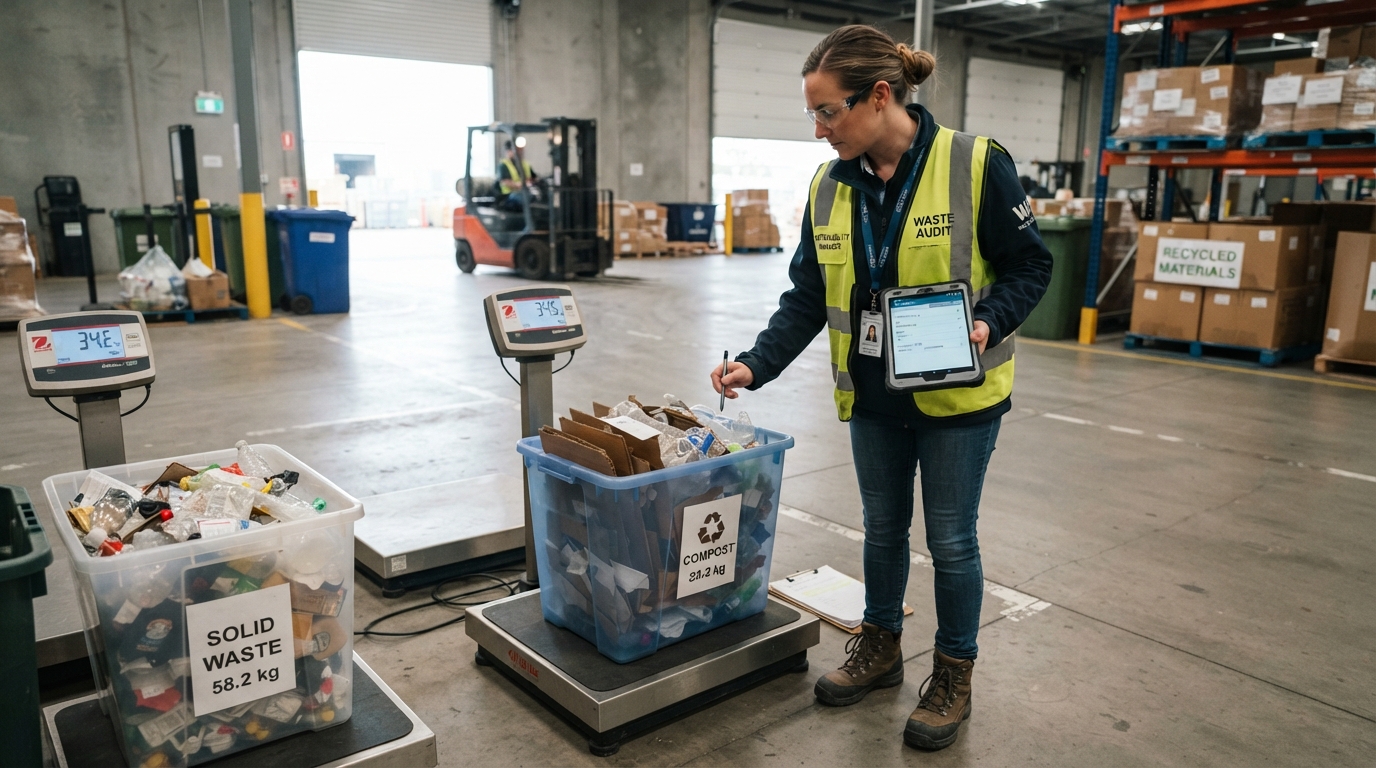
Conduct semi-annual hand-sort audits. Intercept a representative sample of outgoing MSW bins, sort items across 12 standard material categories, and weigh them on calibrated platform scales to determine upstream capture efficiency.
Step-by-Step Practical Calculation Walkthrough
Follow this calibrated procedure to derive an audit-proof facility diversion baseline for any designated period (e.g., 30 calendar days or trailing twelve months):
Aggregate all scale tickets for all containers leaving your facility between the 1st and last day of the audited calendar month. Catalog tickets into two ledger columns: Diverted vs. Landfill.
Calculate your gross diverted sum. For example: 42,000 lbs of Cardboard + 14,500 lbs of Pallet Wood + 8,200 lbs of Commercial Compost + 1,800 lbs of Metal = 66,500 lbs Gross Diverted Mass.
Extract all certified net weigh tickets from your MSW compactors and open-top trash dumpsters. Example: 3 pulls totaling 31,400 lbs Landfill Mass.
Deduct the verified MRF residue factor (e.g., 10% on mixed commingled). Adjusted Diverted Mass = 66,500 - (0.10 × 42,000) = 62,300 lbs. Total Generated Mass = 62,300 lbs + 31,400 lbs = 93,700 lbs.
Diversion Rate % = (62,300 ÷ 93,700) × 100 = 66.48% True Diversion.
Benchmark efficiency by calculating waste intensity metrics: Total Generation ÷ Full-Time Equivalent (FTE) staff, or Generation Mass per 1,000 sq. ft. of active warehouse space.
Aligning with Reporting Frameworks
Enterprise facilities are increasingly beholden to international disclosure mandates. Aligning your arithmetic with prevailing benchmarks ensures seamless verification:
Demands a minimum 90% overall diversion from landfills and incinerators for 12 consecutive months. Thermal WTE without material recovery does not count.
Requires corporations to report waste generation broken down into three mandatory categories: prepared for reuse, recycled, and other recovery operations.
Requests quantified material balances to verify Scope 3 upstream transport and downstream end-of-life processing emissions factors.
assignment_turned_in
Executive Summary: Key Takeaways
Executive Summary: Key Takeaways
Essential operational rules for plant directors, procurement managers, and environmental compliance engineers:
1
2
3
4
5
Frequently Asked Environmental Compliance Questions
Does waste-to-energy (incineration) count toward a legitimate diversion rate?
How often should a commercial facility conduct a physical waste audit?
What should we do if our hauler only bills by container volume instead of weight?
How does construction and demolition (C&D) waste affect our facility's baseline score?
Setting Up Clear Multi-Stream Sorting Stations in Office Buildings
Eliminate under-desk waste cans and replace them with intuitive centralized recycling stations utilizing standardized iconography, restrictive lid apertures, and visual color rules.