
Commercial property managers, executive facility directors, and outpatient clinical administrators face severe statutory liabilities when drawing the line between municipal solid waste and Regulated Medical Waste (RMW).
As corporate wellness rooms, flu shot kiosks, dental practices, and executive concierge health suites proliferate across Class-A commercial environments, failure to segregate bloodborne pathogens and sharps triggers immediate OSHA citations, civil penalties from the Department of Transportation (DOT), and catastrophic workers' compensation exposures for janitorial teams.
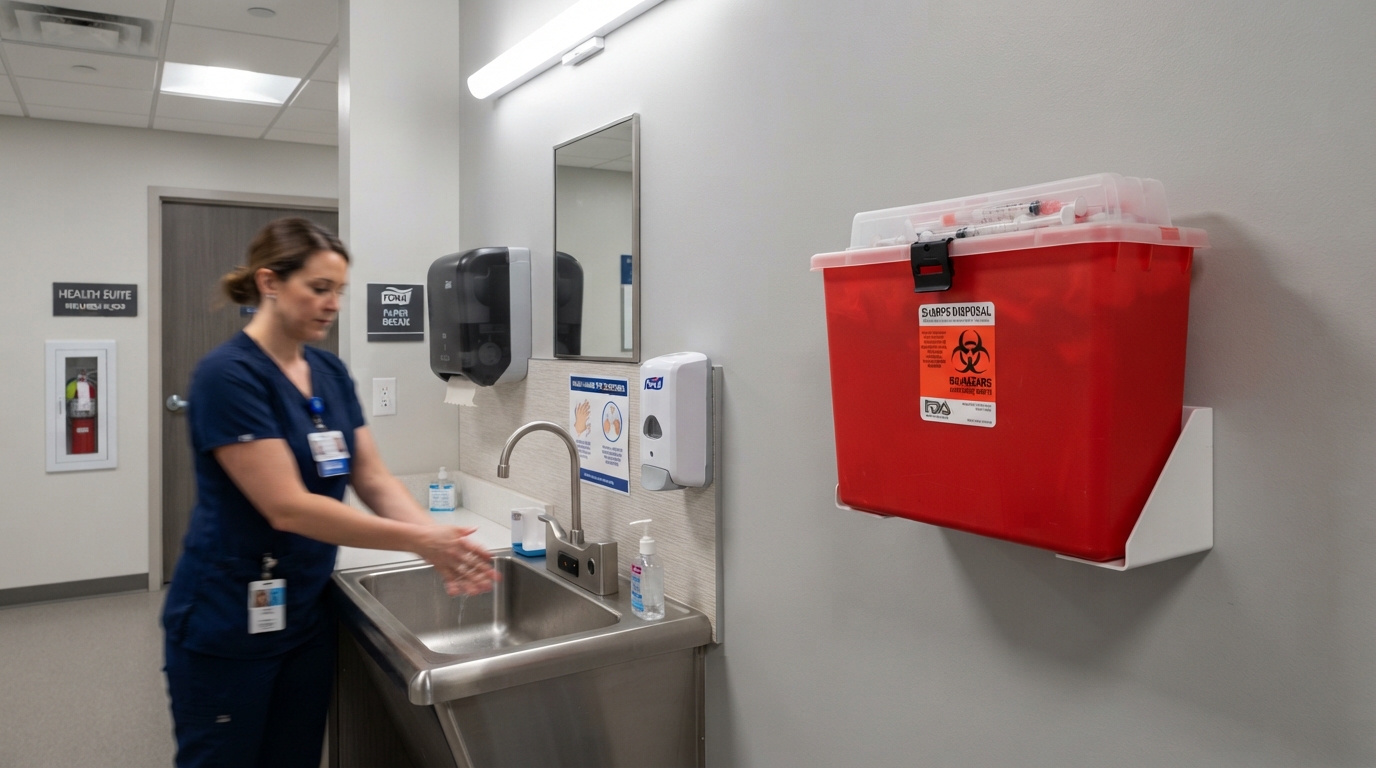
Regulatory Classification: What Counts as Regulated Medical Waste (RMW) in Commercial Settings
One of the most persistent, expensive operational errors inside multi-tenant office complexes and private ambulatory suites is the improper classification of waste streams. Regulated Medical Waste (RMW), commonly referred to as biohazardous waste or red-bag waste, is legally governed by OSHA 29 CFR 1910.1030, EPA municipal frameworks, and state public health statutes. Not all waste containing bodily fluid qualifies as RMW; conversely, treating general commercial trash as biohazard exponentially inflates hauling expenditures by up to 800% per pound.
The Saturated Fluid Standard vs. De Minimis Office First-Aid
According to OSHA enforcement instructions, items that are merely smeared, dried, or spotted with small amounts of blood—such as typical adhesive bandages used for paper cuts, standard facial tissues, or commercial feminine hygiene products deposited in restroom sanipods—do not meet the threshold of Regulated Medical Waste. These items are deemed regular municipal solid waste and may be disposed of via standard compaction, provided they are bagged securely.
In sharp contrast, any absorbent material that is saturated to the point that it would release liquid or semi-liquid blood if compressed, flaked, or handled during transport must legally be classified as RMW. This includes blood-saturated surgical gauze from an in-office dental extraction, saturated cotton rolls, liquid vials containing whole blood or spinal fluids from an on-site occupational phlebotomy lab, and microbiological cultures. Crucially, all sharps are automatically designated as RMW regardless of whether blood is visible.
Sharps Disposal Infrastructure & FDA-Cleared Containers
Sharps represent the absolute highest vector for bloodborne pathogen transmission—specifically Hepatitis B (HBV), Hepatitis C (HCV), and Human Immunodeficiency Virus (HIV)—to facilities management and custodial contractors. Under federal guidelines, any device with acute rigid corners, edges, or protuberances capable of cutting or piercing skin must be secured in an FDA-cleared containment system.
Container Geometry and Wall-Mounting Elevations
Makeshift plastic containers, milk jugs, or non-rigid bins are prohibited under OSHA enforcement and state public health mandates. FDA-cleared sharps units are manufactured from heavy-duty, puncture-resistant polymer with leak-proof sides and bottoms. They must bear the universal biohazard glyph and be tinted vivid fluorescent orange or scarlet red.
In wellness suites, walk-in employee clinics, and tenant restrooms equipped with needle drops, sharps containers must be rigidly mounted to the wall. The National Institute for Occupational Safety and Health (NIOSH) strictly mandates a vertical installation window between 52 and 56 inches from the finished floor to the container opening. This specific vertical clearance ensures the aperture is visible to standing healthcare staff and wheelchair-bound users without requiring upward reach or blind overhead deposits.
Preventing Needle Stick Recoil and Overfill Traps
Never allow sharps receptacles to exceed the permanent manufacturer fill line—strictly calculated at 75% total capacity. When a container exceeds 3/4 full, internal spring tension, needle friction, and stacked syringes create violent mechanical rebound accidents. Modern commercial clinics must institute daily custody inspections and lock the tamper-resistant rotating lids the instant contents intersect the 3/4 marker line.
Never bend, recap, shear, or manually remove needles from disposable syringes prior to disposal. Modern safety-engineered sharps devices feature integrated passive sliding shields or thumb-activated hinges that must be actuated immediately post-use, directly prior to one-handed vertical deposit into the receptacle.
Bloodborne Pathogens Standard (OSHA 29 CFR 1910.1030) Compliance
OSHA's Bloodborne Pathogens standard imposes unequivocal legal responsibilities on commercial employers and building management firms whose personnel face reasonably anticipated contact with blood or other potentially infectious materials (OPIM). This mandate extends not only to licensed nurses or dental hygienists, but directly to internal property engineers, day porters, and evening custodial contractors.
The Written Exposure Control Plan (ECP)
Every facility with clinical or concierge wellness tenants must preserve an active, site-specific written Exposure Control Plan. This operational ledger must identify every job classification with potential exposure, detail engineering controls (such as contactless waste chutes and self-sheathing scalpels), outline universal precautions, and undergo mandatory documented annual review. Failure to update an Exposure Control Plan following an incident yields immediate regulatory penalties exceeding $16,000 per violation.
Immunization Schedules & Post-Exposure Medical Evaluation
Employers must make the full Hepatitis B vaccination series accessible to all at-risk operational staff at zero cost, administered at a reasonable time and place within 10 working days of initial occupational assignment. If an accidental percutaneous puncture or mucosal splash occurs, immediate protocols dictate running warm water and antimicrobial soap over the lesion for 15 minutes, followed by an immediate confidential medical evaluation, source-patient serology assessment where legally permissible, and baseline anti-HBs or HIV post-exposure prophylaxis (PEP) initiation within two hours.
Spill Response Protocol for Commercial Janitorial Teams
When blood, vomit, or infectious clinical fluids breach containment onto commercial carpets, stone lobby pavers, or clinical vinyl composition tile (VCT), standard janitorial mopping techniques are legally prohibited. Standard string mops cross-contaminate municipal floor surfaces and aerate microscopic pathogens into common HVAC air distribution ducts.
EPA-Registered List B & List E Disinfectants
Custodial personnel must exclusively apply an EPA-registered hospital-grade disinfectant displaying documented tuberculocidal and virucidal efficacy against Hepatitis B and HIV. Commercial sodium hypochlorite solutions (bleach) prepared at a 1:10 dilution (approximately 5,000 to 6,000 ppm available chlorine) represent an approved baseline, provided the chemical is mixed fresh within 24 hours of application and maintains a mandatory wet contact dwell time of no less than 10 continuous minutes.
Spill Kit Deployment Sequence
Standard biohazard spill kits stationed across commercial premises must contain chloroisocyanurate or cross-linked sodium polyacrylate encapsulating powder. The responder must don heavy nitrile gloves, eye-protection goggles, fluid-resistant booties, and an impermeable apron. Fluid is gently cordoned off and covered with absorbent polymer crystals to convert the fluid mass into an immobile semi-solid gel within two minutes. The gel is scooped using non-metallic disposable scrapers directly into an approved red biohazard bag, followed by primary disinfection, 10-minute saturation dwell, and secondary wiping with lint-free microfiber towels.
Packaging, Red-Bag Liners & State Storage Duration Regulations
Secondary containment of soft medical waste relies heavily on certified film liners that conform to rigorous American Society for Testing and Materials (ASTM) specifications. Simply utilizing an ordinary red-tinted polyethylene trash bag constitutes a primary DOT violation during public freight transit.
ASTM D1709 & ASTM D1922 Impact Standards
Every primary biohazard liner must possess laboratory-certified tear resistance meeting ASTM D1922 (minimum 480 grams in both parallel and perpendicular directions) and dart impact puncture resistance compliant with ASTM D1709 (exceeding 165 grams). Liners must bear manufacturer stamps validating these metrics alongside the biohazard emblem. Once filled to roughly 80% volume, liners must be cinched using an airtight gathered twist, goose-necked, and secured with heavy-gauge zip-ties or specialized wire closures to prevent vapor leakage under hydraulic pressure.
Storage Temperature and Duration Statutes
Federal and state environmental agencies strictly regulate the length of time biohazard waste can reside inside an on-site waste consolidation room prior to hauler extraction. While low-volume generators (generating under 20 pounds monthly) in states like Texas or Ohio may retain secured waste up to 30 days, strict jurisdictions such as California (under the Medical Waste Management Act) and New York restrict warm ambient room storage to exactly 7 calendar days before mandatory temperature-controlled refrigeration below 45 degrees Fahrenheit (7 degrees Celsius) is legally required.
Vetting Medical Waste Haulers & Manifest Retention
Under federal 'Cradle-to-Grave' doctrine governed by the Resource Conservation and Recovery Act (RCRA) and DOT Hazardous Materials Regulations (49 CFR 172-178), the commercial generator retains perpetual liability for biohazardous waste until certified thermal sterilization or high-heat incineration is executed. Delegating waste to an uncertified or cut-rate transport vendor does not relieve property owners of environmental liability.
The Multi-Part Hazardous Manifest & Certificate of Destruction
Every single dispatch of medical waste must be accompanied by an official non-hazardous/regulated medical waste tracking manifest. This document records generator registration IDs, container tally, gross tare weights, authorized transporter permits, and the designated autoclave or incineration treatment hub. Upon arrival at the treatment terminal, the waste is scanned, sterilized via high-pressure steam autoclave or incinerated, and a formal signed Certificate of Destruction is returned to the generator.
Commercial facility managers must maintain an organized physical or digital compliance binder housing these closed manifests for a minimum statutory retention period of three continuous years (five years under specific joint-commission or state health frameworks). These documents must be readily producible to OSHA or state environmental investigators within 48 hours of formal notice.
Frequently Asked Questions (FAQ)
Authoritative answers to common statutory dilemmas in commercial properties and outpatient facilities.
Does a commercial office building need a medical waste permit if a tenant operates an employee wellness clinic?
Can discarded diabetic needles from office restrooms be collected in standard plastic soda bottles?
What specific certification must a commercial hauler hold to transport biohazardous red-bag waste?
How must janitorial staff disinfect carpet after an accidental bodily fluid spill?
fact_check
Executive Summary: 5 Essential Biohazard Containment Rules
Executive Summary: 5 Essential Biohazard Containment Rules
1
2
3
4
5
Preparing Your Facility for a Surprise Environmental EPA/OSHA Inspection
The ultimate physical walkthrough checklist covering waste manifests, secondary containment integrity, eyewash station logs, and employee training verification binders.