When an unannounced federal or state enforcement officer presents credentials at your gatehouse, the subsequent four hours dictate whether your enterprise navigates a routinely cleared compliance check or endures crippling enforcement actions. Following recent inflation adjustments under the Federal Civil Penalties Inflation Adjustment Act, daily violations under the Resource Conservation and Recovery Act (RCRA) can reach up to $87,855 per violation, per day. Armed with precise, pre-rehearsed opening conference protocols and strict jurisdictional boundaries, industrial facilities can protect worker safety, fulfill environmental reporting mandates, and completely mitigate unjustified escalation.
The First 15 Minutes: Front Desk Protocol & Verification of Credentials
The front desk receptionist, security officer, or guard shack attendant represents the first line of defense during any unannounced regulatory walkthrough. Regulatory enforcement personnel from the EPA, OSHA, or state delegations (such as Cal/OSHA or the Texas Commission on Environmental Quality) frequently exploit unprepared reception staff to initiate visual scans or solicit casual admissions prior to formal entry negotiations.
Actionable Front Gate Standard Operating Procedure:
- check_circle Polite Interception & Sign-In: Direct the visiting compliance officer to sign the standard visitor log, accept personal protective equipment (PPE) requirements, and sign non-disclosure safety waivers typical for any industrial site visitor.
- check_circle Credential Verification: Politely request government-issued photo identification and official inspector business cards. Inspect federal badges closely for EPA Criminal Investigation Division (CID) versus Civil Enforcement distinctions.
- check_circle The Dedicated Holding Room: Immediately escort the inspector to an enclosed, windowless conference room isolated from the active production floor, chemical staging terminals, and loading docks. Never leave an inspector unattended in areas where operations are visible.
- check_circle Internal Alarm Escalation: The receptionist must immediately dispatch an urgent priority notification to the Plant Manager, EHS Director, and designated outside Environmental Legal Counsel. Under established administrative law, requesting a 45-to-60-minute holding window while designated counsel or leadership arrives on-site is deemed reasonable and legally permissible.
The Regulatory Scope: Defining Opening Conferences & Warrant Boundaries
Never permit an inspector to cross into processing yards or industrial suites without conducting a formal Opening Conference. This structured sit-down meeting sets enforceable ground rules, establishes mutual expectations, and clarifies the legal trigger behind the visit.
Clarifying the Inspection Trigger
During the conference, the lead facility representative must directly ask: "What is the statutory basis and explicit scope of today's visit?" Inspections typically fall into three distinct classifications:
Triggered under OSHA § 8(f) or EPA whistleblower provisions. Demand to review the redacted complaint letter before proceeding.
Scheduled initiative driven by NAICS code regional emphasis programs (e.g., secondary lead smelting, chemical logistics).
Involves sworn special agents bearing a judicial warrant. Halt voluntary procedures and immediately defer directly to legal counsel.
If the audit is an unannounced administrative inquiry stemming from a specific odor or chemical venting complaint in Bay 4, you are legally entitled to restrict their physical route directly to Bay 4, avoiding unnecessary exposure of unrelated industrial waste storage infrastructure.
The 5 High-Risk Physical Inspection Hotspots
Regulatory auditors do not wander aimlessly. They gravitate towards areas where common human fatigue causes chronic violations. Ensure internal pre-audit inspections systematically target these five vulnerable operational nodes:
1. Satellite Accumulation Areas (SAAs) & Central Storage Containers
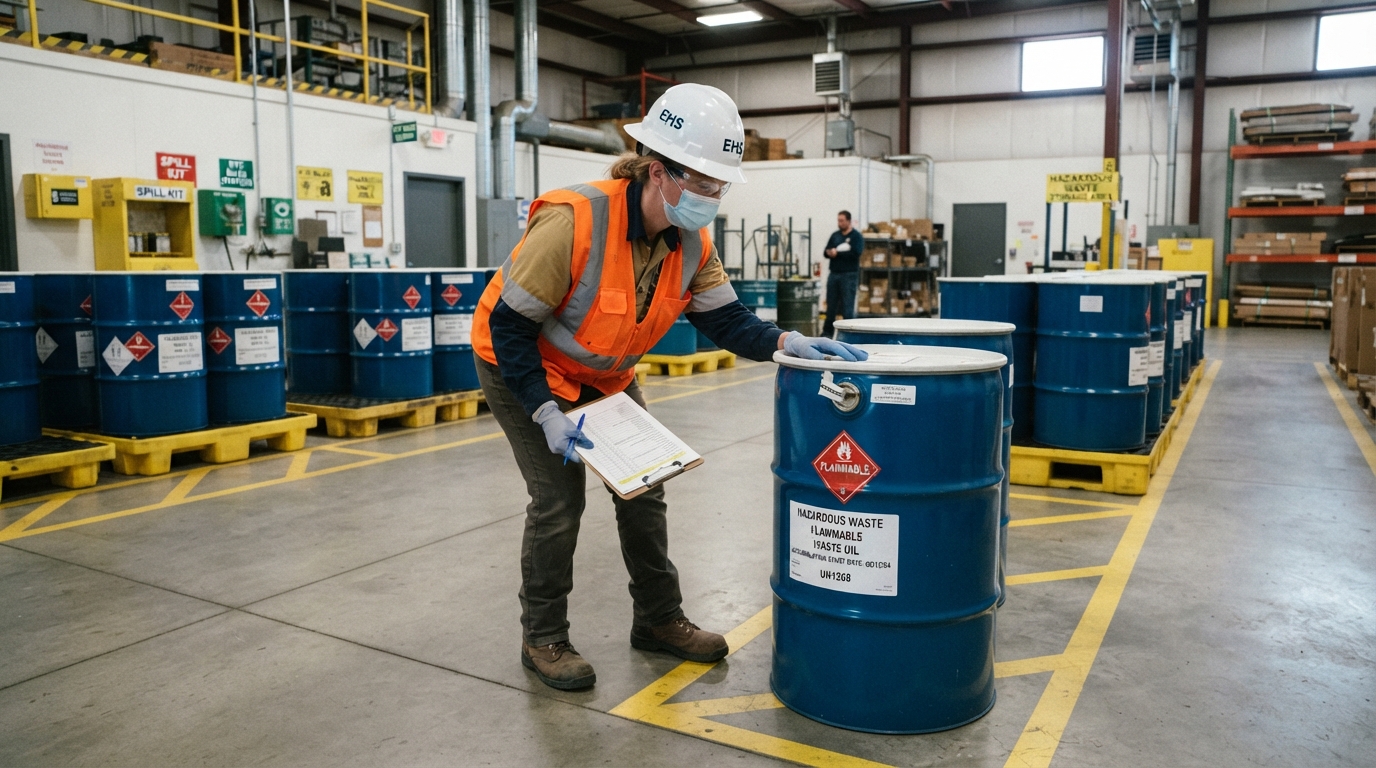
Ensure all containers are marked with the precise words "Hazardous Waste" and indicate hazardous characteristics (e.g., Ignitable, Corrosive, Toxic, Reactive). Check accumulation start dates on every central drum. Accumulating past 90 days for Large Quantity Generators (LQGs) or 180 days for Small Quantity Generators (SQGs) results in immediate Class I penalties.
2. Closed Container Compliance Rule
Drums must remain closed at all times except when adding or removing waste. Funnels with unbolted lock-rings, open ball-valves, loose bung caps, or unlatched lids represent the single most common RCRA citation nationwide.
3. Secondary Containment Integrity & Sumps
Inspectors examine containment basins for cracks, structural failure, chemical corrosion, and accumulated liquid. Sump liquid must be evaluated and pumped immediately; unemptied secondary containment voids the 110% net capacity calculation.
4. Emergency Eyewash & Safety Showers
OSHA inspectors cross-check the weekly operational activation tags on all eyewash stations located within 10 seconds (55 feet) of corrosive chemical and battery charging banks. Obstructed access paths earn rapid serious citation status.
5. Outdoor Stormwater Inlets & Loading Docks
Inspectors scrutinize outdoor dumpster pads, hydraulic compactor oil reservoirs, and exterior drop inlets. Evidence of hydraulic fluid dripping into storm drains or uncovered waste dumpsters without plugs creates severe Clean Water Act liability.
EHS Audit Tip: The One-Finger Closed Container Test for Hazardous & Universal Waste Drums
During plant walkthroughs, EPA enforcement inspectors routinely execute the informal "one-finger tip test" on hazardous waste collection drums and spring-loaded funnels. If an inspector can tilt the lid or funnel lip upward using slight pressure from a single finger, the container is officially deemed non-vapor tight and unsecured under 40 CFR § 262.16(b). Require operators to confirm that all drum ring closures are torqued down and funnel latches click fully closed after every deposit.
The Shadow Protocol: Documenting Every Photo, Sample, and Interview
The golden rule of federal inspections is absolute parity: "Everything they see, you record. Everything they take, you match." Implement an active shadowing protocol from the exact second the inspector crosses the production threshold:
Symmetrical Photography
Equip your EHS escort with a dedicated digital camera. Every time the inspector snaps a photograph, immediately step into the identical position and capture the exact same angle, lighting, and panoramic framing to counteract selective or out-of-context enforcement shots.
Mandatory Split Sampling
If inspectors draw wipe samples, wastewater grab discharges, or soil core samples, request an exact 50/50 split sample. Package and preserve your half using certified chain-of-custody protocols for independent accredited lab re-verification.
When an inspector conducts non-management hourly worker interviews, note that employees have the legal right to request a management representative be present, although they may choose private discussions. For managers and supervisory personnel, plant counsel has the absolute right to be present; supervisors' statements bind the enterprise legally under federal evidence standards.
Essential Document Readiness: The "5-Minute Binder" Rule
Hesitation in producing compliance paperwork signals institutional disorganization to an auditor. Maintaining a physical or cloud-mirrored "5-Minute Binder" readily accessible from the central front desk or safety office signals robust operational discipline:
3 years of signed TSDF return copies (Copy 3) & e-Manifest receipts.
Spill Prevention plan updated within 5 years with professional engineer stamp.
Complete 52-week records of secondary containment and drum inspections.
Previous 5 years of injury and illness reporting and annual postings.
Closing Conference & Post-Inspection Response Strategy
The walkthrough culminates in the Closing Conference. Maintain rigorous emotional and tactical control. While inspectors summarize their tentative field observations, staff must listen attentively, record exhaustive notes, and avoid admitting liability or agreeing that specific conditions constituted legal violations.
If an inspector identifies an immediate, non-systemic issue—such as an open funnel valve on a universal waste drum—remedy it instantly while the inspector remains on-site. Document the immediate fix with a photograph and request that the inspector note immediate corrective action in their preliminary field log. Initiating corrective action within 30 days of receiving a written Notice of Violation (NOV) significantly positions your organization for penalty reductions or full dismissal during informal administrative settlement negotiations.
Frequently Asked Questions
Can a facility legally refuse entry to an EPA or OSHA inspector who arrives without a warrant?
What are inspectors looking for when examining hazardous waste drum bungs and latches?
Are employees required to answer inspector questions without management present?
What is the difference between an informal Notice of Violation (NOV) and an administrative order?
fact_check
EHS Leadership Summary: 5 Core Readiness Directives
EHS Leadership Summary: 5 Core Readiness Directives
1
2
3
4
5
Warehouse Stretch Wrap Recycling: LDPE Film Collection Systems
How logistics facilities aggregate clean Grade A polyethylene film into compact bales that brokers buy directly, cutting general solid waste dumpster fees by up to 28%.