
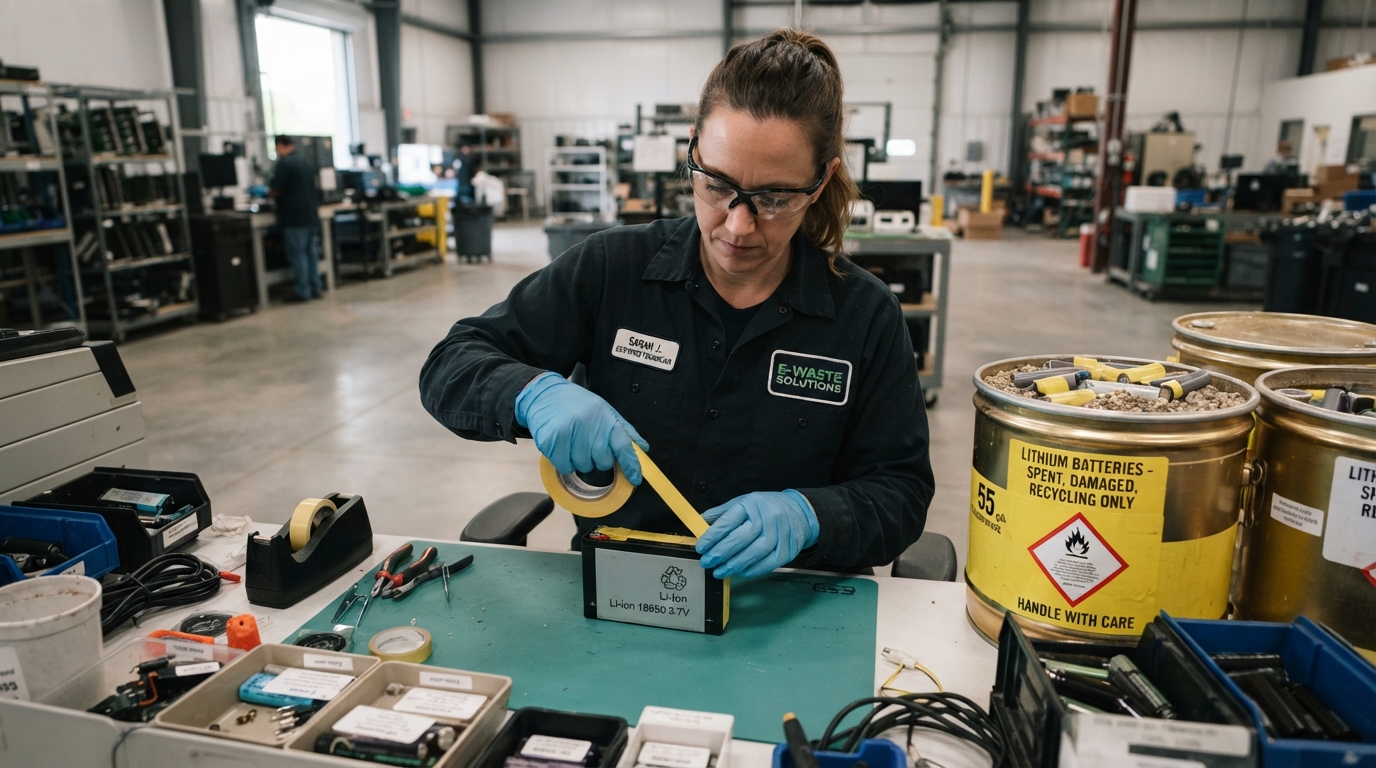
Chemistry & Physics of Lithium-Ion Thermal Runaways
Commercial facilities generate tons of secondary lithium chemistry waste annually through uninterruptible power supply (UPS) banks, corporate mobile devices, power tool fleets, and material handling systems. Unlike alkaline or nickel-cadmium chemistries, lithium-ion battery cells pack volatile organic electrolytes with exceptionally dense oxidizers in tightly stacked polymer envelopes.
Thermal runaway represents an uncontrollable self-heating cascade. Under normal operation, a micrometric microporous separator prevents contact between the graphitic anode and lithium metal oxide cathode. However, internal short circuits trigger an exponential exothermic reaction:
Primary Commercial Initiation Vectors
- Lithium Dendrite Propagation: Repeated rapid charging cycles or storage at sub-freezing temperatures cause microscopic needle-like lithium metallic crystals (dendrites) to grow across the anode. Eventually, these pierce the separator, causing spontaneous combustion even while inactive on a warehouse shelf.
- Mechanical Deformation & Puncture: Rough bulk dumping, pallet compression, or forklift tines penetrating casing jackets compress internal foil layers directly into contact, igniting the organic solvents within milliseconds.
- Overcharging & Incompatible Telemetry: Damaged battery management systems (BMS) feeding incorrect amperage overfill the cathode lattice, triggering severe Joule heating and rapid cell rupture.
Safe Staging and Storage Protocols for Commercial Facilities
Standard warehouse waste collection bins are strictly prohibited for commercial battery recycling programs. When batteries are loose in bins, friction and casual terminal contact across live contacts easily spark fires. Commercial standard operating procedures (SOPs) mandate triple-layer staging isolation before logistical pickup.
verified Terminal Insulation Mandate: Zero Exposed Conductors
Every single multi-cell pack, laptop battery, tool battery, and single-cell unit exceeding 9 volts must have all exposed conductive contacts completely masked using non-conductive, dielectric tape. Standard paper masking tape and porous packing tape are strictly non-compliant under federal hazardous transport guidelines due to hygroscopic moisture absorption and adhesive shear failure.
Engineered Cushioning Agents: Vermiculite vs. PyroBubbles
Commercial collection drums (UN-rated 1A2 open-head steel drums) must be lined with mineral-grade thermal absorption buffers. Traditional expanded vermiculite cushions physical shock and absorbs electrolyte vapor. However, for large server UPS lithium iron phosphate (LiFePO4) or nickel manganese cobalt (NMC) modules, PyroBubbles—hollow borosilicate glass micro-granulates—provide DIN EN 3-7 Class A, D, and F fire suppression. PyroBubbles melt at elevated temperatures around the thermal runaway origin, forming a gas-tight glass matrix that smothers nascent reactions and absorbs molten toxic fluorides.
Class D dry powder fire suppression canisters or certified F-500 encapsulator agent systems must be stationed within 25 linear feet of all battery staging enclosures. Never utilize conventional water pressurized extinguishers or standard ABC dry chemical units directly on open, cascading lithium metal cells.
Handling Swollen, Punctured, or Compromised Cells (DDR/POGs)
Damaged, defective, or recalled (DDR) batteries—frequently characterized by swelling, commonly termed “pillowed” or “pillow of gas (POG)” cases—represent an immediate Category 1 Hazmat emergency on facility premises. The swelling occurs as combustible gases (carbon monoxide, hydrogen, hydrogen fluoride, and ethylene) inflate the casing under localized micro-shorting.
1. Do Not Attempt Charging or Discharging: Never connect diagnostic rigs or attempt power drainage on mechanically swollen or hissing hardware.
2. Physical Isolation: Transfer the swollen unit using non-sparking brass or insulated tongs into an outdoor, ventilated staging vessel. Never store swollen cells inside standard offices, server closets, or main thoroughfares.
3. Thermal Containment Chamber: Submerge the cell into a dedicated steel vessel packed with dry masonry sand, expanded vermiculite, or a specialized fireproof safety containment bag (Lith-Ex containment envelope).
4. Quarantine Radius: Maintain a minimum 30-foot perimeter clearance from combustible materials and primary building egress points while contacting an EPA-certified hazardous waste emergency responder.
Enterprise IT Asset Disposition (ITAD): Chain-of-Custody & Data Security
Retiring corporate IT infrastructure involves dual catastrophic risks: environmental catastrophe via rogue landfill fires and existential corporate liability via data security breaches. Commercial computers, servers, storage area networks (SAN), and smart peripherals contain unencrypted storage chips paired alongside integrated lithium
Modern Enterprise ITAD programs must enforce unbroken chain-of-custody protocols aligned strictly with NIST SP 800-88 Revision 1 (Guidelines for Media Sanitization). Simple factory resets or formatting leaves forensic magnetic and solid-state NAND flash footprints completely accessible to illicit salvage operators.
Solid-state memory cannot be reliably sanitized via legacy magnetic degaussing. ITAD providers must utilize cryptographic erasure (ATA Secure Erase command sets) accompanied by dual-pass physical micro-shredding to particle widths under 2mm to completely disrupt microcode silicon wafers.
Every commercial asset tagged during facility decommission must match barcode scans upon freight loading, transport arrival, and disassembly. Certificates of Destruction (COD) must explicitly enumerate every serial number alongside timestamped video logs of the shredder infeed hopper.
Certified Recycler Vetting: R2v3 vs. e-Stewards
Under the Comprehensive Environmental Response, Compensation, and Liability Act (CERCLA / Superfund), corporate waste generators retain “cradle-to-grave” legal liability for their hazardous waste. If an unvetted local junk collector dumps your company’s lead-soldered circuit boards or cobalt-rich lithium cells into an illegal overseas landfill or domestic waterway, regulators can hold your enterprise financially liable for multimillion-dollar site remediations.
To inoculate corporate directors from downstream environmental liability, facilities managers must restrict contracts exclusively to processors holding third-party accredited credentials:
Administered by Sustainable Electronics Recycling International (SERI), R2v3 focuses heavily on facility data security standards (Core Requirements 7 & 8), process safety management for mechanical shredding, and rigorous downstream vendor tracking down to the ultimate refined smelter output.
Founded by the Basel Action Network (BAN), e-Stewards prohibits the export of non-functional electronic waste and toxic battery sludge to developing nations, forbids the use of prison labor in recycling disassembly lines, and enforces the strictest occupational toxic exposure limits in the sector.
Always require downstream recycling manifests that include certified certified scale weight receipts, fractional recovery certificates, and full environmental insurance policies ($5M–$10M environmental impairment liability coverage).
DOT Special Permits and Transport Compliance (49 CFR § 173.185)
Transporting commercial lithium battery scrap over public highways without adhering to Title 49 of the Code of Federal Regulations triggers civil penalties exceeding $89,000 per violation day from the Pipeline and Hazardous Materials Safety Administration (PHMSA).
Standard commercial shipments must display the UN 3480 (Lithium-ion batteries) or UN 3481 (Lithium-ion batteries packed with equipment) class 9 diamond hazard labels. Each freight package must feature:
- The standardized black-and-white striped Class 9 Miscellaneous Dangerous Goods diamond placard with battery silhouette.
-
The designated text marking:
LITHIUM ION BATTERIES - FOR DISPOSAL / RECYCLING. - A 24-hour certified emergency telephone response number (e.g., CHEMTREC or INFOTRAC) printed legibly on the bill of lading and master packaging exterior.
- For known damaged, defective, or recalled (DDR) batteries, special DOT-SP (Special Permit) packaging featuring pressure-venting closures and certified non-combustible internal insulation is legally non-negotiable.
Frequently Asked Compliance Questions
Can commercial facilities tape battery terminals with standard masking tape?
What constitutes a reportable lithium battery fire under OSHA regulations?
How long must ITAD certificates of destruction be retained for corporate audits?
What are the legal liabilities of unmonitored employee battery drop boxes?
verified
Key Takeaways & Operational Safety Rules
Executive Summary for EHS Directors & Facility Managers
Key Takeaways & Operational Safety Rules
Executive Summary for EHS Directors & Facility ManagersCardboard Balers vs. Open Dumpsters: Which Saves More?
Breaking down the volume thresholds where investing in a vertical or horizontal baler pays for itself versus paying weekly open-top pull fees and loose cardboard contamination charges.