Volume Reduction Factor: 10:1
Uncompacted corrugated containers occupy an average bulk density of only 30 to 50 lbs per cubic yard inside standard front-load dumpsters. High-pressure hydraulic balers compress identical material to over 500 lbs per cubic yard, capturing substantial hauling cost arbitrage while transforming direct waste expenses into marketable secondary fiber commodities.
The True Cost of Air: Why Loose Cardboard Hauling Drains Margins
In industrial warehousing, fulfillment, and light manufacturing environments, corrugated cardboard (OCC) is the single largest volumetric waste stream generated daily. However, managing this volume using standard commercial waste containers—typically 8-cubic-yard front-load bins or 30-to-40-yard roll-off open dumpsters—introduces an unsustainable structural inefficiency colloquially known in MRF operations as “paying to haul atmospheric air.”
When commercial boxes are tossed into an open container without mechanized compaction, structural voids and folded corners resist settlement. An 8-yard dumpster filled with hand-flattened cartons rarely achieves a gross net weight exceeding 320 pounds. Yet, commercial solid waste haulers assess invoices based on container pull fees, disposal tip fees, variable diesel fuel surcharges, container rental fees, and environmental regulatory compliance fees.
Under this model, facility managers are effectively paying for dozens of dedicated truck dispatches each month solely to transport empty geometric space. Furthermore, unbaled cardboard stored outdoors absorbs rain and ambient moisture, increasing tare weights at landfill weigh stations while simultaneously destroying any secondary resale value. If uncompacted cardboard overflows, haulers trigger punitive overage surcharges and blocked-access penalties that rapidly inflate monthly facility operating expenditures.
Vertical vs. Horizontal Balers: Footprint, Mill Specs & Engineering
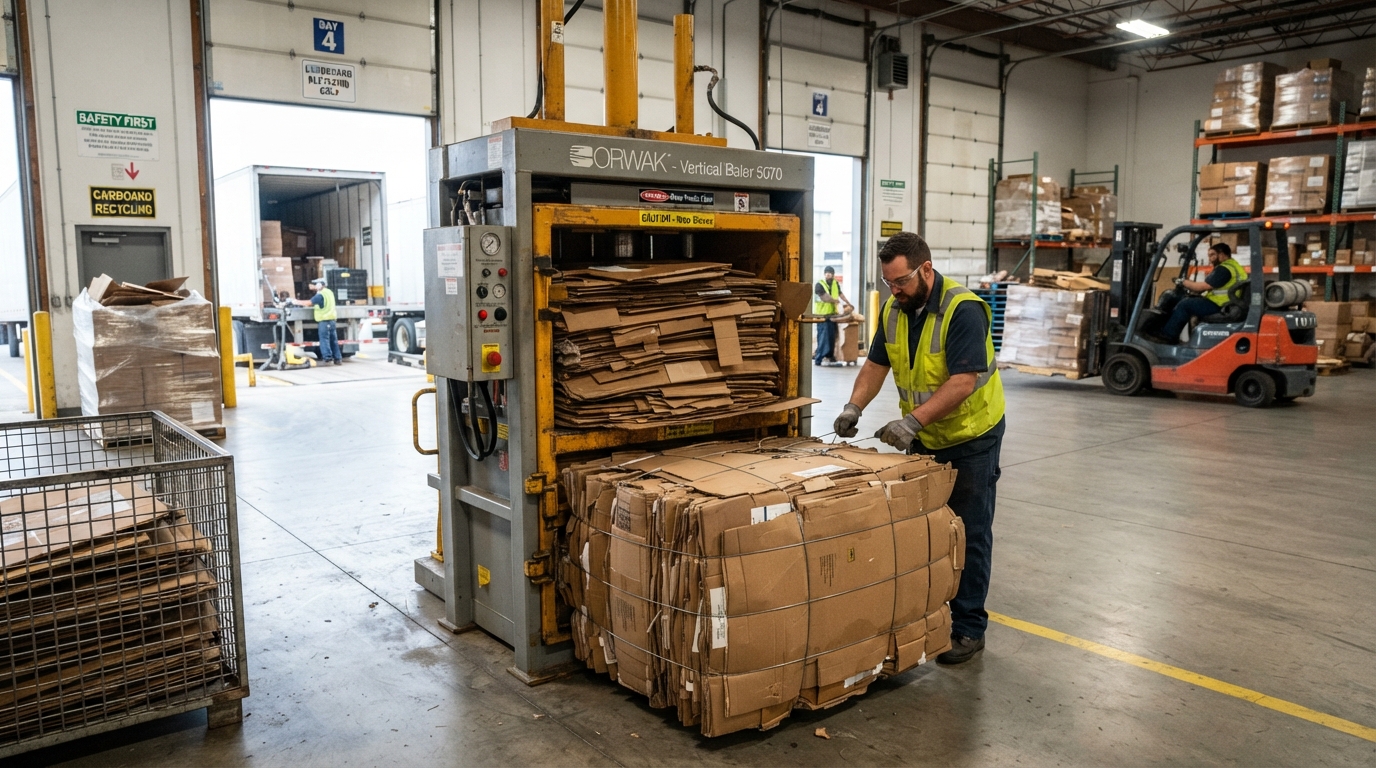
Selecting the appropriate on-site compaction hardware requires matching internal box volume generation against plant floor space, ceiling clearance, and electrical supply capabilities. Industrial balers fall broadly into two mechanical architectures: vertical downstroke units and horizontal continuous or closed-door balers.
Vertical Downstroke Balers (V60 Series)
Vertical balers operate with a vertical hydraulic cylinder compressing downward into a rectangular chamber. The industry gold standard is the 60-inch vertical baler (e.g., standard V6030 format). These units require a compact ground footprint—typically 78 inches wide by 42 inches deep—making them ideally suited for interior staging corridors, receiving loading docks, and back-of-house storage areas.
Standard vertical units operate on 208V, 230V, or 480V 3-phase electrical feeds, though single-phase options exist for lower-duty applications. Operating cycles range from 45 to 60 seconds per ram stroke. Most crucially, a 60-inch vertical baler yields “mill-size” dimensions: 60 inches wide, 30 inches deep, and 48 inches high, with compressed weights ranging between 900 and 1,150 lbs depending on platen hydraulic pressure ratings (typically 50,000 to 62,000 lbs of total ram force).
Horizontal Auto-Tie and Closed-Door Systems
When corrugated generation surpasses 80 tons per month, manual vertical loading becomes a labor bottleneck. High-throughput distribution hubs require horizontal balers equipped with continuous conveyors, air-pneumatic feeding systems, or integrated cart tippers. While requiring extensive linear floor plans (often 25 to 40 feet in length) and high-amperage 480V service, horizontal systems achieve cycle times under 15 seconds, ejecting dense 1,500-to-2,000-pound bales continuously with automated wire-tying mechanisms.
The Economics of Mill-Size Bales: Flipping Haul Expenses into Revenue
The fundamental economic transformation between open dumpsters and on-site balers lies in commodity qualification. Paper mills, pulp manufacturers, and export brokers do not procure loose cardboard; they purchase standard “OCC Grade #11” or “OCC Grade #12” (sorted residential and industrial corrugated) bundled specifically into stackable, truckload-optimized mill-size bales.
A standard 53-foot dry van trailer can legally transport between 40,000 and 44,000 lbs of freight. With mill-size bales weighing ~1,000 lbs each and sized at 60" x 30" x 48", logistics personnel can double-stack precisely 40 to 44 bales per trailer without exceeding federal gross axle weight maximums.
When loose cardboard is dumped into a mixed waste or loose recycling dumpster, the customer pays $200 to $450 per haul plus landfill tipping fees, resulting in a 100% net capital loss. In contrast, accumulating 40 mill-size bales allows the facility to schedule full trailer pickups with regional recycling mills or fiber aggregators. Depending on monthly PPI (Pulp & Paper Index) and secondary fiber market rates, high-grade OCC commands rebates ranging from $60 to $160+ per ton FOB dock. The waste stream immediately pivots from an operating expense liability to an audited balance sheet revenue credit.
Labor & Operational Workflows: Breakdown Hours vs. Baling
Facility financial analyses frequently overlook human labor friction when assessing open waste dumpsters. To fit uncompacted boxes into an 8-yard bin, receiving staff and stock associates must slice packing tape with utility knives, stomp flat folded edges, and push bulky boxes manually into the container.
Time-motion audits indicate that a typical retail warehouse associate spends between 45 and 90 seconds manually breaking down, collapsing, and walking an oversized triple-wall shipping box to an exterior loading pad dumpster. For a facility unloading 300 boxes daily, that equates to approximately 4.5 employee hours spent solely on cardboard degradation every single shift. At a fully burdened labor rate of $24/hour, manual cardboard handling costs exceed $3,200 per month in unrecovered internal productivity.
With a vertical baler stationed directly adjacent to inventory de-trashing stations, whole, unopened boxes are thrown immediately into the loading chamber. The operator closes the interlocked safety gate and pushes the cycle button; hydraulic platen cylinders compress the cartons in 50 seconds while the worker continues primary receiving tasks. When the chamber is full (indicated by an optical sensor or mechanical trip lever), threading baling wire and activating the semi-automatic bale ejector takes a single trained operator approximately 8 to 10 minutes total.
Hauling Frequency Reductions: Slashing Pull Fees and Carbon Footprints
Consider a regional distribution facility producing 16 tons of cardboard per month. In an open-top dumpster environment, loose cardboard density rarely exceeds 40 lbs per yard. To evacuate 32,000 lbs of loose bulk, the facility requires approximately 800 cubic yards of container capacity monthly.
Dividing 800 yards across an 8-yard front-load dumpster mandates 100 separate hauler empties per month—demanding daily or twice-daily truck visits. Even utilizing two 30-yard open-top roll-off containers, the facility faces roughly 26 pulls each month. At an average contracted haul fee of $275 per pull plus fuel surcharges, monthly transportation billing alone reaches $7,150.
By shifting to an on-site vertical baler, that identical 16 tons of cardboard compresses into precisely 32 mill-size bales. These bales occupy a floor area of roughly 320 square feet when stacked two-high indoors. Instead of 26 noisy, diesel-spewing roll-off hauler dispatches, the facility schedules a single flatbed or dry van freight pickup once every 30 to 45 days. The direct hauling frequency drops by more than 95%, eliminating dock congestion, reducing parking lot pavement asphalt fatigue, and drastically shrinking corporate Scope 3 freight emissions.
Lease vs. Purchase ROI Breakdown: Capex, Maintenance & Wire Consumables
Implementing baling infrastructure requires choosing between capital expenditure (outright hardware purchase) or operational equipment leasing through an industrial waste management partner. Both pathways offer rapid payback horizons compared to open container haul contracts.
A new commercial-grade 60-inch vertical downstroke baler retails between $12,500 and $18,500 depending on motor specifications, safety interlock grades, and weatherized outdoor power packages. Installation, freight, and 480V 3-phase electrical drops typically add $1,800 to $3,500 in one-time commissioning costs. Under Section 179 of the IRS tax code, qualified equipment purchases may be eligible for 100% first-year accelerated bonus depreciation.
Alternatively, equipment operating leases average $280 to $450 per month on a 36-to-60-month term. Commercial leases often bundle full comprehensive preventive maintenance, annual hydraulic fluid flushes, cylinder seal rebuilds, and priority breakdown response into a single fixed operating expense line item.
Consumable overhead is exceptionally minimal: standard 14-gauge, 14-foot galvanized loop-end baling wire costs approximately $95 per bundle of 250 wires. Because a standard bale utilizes 4 to 5 wires, the direct consumable cost per finished 1,000-lb bale is under $2.00. Facilities generating more than 4 tons of cardboard monthly routinely demonstrate net positive cash flow within 90 days of baler commissioning.
Frequently Asked Questions (FAQ)
What cardboard volume justifies installing a vertical baler?
Do paper mills buy partial or non-mill-size bales?
What safety certifications (ANSI/OSHA) are required for baler operators?
How does moisture affect cardboard bale weight and acceptance?
fact_check
EXECUTIVE SUMMARY
Key Operational Takeaways
compress
currency_exchange
timelapse
format_image_left
Understanding State Commercial Organics Mandates (SB 1383 & NYC LL87)
Summary of mandatory commercial food waste segregation thresholds, hauler reporting duties, and how to avoid hefty municipal violation notices with certified food recovery agreements.