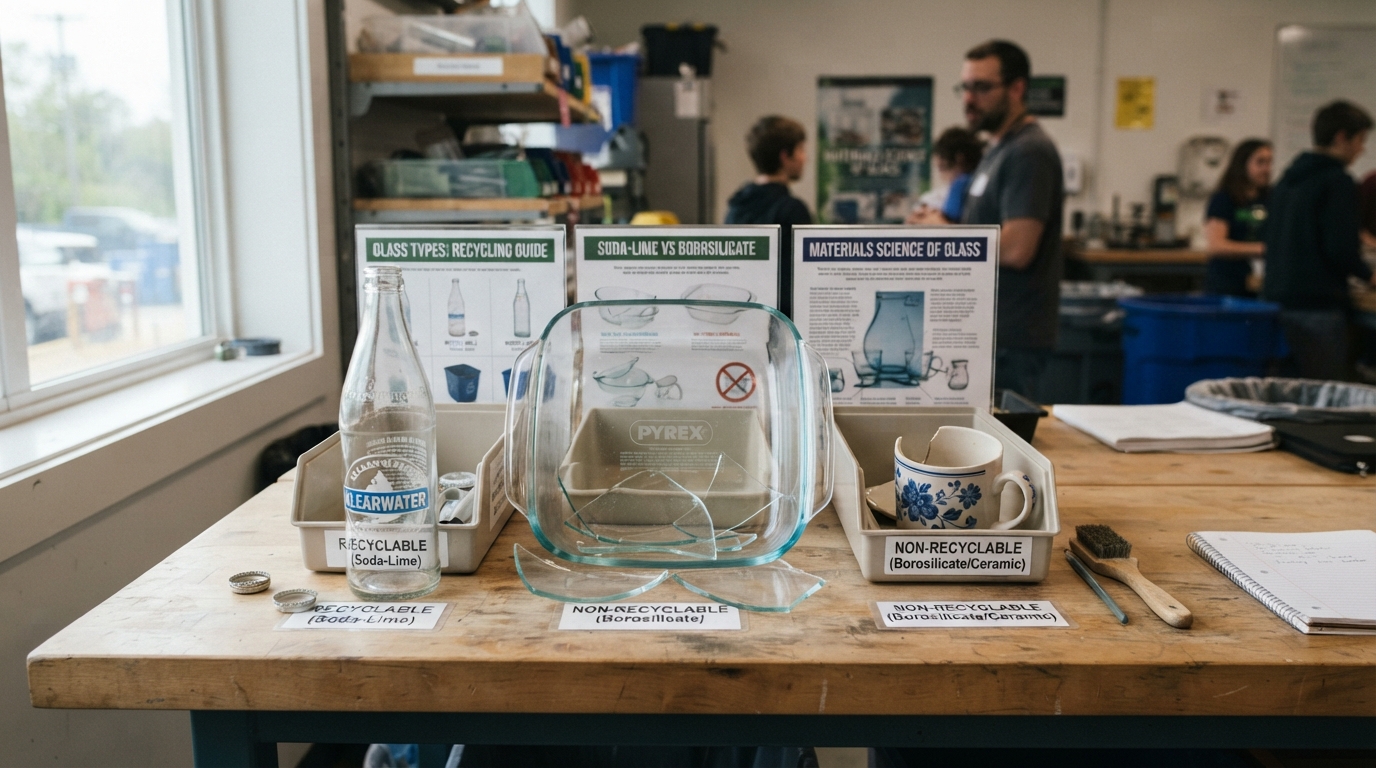
Inside the modern beneficiation plant and industrial container furnace, few operational failures trigger more devastating consequences than the cross-contamination of container glass cullet with non-container vitreous matrices. To the average household resident or facility custodian, transparent, brittle, or rigid housewares appear fundamentally interchangeable: a spent pickle jar, a shattered Pyrex casserole lid, a chipped wine goblet, and a fractured picture-frame pane are all casually categorized as "glass."
That superficial intuition is catastrophically wrong. Commercial container glass manufacturing operates on razor-thin thermodynamic and stoichiometric tolerances. The inadvertent introduction of a single shattered heat-resistant Pyrex dish or a fragmented ceramic espresso mug into a ten-ton load of container cullet will not simply dissolve harmlessly during remelt. Instead, it creates microscopic solid crystalline inclusions that migrate through the molten stream into newly formed bottles, transforming them into spontaneous fracture hazards that rupture on high-speed bottling lines.
“Introducing cookware or architectural float glass into a container glass furnace is not a matter of harmless dilution. It is the deliberate introduction of an insoluble mechanical fault that guarantees catastrophic bottle failure under pressure.”
The Chemistry of Glass: Soda-Lime Cullet vs. Borosilicate Formulations
To grasp why municipal programs draw an unyielding line between beverage containers and cookware, one must examine their elemental formulation. More than 95% of packaging glass globally—encompassing wine bottles, beer flutes, baby food jars, and condiment flasks—belongs to a single chemical family: soda-lime-silica glass. The stoichiometry of this matrix has been optimized over two centuries for high-speed automated forming and predictable remelting kinetics.
Standard container glass relies on a three-part equilibrium:
-
check_circle
Silica Sand (SiO2, ~70–73%): Provides the foundational tetrahedral glass-forming network that gives glass its mechanical rigidity and chemical resistance.
-
check_circle
Soda Ash (Sodium Carbonate, Na2O, ~12–15%): Acts as a powerful network flux, lowering the melting point of quartz from an unattainable 3,100°F (1,700°C) down to a manageable working temperature of roughly 2,600°F (1,425°C).
-
check_circle
Limestone & Dolomite (CaCO3 / MgCO3, ~10–12%): Supplies divalent calcium and magnesium ions that act as network stabilizers, rendering the silicate matrix totally insoluble in water, mild acids, and alcoholic beverages.
In stark opposition, heat-resistant bakeware like laboratory-grade Pyrex, laboratory beakers, graduated cylinders, and borosilicate measuring cups belongs to an entirely divergent chemical matrix: borosilicate glass. In borosilicate formulations, at least 7% to 13% of the silica matrix is systematically replaced by boron trioxide (B2O3), alongside minimal alkali modifiers and elevated aluminum oxides.
This molecular tailoring dramatically depresses the material's Coefficient of Thermal Expansion (CTE). Whereas soda-lime glass exhibits a CTE of approximately 9.0 × 10⁻⁶ K-1, borosilicate glass expands at just 3.3 × 10⁻⁶ K-1. This allows a borosilicate casserole dish to survive thermal gradients from oven to cold countertop without shattering. However, that very same physical property makes it a lethal contaminant inside a soda-lime remelt furnace.
What Happens Inside the Glass Furnace: The Unmelted "Stone" Catastrophe
Industrial container glass melters are massive, continuous-feed thermodynamic reactors. These continuous refractory-lined tanks hold up to 400 tons of molten glass at an operating zone precisely maintained between 2,550°F and 2,650°F (1,400°C to 1,455°C). Within this calibrated window, crushed container cullet liquefies, undergoes chemical fining (the purging of trapped gas micro-bubbles), and flows smoothly down the forehearth channels toward automated Individual Section (IS) bottle-blowing carousels.
Borosilicate cookware, however, does not yield at these temperatures. Due to the high covalent bonding strength of boron-oxygen networks, true borosilicate requires sustained soaking temperatures exceeding 2,900°F to 3,100°F (1,600°C to 1,700°C) to fully melt, dissolve, and homogeneously diffuse.
When crushed borosilicate shards or ceramic fragments (such as broken coffee mugs or porcelain ramekins, which melt above 3,200°F) enter the furnace melt, they do not dissolve. Instead, they remain solid or semi-vitrified particles called refractory stones or "knots." These dense unmelted inclusions travel down the forehearth channel, completely escaping optical filter sensors, and become embedded directly within molten gobs sheared for bottle blow molding.
The Annealing Lehr and Spontaneous Burst Failures
When a container bottle containing an embedded refractory stone exits the mold and enters the annealing lehr (a controlled cooling tunnel designed to relieve internal stresses), a severe physical failure is set into motion:
-
report_problem
Differential Thermal Contraction: As the container cools from 1,050°F down to room temperature, the bulk soda-lime bottle contracts at nearly three times the rate of the embedded borosilicate stone.
-
report_problem
Localized Tensile Stress Fields: The surrounding soda-lime glass exerts enormous hoop stress around the inclusion, producing microscopic radial micro-cracks known as “butterfly wings” within the bottle wall.
-
report_problem
Explosion on Commercial Bottling Lines: When that newly blown bottle is delivered to a brewery or beverage packaging facility and pressurized with 45 to 80 psi of carbonated cider, beer, or sparkling water, the stone acts as an immediate failure locus. The container explodes violently inside the filling carousel, halting high-speed production lines, showering operating cells with razor-sharp cullet, and prompting catastrophic inventory recalls.
Window Panes, Mirrors, and Lead Crystal: Why Plate Glass Fails the Bottle Test
Another frequent source of costly contamination in municipal collection carts is flat architectural glass: window panes, sliding glass door shards, and tabletop covers. Many well-meaning residents reason that because float glass is also a soda-lime matrix, it should melt cleanly alongside beverage bottles.
While flat glass is chemically closer to container glass than borosilicate, it introduces three crippling manufacturing disruptions:
-
close
Viscosity and Flow Mismatch: Float glass is engineered with higher magnesium oxide and distinct alumina ratios to allow it to spread across baths of molten tin without devitrifying. Its viscosity-temperature curve deviates significantly from packaging glass, creating flow irregularities in IS forehearth feeders.
-
close
Metallic Low-E and Reflective Coatings: Modern architectural window glass is coated with magnetron-sputtered thin films composed of silver, titanium dioxide, zinc oxide, and fluoropolymer hard-coats. When melted in massive quantities, these metal oxides destabilize the furnace’s oxidation-reduction (redox) equilibrium, causing unpredicted amber discoloration in clear flint glass and chemically eroding refractory furnace bricks.
-
close
PVB Polymer Interlayers in Windshields: Automotive safety glass contains a durable sandwich interlayer of Polyvinyl Butyral (PVB). If crushed into container cullet, the PVB decomposes pyrolytically inside the melter, leaving black carbon deposits, extreme slag foaming, and gas blisters in the finished packaging.
The Danger of Leaded Crystal and Tabletop Glassware
Fine crystal glassware, antique decanters, and chandeliers contain between 24% and 32% lead oxide (PbO) by weight to enhance optical refraction and acoustic ring. Melting even a modest quantity of leaded crystal into a container glass stream introduces toxic heavy metal leachates into food and beverage containers, violating stringent FDA and European EFSA food-contact migration thresholds.
Similarly, drinking tumblers and wine stems are frequently treated with potassium oxide and barium modifiers to improve surface luster and dishwasher resilience. These additives disrupt the thermal cooling curve of container glass, triggering high reject rates at cold-end plant inspection monitors.
Color Sorting Realities: Flint (Clear), Amber, and Emerald Cullet
Beyond chemical composition, maintaining commercial cullet value hinges on strict color separation. Glass is infinitely recyclable without degradation, but container furnaces cannot remove color once cullet has melted. Cullet is segregated into three primary commercial streams:
The highest-value cullet commodity. Requires >99% purity. Even a single amber beer bottle in a 1,000-bottle clear melt introduces trace iron-sulfur chromophores that turn an entire clear production run into an unmarketable greenish-gray hue.
Formulated with iron, sulfur, and carbon to absorb ultraviolet and short blue light wavelengths below 450 nm, shielding beer, pharmaceutical tinctures, and premium oils from photo-oxidation. Amber furnaces tolerate moderate green glass inputs, but zero clear glass dilution.
Tinted with chromium oxide (Cr2O3). While highly tolerant of amber cullet mixtures, global demand for green packaging has contracted, creating regional oversupplies that challenge single-stream recovery economics.
In single-stream municipal collection trucks, compaction hydraulics break up to 60% of glass containers prior to MRF unloading. This pulverized, mixed-color fraction—known as 3-Mix cullet—cannot be optically color-sorted cost-effectively. Instead of returning to closed-loop bottle furnaces, 3-Mix is downcycled into secondary industrial aggregates: spun fiberglass insulation, cellular foam glass gravel for roadway foundations, and abrasive sandblasting media.
Safe Disposal Protocols for Broken Ovenware, Mirrors, and Ceramics
Protecting the municipal glass stream from high-temperature contaminants requires strict household adherence to safe disposal standard operating procedures (SOPs). When cookware, mirrors, or window panes break, follow these non-negotiable handling rules:
Landfill Trash Only for Cookware
All broken Pyrex dishes, ceramic coffee mugs, Corelle plates, stoneware, and crystal stemware belong exclusively in the municipal solid waste (landfill) cart. Never place them in blue curbside carts, regardless of cleanliness.
Puncture-Proof Packaging
Wrap broken ovenware shards securely in multiple layers of newspaper or pack them inside a rigid corrugated cardboard box. Seal the carton with heavy packing tape and clearly mark it "CAUTION: BROKEN GLASS" to prevent lacerations to sanitation collection operators.
Specialty Glazing Drop-Off
Full window panes, frameless mirror sheets, and tempered shower door glass should be diverted to dedicated Construction & Demolition (C&D) recyclers or architectural salvage centers that maintain specialized processing streams for flat float glass.
Unscrew Metal Lids
Remove steel jar lids and aluminum caps from glass containers before placing bottles in curbside bins. Metal caps are recovered efficiently by cross-belt magnets and eddy-current separators, while intact bottles can be optically processed without trapped internal pressures.
Frequently Asked Questions (FAQ)
Can I recycle Pyrex if it is whole and unbroken?
What is the difference between old borosilicate Pyrex and modern tempered Pyrex?
Why can't drinking glasses and wine stems be recycled with bottles?
Do I need to remove paper labels from glass bottles before recycling?
verified_user
Key Takeaways
5 Operational Standards for Glass Recycling Purity
Key Takeaways
5 Operational Standards for Glass Recycling Purity
1
2
3
4
5
Yard Trimmings, Mulching & Fire Blight: Best Green Bin Practices
Managing seasonal lawn clippings, tree branches under 4-inch diameter, and keeping non-organic invasive weed seeds out of city composting streams.