For generations, the standard domestic counsel passed down from family physicians and public health authorities was deceptively straightforward: when a course of treatment ends, flush leftover capsules, tablets, and elixirs down the nearest residential toilet. The rationale was founded entirely on acute domestic risk mitigation—ensuring inquisitive toddlers, vulnerable elderly individuals suffering from cognitive decline, or household domestic animals could not accidentally ingest lethal pharmaceutical doses from bathroom medicine chests or kitchen wastebaskets.
While well-intentioned, this historical practice created a silent, compounding environmental emergency. Modern environmental toxicology and hydrological tracing have revealed that municipal sewer systems and septic drain fields are fundamentally incapable of neutralizing bioactive synthetic chemistry. When synthetic molecules enter sewer mains, they bypass standard sewage filtration barriers, flow into surface rivers, contaminate groundwater aquifers, and bioaccumulate across downstream ecosystems.
“Flushing prescription medications does not destroy them; it merely weaponizes municipal drainage networks into direct pipelines delivering bioactive synthetic compounds into alluvial aquifers and public waterways.”
The Water Quality Crisis: Endocrine Disruptors, Antibiotic Resistance, and Wastewater Limits
Conventional Publicly Owned Treatment Works (POTWs) are triumphs of civil engineering, calibrated over more than a century to treat human biological effluent, suspended organic solids, biological oxygen demand (BOD), excess phosphorus, and pathogenic coliform bacteria. They operate through primary mechanical gravity settling, secondary microbial activated-sludge digestion, and tertiary chemical disinfection (typically sodium hypochlorite chlorination or ultraviolet irradiance).
However, synthetic pharmaceuticals are deliberately designed by medicinal chemists to withstand enzymatic hydrolysis, extreme pH shifts inside the human stomach, and thermal stress. The structural molecular motifs—such as halogenated aromatic rings, quaternary amine linkages, and fluorinated carbon bonds—render these molecules chemically refractory to the standard microbial consortia resident in municipal activated-sludge basins.
Key Pharmacological Classes Evading Municipal Digestion:
- warning Synthetic Estrogens (17α-Ethinylestradiol): Potent oral contraceptive hormones that induce vitellogenin synthesis in male teleost fish at parts-per-trillion levels, resulting in severe intersex gonadal development and downstream reproductive collapse.
- warning Fluoroquinolones & Broad-Spectrum Antibiotics: Sub-inhibitory concentrations discharged into biological streams place perpetual selective pressure on riverbed bacteria, accelerating horizontal gene transfer and propagating multi-drug resistant superbugs.
- warning Cardiovascular Beta-Blockers (Atenolol, Metoprolol): Lipophilic formulations that bioaccumulate in benthic invertebrates and game fish, altering cardiac output and predator escape responses.
- warning Carbamazepine: An anticonvulsant and mood stabilizer so impervious to standard water reclamation that hydrologists globally rely on its presence as an unambiguous chemical marker of treated human sewage intrusion in groundwater wells.
When treated effluent is released into receiving rivers, estuaries, or percolation basins, trace concentrations infiltrate subterranean aquifers that serve as municipal drinking water supplies. While advanced purification facilities utilizing reverse osmosis membranes and advanced oxidation processes (UV/H₂O₂) can remove these micropollutants, such systems demand enormous capital expenditure and kilowatt loads that fewer than 5% of global municipal utilities possess. True environmental protection requires source reduction: capturing pills at the consumer threshold before they touch water.
DEA Rule 21 CFR 1317: How Secure Pharmacy Collection Kiosks Operate
To establish a legally bulletproof, contamination-free collection network, the United States Drug Enforcement Administration published the Disposal Act regulations within Title 21 of the Code of Federal Regulations (21 CFR Part 1317). Prior to these rules, federal narcotics statutes made it a felony for anyone other than the registered patient to possess Schedule II controlled substances, effectively preventing retail pharmacies from accepting returned prescriptions.
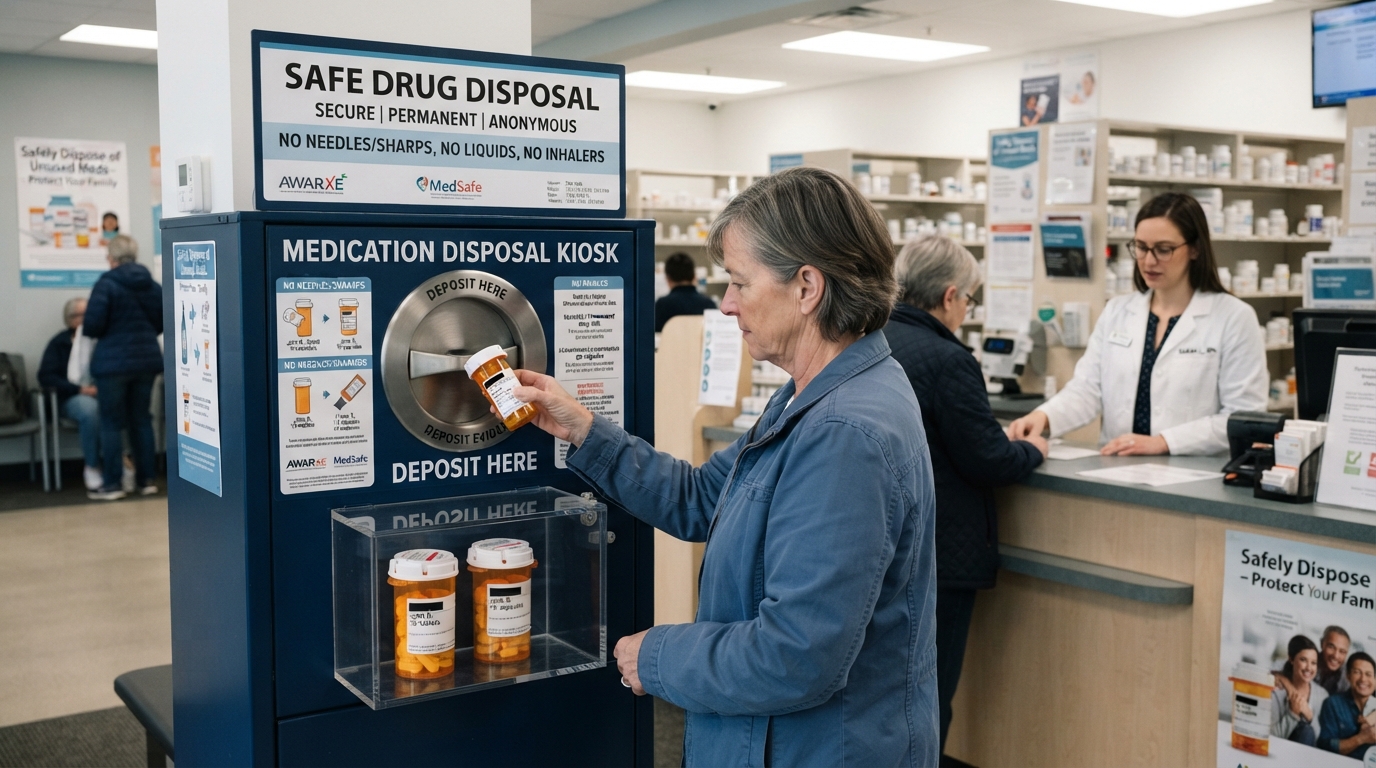
Under 21 CFR § 1317, authorized collectors—including licensed retail community pharmacies, institutional hospitals, and municipal law enforcement agencies—may deploy permanent public drop receptacles engineered to rigorous dual-custody physical security standards:
Physical Kiosk Engineering
Kiosks are constructed of continuous-weld 14-gauge or 16-gauge steel, bolted directly to permanent building masonry. The intake slot features a counterbalanced, anti-phishing baffled drawer mechanism: once a container is placed inside and the door closes, gravity drops the medication into an enclosed inner vault with zero external retrieval access.
Inner Liner Serialization
Inside the vault sits an opaque, waterproof, puncture-resistant liner equipped with a unique serialized tracking barcode. Removal requires two registered pharmacy staff acting in tandem. Neither employee is legally permitted to view, touch, or inventory the contents. The liner is heat- or adhesive-sealed before removal and logged into federal manifests.
Once removed, sealed liners are transferred directly to registered reverse distributors and hauled under armed dual-custody logistics manifests. The final destination is an EPA Clean Air Act Title V permitted Hazardous Waste Incinerator. In specialized rotary kilns operating between 1,800°F and 2,200°F (980°C to 1,200°C), complex synthetic pharmaceutical chains undergo complete thermal destruction and oxidative mineralization. The organic bonds are cleaved into inert carbon dioxide, water vapor, and vitrified slag, with alkaline wet scrubbers neutralizing halogen gases.
National Prescription Drug Take Back Day vs. Permanent Year-Round Drop Boxes
Since 2010, the DEA in coordination with state police departments, municipal sheriffs, and community anti-drug coalitions has held semi-annual National Prescription Drug Take Back Days—typically scheduled on the last Saturday of April and October. Over their tenure, these single-day events have gathered and incinerated over 8,500 tons of unwanted prescription compounds nationwide, serving as essential focal points for public education.
However, municipal waste specialists and toxicologists emphasize that single-day events cannot stand alone as a comprehensive diversion strategy. The primary operational flaw is medication stockpiling:
When patients conclude acute post-surgical recovery or modify cancer chemotherapy protocols, potent analgesic compounds sit unattended in residential medicine cabinets for up to six months awaiting the next bi-annual municipal collection date. SAMHSA research confirms over 50% of diverted prescription pain relievers originate from medicine cabinets of friends and relatives.
Permanent, year-round pharmacy kiosks bridge this perilous lag time. Over 15,000 national pharmacy retail outlets (such as CVS, Walgreens, and regional grocers) alongside hospital outpatient centers and law enforcement headquarters now host permanent drop boxes accessible during standard business hours with zero fees, no residency questions, and no personal documentation demanded.
What Is Accepted vs. Prohibited (Controlled Substances, Blister Packs, Inhalers, Sharps)
Operating a safe reverse logistics stream requires absolute clarity regarding material boundaries. While high-temperature industrial kilns can mineralize nearly all solid organic molecules, introducing pressurized vessels, liquid biohazards, or sharps into collection liners can cause catastrophic mechanical damage, worker infection, or explosions.
Permitted Materials
- check Controlled Substances: Schedule II through V narcotics (e.g., OxyContin, Percocet, Vicodin, Adderall, Xanax, Ambien).
- check Maintenance Prescription Drugs: Blood pressure tablets, statins, oral contraceptives, antibiotics, and antidepressants.
- check OTC Medications & Vitamins: Analgesics, antihistamines, sleep aids, and effervescent antacid tablets.
- check Blister Packs & Patches: Solid foil-backed unit dose cards and securely folded transdermal patches.
- check Pet Medications: Veterinary prescription capsules, chewable antiparasitics, and thyroid tablets.
Strictly Prohibited
- close Sharps, Needles & Syringes: Hypodermic needles, autoinjectors (EpiPens), lancets, and infusion sets puncture liners and expose logistics workers to bloodborne pathogens.
- close Aerosols & Inhalers: Pressurized metered-dose asthma inhalers contain propellant gases that explode violently when heated in incinerator feed hoppers.
- close Chemotherapy & Cytotoxic Drugs: Hazardous oncological IV fluids and antineoplastic pills require dedicated RCRA dangerous-waste pathways.
- close Bulk Liquid Bottles: Liquid cough syrups over 4 oz and hydrogen peroxide bottles can rupture, compromising liner integrity.
- close Mercury Thermometers: Elemental mercury releases neurotoxic vapor upon combustion and must be delivered to household chemical roundups.
Safe Home Inactivation and At-Home Deterrent Pouches
When rural remoteness, severe mobility impairment, or severe weather conditions preclude physical travel to a permanent pharmacy kiosk or municipal take-back event, residents must never revert to toilet flushing. Instead, employ verified home inactivation and encapsulation protocols approved by the FDA and EPA to render the drugs biologically unavailable before domestic solid waste disposal.
Activated Charcoal Drug Deactivation Pouches (Deterra, DisposeRx)
The clinical gold standard for in-home destruction. These pouches contain granular activated carbon or cross-linking polymer gels. You place uncrushed tablets, patches, or liquids directly into the pouch, add warm tap water, and seal the closure. Within 30 seconds, the active pharmaceutical ingredients are permanently adsorbed into the porous carbon matrix via van der Waals forces, rendering the compounds non-retrievable and inert for curbside household trash disposal.
The FDA Cat Litter & Coffee Grounds Encapsulation Method
If commercial deactivation pouches are unavailable, combine the pills whole—never crush or pulverize them, as crushing increases chemical leaching and dangerous aerosol exposure—inside a heavy-duty sealable freezer bag or empty plastic yogurt container. Mix with an unpalatable, highly absorbent deterrent substrate: damp clumping bentonite cat litter, spent wet espresso grounds, or bitter potting soil.
Hermetic Sealing & Bottle De-Identification
Tightly zip and seal the container, wrapping the seam with heavy duct tape to resist hydraulic compaction pressures inside curbside refuse trucks. Toss this reinforced packet into your exterior municipal garbage bin right before pickup. Separately, take your empty plastic amber prescription vials, draw a black permanent marker line through your full name, doctor’s details, and Rx barcode, and place the clean empty plastic bottles in your curbside blue bin.
Frequently Asked Questions (Safe Pharmaceutical Stewardship)
Why does the FDA maintain a "Flush List" if flushing harms aquatic biology?
Do I need to peel off the prescription label before dropping bottles into a kiosk?
Where can I legally dispose of diabetic insulin syringes and autoinjectors?
Are take-back drop boxes free to use, and is my privacy guaranteed?
verified_user
Key Takeaways
5 Actionable Rules for Safe Pharmaceutical Disposal
Key Takeaways
5 Actionable Rules for Safe Pharmaceutical Disposal
1
2
3
4
5
Donation vs. Downcycling: What Actually Happens to Old Clothes?
Navigating textile donation bins, unwearable fabric recycling programs, and brand take-back incentives for worn denim and athletic shoes.