The Curbside Catastrophe: Why Film Wraps Are Public Enemy #1 at Modern MRFs
Modern Materials Recovery Facilities (MRFs) are masterpieces of mechanical engineering designed to process 30 to 60 tons of single-stream household recyclables every hour. When a municipal collection truck unloads its payload onto the tipping floor, front-end loaders push commingled containers onto high-speed metering conveyors. From there, the stream hits an intricate gauntlet of mechanical sorting: spinning rubber disc screens, massive inclined rotary trommels, high-velocity air-knife separators, eddy current rotors, and optical sensors equipped with near-infrared (NIR) spectrometry.
Every millimeter of this automated machinery is calibrated for materials that maintain distinct three-dimensional physical profiles: corrugated cardboard boxes, rigid HDPE milk jugs, and spherical aluminum cans. When an everyday flexible polyethylene grocery bag or strip of bubble wrap enters this mechanical sequence, catastrophe follows within minutes.
Instead of bouncing across the spinning stars of an elliptical disc screen, thin flexible film behaves like high-tensile rope. It instantly wraps around the central spinning drive shafts, binding bearings, slipping drive belts, and generating extreme friction heat. Within a single shift, hundreds of grocery sacks wind around axles in dense, heat-fused layers up to six inches thick.
When shafts seize, operators are forced into an emergency line shutdown. Across North America, the average MRF halts total plant operations two to three times every single day purely for film extraction. The clearance procedure is grueling and hazardous: technicians must strap into lockout-tagout safety harnesses, climb directly onto elevated, grease-laden screen decks, and physically carve the fused polyethylene off spinning axles using manual carpet hooks and utility knives.
Beyond the severe occupational laceration and crush hazards imposed on maintenance personnel, municipal downtime costs average between $1,200 and $2,800 per hour in lost throughput, electrical surge cycles, and worker compensation overhead. This single behavioral flaw—putting stretchy film into the blue household cart—costs taxpayers tens of millions of dollars each fiscal cycle.
Molecular Profile & Acceptance
The Chemistry of Film: LDPE (#4) vs. HDPE (#2) vs. Multi-Layer Blends
The fundamental reason flexible films can be remanufactured at store drop-offs—yet must never go curbside—comes down to polymer purity. Store drop-off infrastructure targets pure, unblended polyethylenes:
Low-Density Polyethylene: Characterized by high branching chains that prevent tightly packed crystallization. Yields soft, high-elongation, transparent films like air pillows, bubble wrap, and dry-cleaner bags.
High-Density Polyethylene: Features minimal polymer branching, providing elevated tensile strength with lower gauge thickness. Common in crinkly retail grocery t-shirt bags and department store sacks.
If an item lacks a visible resin code, execute the standardized mechanical thumb test: Press your thumb firmly into the flexible plastic sheet and attempt to stretch it outward.
- check Plastic retail grocery sacks & pharmacy bags
- check Air packaging pillows (fully deflated)
- check Perforated bubble cushioning wraps
- check Clean, bone-dry bread bags & bagel sleeves
- check Case overwrap film (water bottles, paper towels)
- check Dry cleaning protective garment film bags
- check Zip-top food storage baggies (clean, dry, tracks removed)
- close Frozen vegetable bags (contain laminated Nylon barriers)
- close Pre-washed salad mix pouches (contain anti-fog coatings)
- close Biodegradable or Compostable PLA bags (ruin PE melt)
- close Metallized chip bags, bar wrappers, candy pouches
- close Silicone food bags or heavy multi-ply pet food sacks
- close Degraded, sun-baked brittle landscape plastic films
Reverse Logistics Pipeline
The Closed-Loop Journey: What Actually Happens to Drop-Off Film
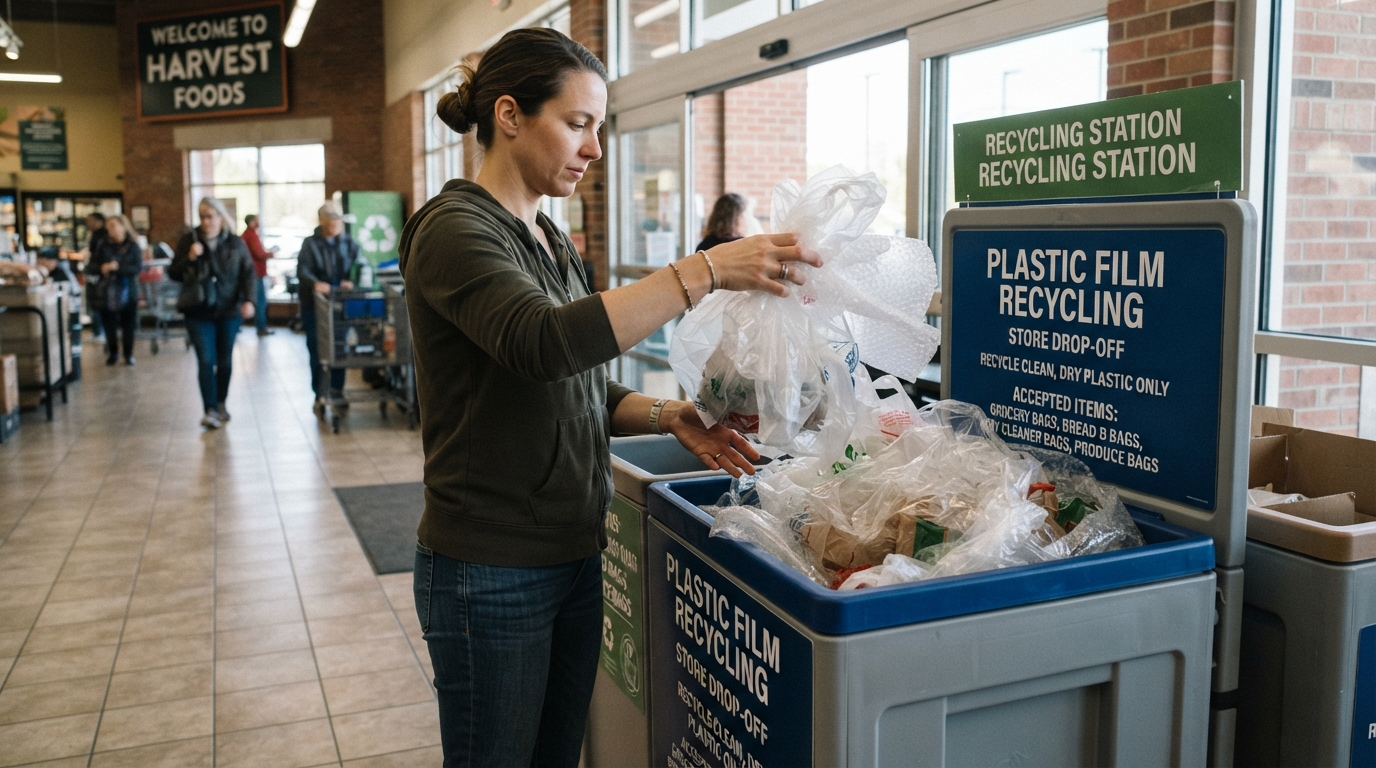
When you deposit plastic bags into retail vestibule collection bins at grocery supermarkets and big-box home improvement chains, they do not enter the municipal waste pipeline. Instead, they become integrated into a specialized industrial reverse-logistics infrastructure pioneered by organizations like NexTrex.
Supermarket distribution centers operate thousands of semi-trailers delivering fresh groceries to regional retail stores every day. If those trucks returned empty, it would represent millions of gallons in wasted diesel fuel. Under the retail backhaul system, grocery staff consolidate customer drop-off bags with the massive quantities of transparent pallet stretch wrap generated in stockrooms. These materials are compressed into dense 1,000-pound bales and loaded into the return-trip trailers.
The 4-Stage Polymer Regeneration Sequence
Bales are de-wired and pushed into industrial shredders reducing film to postage-stamp flakes.
Water float tanks isolate pure PE (density <1.0 g/cm³) from denser dirt, paper, and rigid grit.
Washed clean flakes melt inside vented twin-screw extruders and solidify into uniform resin pellets.
Pellets blend 50/50 with reclaimed woodworking sawdust to fabricate 25-year architectural boards.
A standard 500-square-foot residential composite deck incorporates approximately 140,000 recycled plastic film bags and stretch wraps. By bypassing the MRF entirely and utilizing clean, pre-screened reverse trucking paths, the store drop-off mechanism represents one of the few commercially profitable, closed-loop circular economy models functioning in contemporary resource logistics.
Implementation Protocol
Operational SOP: The 3 Golden Rules of Household Film Collection
Clean, Bone-Dry & Crumb-Free
Never deposit damp bags or wrappers with food remnants. In closed, compressed 1,000-lb retail bales waiting in humid back rooms, trapped moisture rapidly incubates aggressive black mold and fungal decay. Whole bales will be rejected by reclaimers and discarded if moisture exceeds strict 2% factory thresholds.
The "Bag-in-a-Bag" Consolidation System
Avoid tossing loose individual bags into retail drop bins where they easily blow across parking lots on breezy days. Dedicate one master plastic sack or bread sleeve under your sink. Pack 50 to 100 clean bags, wraps, and shipping sleeves tightly into that single bag until it is packed firm as a soccer ball before delivering.
Puncture Air Pillows and Pop Bubble Cells
Air cushioning materials are 99% ambient air by total volume. Unpopped pillows fill vestibule retail bins within minutes, causing early overflowing and unnecessary container servicing. Slit air cushions across the seam with a quick scissors cut or twist-pop bubbles to conserve 90% collection volume.
Real-World Dilemmas
Frequently Asked Questions: Technical Film Recovery
Do I need to cut paper receipt stickers and shipping labels off bubble mailers?
Can biodegradable or compostable plant-based bags go into the store drop-off bin?
Why don't municipal curbside programs simply add film recycling to blue carts?
What should I do with padded envelopes lined with plastic bubble wrap inside and paper outside?
fact_check
Executive Summary
Key Operational Takeaways
1
2
3
4
5
Disposing of Leftover Latex vs. Oil-Based Paint: Step-by-Step
Why oil-based paints require municipal hazardous drop-offs while dried latex cans can enter standard trash with cat litter hardening techniques.