
The Basement Backlog: Why 10% of All Architectural Paint Sits Unused
Every year across the United States, municipal transfer stations and regional waste authorities contend with a quiet, pervasive environmental challenge: post-consumer architectural paint. Reliable industry calculations consistently demonstrate that roughly 10% of all purchased interior and exterior architectural coatings—equating to an astounding 75 million gallons each year—remains unapplied, tucked away in damp crawlspaces, utility closets, and suburban garages.
Left indefinitely in rusted steel drums or unsealed plastic buckets, these liquid residues represent a monumental logistics and safety liability. When homeowners eventually clean out estates or complete renovation projects, impatience frequently precipitates improper disposal. Liquid coatings poured directly into household kitchen sinks, laundry basins, or storm drains inflict acute, irreversible stress on public water infrastructure.
- Sewage Treatment Interruption: Surfactants and coalescing biocides exterminate the delicate anaerobic microflora essential for municipal sewage digestion.
- Biological Filter Clogging: Suspended pigment aggregates coalesce onto physical filtration membranes, triggering premature failure and multi-million-dollar emergency retrofits.
- VOC Sewer Vaporization: Solvents quickly separate from paint emulsions in turbulent pipe flows, generating combustible concentrations of volatile compounds within public utility corridors.
- Riparian Contamination: Stormwater sewers directly discharge untreated flows into local wetlands and rivers, suffocating aquatic larvae with heavy-metal acrylic resins.
format_quote“Pouring a single gallon of solvent-borne paint into a residential storm drain can contaminate up to one million gallons of clean municipal drinking water.”
— EPA Office of Ground Water & Drinking Water Compliance Bulletin
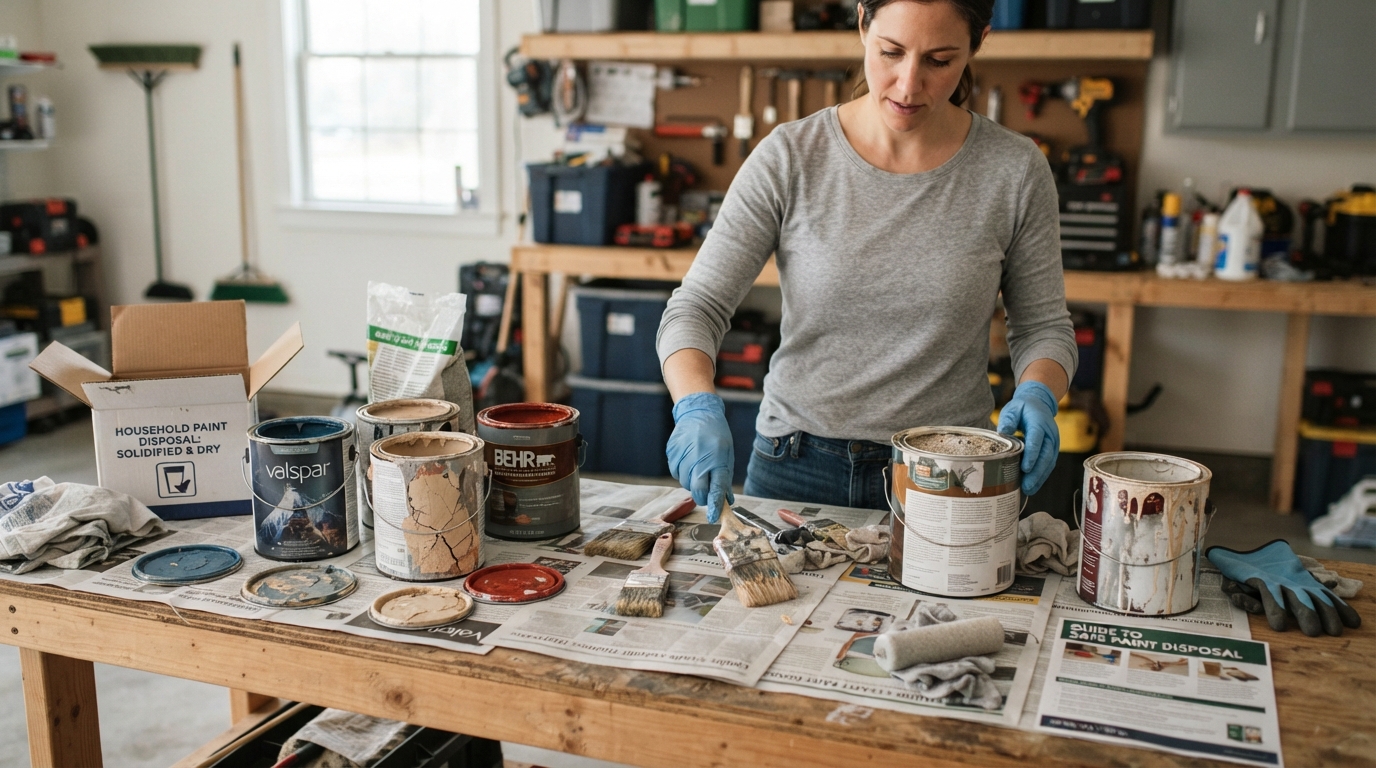
The Fundamental Chemical Divide: Waterborne Latex vs. Solvent-Based Alkyd
Effective paint disposal requires understanding the underlying polymer chemistry. The modern coatings market is partitioned into two distinct categories: waterborne acrylic formulations and solvent-thinned organic alkyd resins. Their distinct binder and vehicle structures dictate entirely opposing disposal channels.
Latex, Vinyl & Acrylic
Water-carrier emulsion containing synthetic resin polymers. Characterized by negligible flashpoints, minimal toxicity, and faint odor.
Alkyd, Enamel & Stains
Formulated using petroleum distillates (mineral spirits, xylene, and toluene). High flammability with combustible vapors.
The Simple Solvent Solubility Test
If the product label is faded or missing, dip a clean cotton swab or rag in pure acetone or 91% isopropyl alcohol. Rub vigorously against a dried paint drip on the can lip for 15 seconds. If the coating readily dissolves, softens, and transfers pigment onto the cotton, it is waterborne latex. If the film resists dissolution and remains glassy, hard, and unchanged, it is solvent-based oil paint and must never enter municipal curbside streams.
Step-by-Step Guide: Hardening Latex Paint for Curbside Collection
Municipal sanitation drivers and compaction trucks cannot accept wet liquids of any kind due to the hydraulic bursting risk during mechanical compacting. Solidification chemically neutralizes run-off threats, converting liquid latex into a chemically stabilized solid cake suitable for modern engineered landfill liners.
Volume Assessment
Open the can and measure residual depth with a wooden stir stick. One inch or less requires simple evaporation. Greater depths (a half-can to nearly full) require active binder absorption agents. If the can is over 80% full of usable paint, skip hardening and prioritize community architectural donation instead.
The Open-Air Evaporation Method
For volumes under 1 inch, remove the metal lid entirely. Position the container in a warm, dry, secure space with high cross-ventilation—such as an open shed or elevated garage shelf out of reach of household pets and children. Let sit for 48 to 72 hours until the film cures completely solid down to the base.
Absorbent Solidification Agents
For deeper volumes, pour in equal parts absorbent material. Inexpensive non-clumping clay cat litter, coarse kiln-dried sawdust, or clean garden soil will bond with the latex polymer. Alternatively, purchase commercial cross-linking sodium polyacrylate crystals (paint hardener powders), which bind water molecules within minutes.
The 24-Hour Cure & Stir
Mix vigorously with a heavy wooden paint stick until the slurry reaches a stiff, dry oatmeal texture. Leave the can uncovered in a protected, ventilated area for a full 24 hours. Verify vulcanization by pressing the center with a stick; there should be zero liquid migration or soft damp spots underneath the crust.
Curbside Presentation Protocol
Place the hardened can into your municipal solid waste cart with the LIDS REMOVED (discard metal lids separately in the trash). Hauling technicians must be able to visually verify that the payload is completely solid and uncompressed before emptying the bin.
Managing Oil-Based Paint, Thinners & Varnish: The HHW Protocol
Unlike waterborne paints, solvent-thinned varnishes, polyurethane finishes, oil primers, and marine enamels maintain low ignition flashpoints and contain long-chain aromatic hydrocarbons. Under RCRA (Resource Conservation and Recovery Act) directives, these substances are classified as hazardous wastes. Solidifying oil-based paint with cat litter is strictly prohibited in most jurisdictions because the volatile solvents continuously vaporize rather than cure.
Industrial Recycling & HHW Downcycling
When surrendered at an authorized municipal Household Hazardous Waste (HHW) depot or a participating PaintCare drop-off center, solvent coatings are segregated by chemical compatibility. They are routinely directed toward:
High-BTU solvent liquids are blended as supplementary fuel for industrial rotary cement kilns operating over 2,500°F.
Specialized reclamation units heat raw paint to vaporize and capture mineral spirits for industrial parts washers.
Unsalvageable resins containing lead or heavy metals undergo enclosed high-temperature destruction with scrubber capture.
local_fire_department
Critical Warning: The Spontaneous Combustion Threat of Rags
Natural drying oils—principally raw or boiled linseed oil, tung oil, and alkyd wood finishes—dry via an exothermic oxidation reaction. Unlike water evaporation, this chemical transformation releases sustained heat. If rags soaked in oil-based stains are crumpled in a heap, tossed in a wastebasket, or gathered in a cardboard box, the trapped thermal energy will steadily escalate to the cloth's ignition point (approx. 450°F), spontaneously bursting into flame without an external spark.
Frequently Asked Questions: Real-World Paint Dilemmas
How does the PaintCare program work and is it free?
Can leftover good paint be donated to local non-profits?
Can I recycle the empty metal or plastic paint cans in my curbside blue bin?
How long does unopened paint remain usable in a temperature-controlled room?
fact_check
Key Takeaways & Compliance Summary
1
2
3
4
5
Old TVs, Monitors & Laptops: Free Local E-Waste Recycling Options
Safely wiping personal hard drives before disposal, manufacturer take-back programs, and avoiding illegal curbside fly-tipping citations.