Global e-commerce fulfillment has fundamentally restructured municipal solid waste generation. Over 160 billion parcels now navigate continental logistics networks every single year, funneling millions of tons of transit packaging directly into suburban doorsteps. For generations, the brown cardboard box served as the undisputed workhorse of domestic shipping—an unblemished, universally understood commodity that sustained municipal recycling revenues.
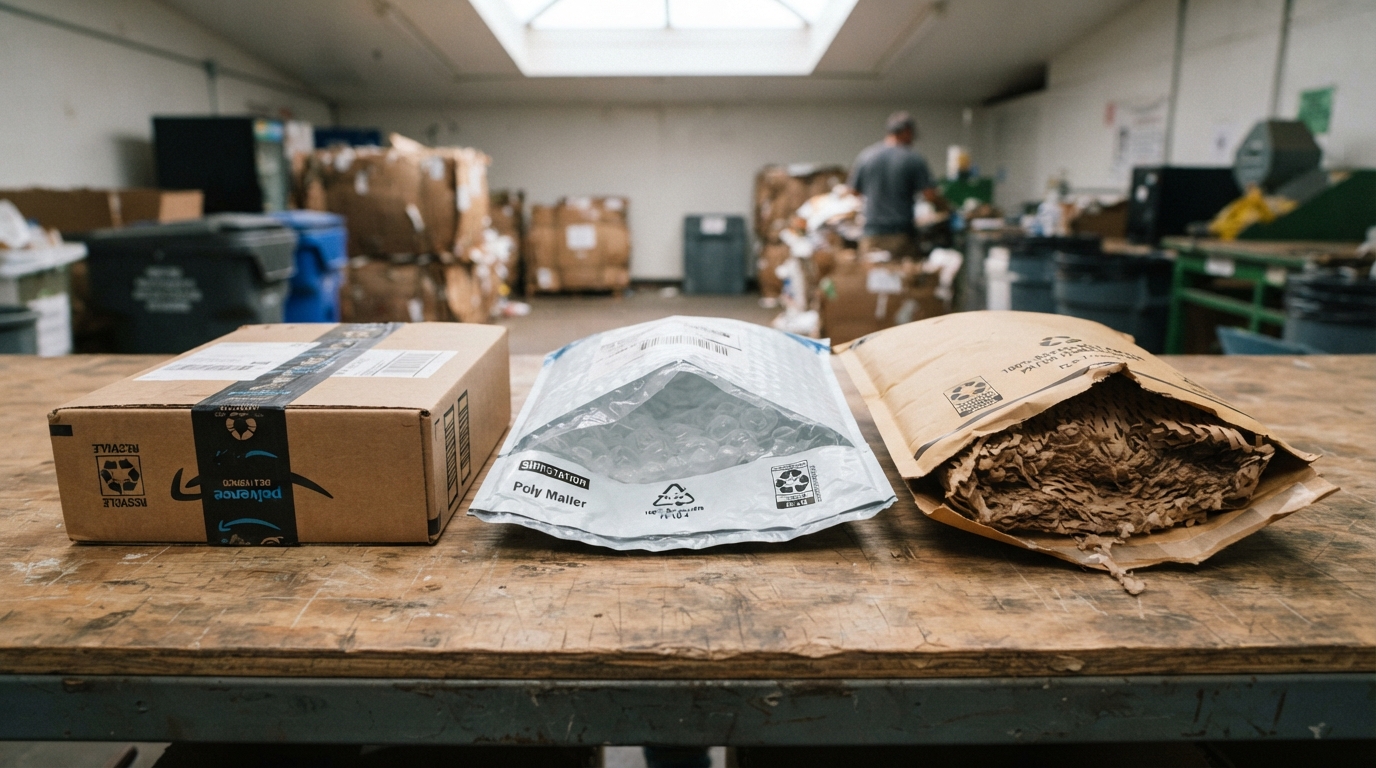
However, modern parcel carriers and fulfillment titans have increasingly turned to automated poly bagging, ultra-thin film mailers, and hybrid composite envelopes to mitigate freight fuel costs and diminish package dimensional weight. While this lightweighting reduces transport fuel burn, it shifts an enormous burden onto municipal recovery channels. Today, an innocent glance at a parcel’s exterior cannot confirm its circularity: what appears to be paper may conceal a destructive plastic inner liner, while flexible plastic pouches wreak havoc on high-speed mechanical sorting disks.
“When consumers confuse lightweight polymer bubble envelopes with pure cellulose paper streams, processing lines choke. Sorting by visual assumption rather than material composition costs the recycling industry hundreds of millions of dollars each year in downtime and downgraded bales.”
The Packaging Paradox: The Shift from Corrugated Boxes to Lightweight Mailers
For nearly a century, the backbone of secondary parcel logistics has been Old Corrugated Cardboard (known throughout the commodities trade as OCC Grade 11). Corrugated board is a mechanical triumph: two flat exterior linerboards sandwiching an interior wave-patterned fluted medium. This geometric fluting provides exceptional vertical compression resistance while keeping tare weight minimal. Furthermore, unbleached kraft softwood fibers offer outstanding tensile tear strength, permitting the same virgin cellulose to be re-pulped, refined, and made into fresh cartons up to seven consecutive cycles before individual fibers become too short to knit together.
Despite these circular benefits, fulfillment algorithms penalize corrugated cartons for small merchandise. Dimensional weight pricing models—enacted by major national couriers—charge shippers based on total volume rather than actual mass. Transporting a thumb drive or clothing item in a rigid cardboard box means moving cubic feet of empty atmospheric air cushioned by plastic air pillows. To slash volumetric charges, distributors adopted automated on-demand bagging machines that seal products inside thin polyethylene or padded mailers.
This transition created a profound packaging paradox. While flexible mailers require roughly 70% less raw polymer by weight than an equivalent cardboard box and generate lower transit greenhouse gas emissions per parcel mile, their end-of-life handling in municipal systems is fraught with failure. Corrugated containers boast a domestic recovery rate near 80%, feeding a liquid, high-demand secondary market. Lightweight multi-material mailers, conversely, often contaminate optical sorting equipment, tangle rotating screens, and degrade regional paper pulp quality.
OCC Grade 11 represents the single most traded, economically stable commodity in residential recovery facilities. Contaminating an OCC bale with non-fiber polymers or sticky adhesive laminates risks rejected shipments, baler downtime, and substantial financial penalties from secondary paper mills.
Anatomy of a Mailer: Paper-Padded (Curbside Recyclable) vs. Bubble-Lined Poly (Store Drop-Off)
The most pervasive sorting mistake in residential bins today centers on padded shipping envelopes. Because their exterior color frequently presents as natural kraft brown or crisp parcel white, consumers routinely toss both plastic-lined and fiber-cushioned mailers directly into curbside paper recycling. Yet beneath that exterior surface lies a critical technical divide:
Bubble-Lined Poly & Kraft-Poly Composites
Structural Composition: These envelopes consist of an exterior Low-Density Polyethylene (LDPE #4) film or kraft paper shell thermally laminated to an internal layer of plastic bubble cushioning. Amazon’s ubiquitous white-and-blue Prime bubble mailers and traditional gold Jiffy-style bubble envelopes fall into this category.
The Curbside Failure Mode: When loaded into residential single-stream carts, these flexible plastic envelopes behave like grocery bags. They float across sorting screens, become wrapped around high-speed star-screen axles, and wedge into bearing housings. At the recycling facility, human sorters must halt sorting lines multiple times daily to slice wrapped film out with box cutters. If a composite paper-and-bubble mailer slips through into the paper line, its heat-fused plastic bubble layer refuses to dissolve in the hydrapulper, spoiling paper slurry batches.
Action Protocol: 100% plastic bubble mailers must be deposited in dedicated store drop-off bins (found at supermarkets alongside bread bags). Hybrid envelopes where paper is laminated to internal plastic bubbles cannot be cleanly separated and belong strictly in your landfill trash cart.
Macerated & Curbside-Recyclable Paper-Padded Mailers
Structural Composition: Developed as an eco-conscious alternative to plastic bubble envelopes, these mailers utilize two sturdy kraft paper walls sandwiching a thick layer of macerated (shredded and pulverized) newsprint or expandable die-cut paper lattice. They are bound together using water-soluble starch adhesives.
The Curbside Success Mode: Because their cushioning is entirely derived from cellulose fiber, these envelopes disperse effortlessly when immersed in water. Inside a repulping tank, the macerated newsprint interior rehydrates into workable pulp within minutes, blending seamlessly into recycled paperboard and corrugating medium production without leaving behind melted polymer residues or clumping filters.
The 2-Second Tear Test: When unsure whether a padded mailer contains plastic bubbles or macerated paper, tear a small notch in the corner. If you see grey or brown fuzzy shredded newspaper fibers fall out, drop it straight into your curbside paper bin. If you see or feel a plastic air bubble film stretching, place it in the trash.
Tape, Staples, and Shipping Labels: How Much Preparation Does Cardboard Need?
A pervasive myth in residential recycling is that cardboard boxes must be stripped completely bare before they are curbside compliant. Many well-intentioned residents spend considerable time painstakingly peeling off clear plastic packing tape, slicing off adhesive shipping labels with razor blades, and pulling heavy-duty brass staples from carton joints.
From a paper mill processing standpoint, this intense pre-cleaning is completely unnecessary. Modern paper recycling infrastructure is specifically engineered to handle minor non-cellulose contaminants. Here is how standard preparation items actually perform during industrial sorting and pulping:
Clear Polypropylene & Fiberglass Packaging Tape
Standard 2-inch clear acrylic tape and reinforced paper water-activated tape (containing embedded fiberglass threads) do not dissolve in water. However, when the box is submerged in the hydrapulper, the wood fibers rapidly swell and detach from the tape's adhesive backing. The plastic tape fragments float to the top of the slurry where mechanical skimming rakes (known as raggers) snag and pull them out in continuous rope-like bundles. Excessive peeling by consumers is redundant.
Thermal Shipping & Barcode Labels
Direct thermal parcel labels utilize heat-sensitive chemical coatings and permanent pressure-sensitive adhesives. While these hot-melt adhesives can generate microscopic gummy particles called "stickies" if left untreated, contemporary paper recovery mills inject chemical dispersants and utilize pressurized cyclonic centrifugal cleaners. These fine slotted screens (with apertures as narrow as 0.004 inches) screen out label adhesives easily. Cutting shipping labels off cartons is never required.
Steel Staples & Stitching Wire
Heavy-duty corrugated boxes used for furniture or heavy appliances are often joined with heavy steel staples. These metallic elements pose zero threat to the hydrapulping process. Because metal is dramatically denser than water and paper slurry, staples sink straight into the pulper's high-density junk trap at the base of the tank, where powerful magnetic separators extract them for scrap metal recycling.
The Hydrapulper Reality: How Plastic Coatings and Fiber Fragments Separate
To understand why certain materials are accepted while others are forbidden, one must observe the industrial mechanics of secondary fiber reclamation. Recovered corrugated cardboard from residential routes arrives at paper mills in compressed thousand-pound bales. These bales are conveyed directly into a massive industrial machine called a hydrapulper.
A hydrapulper operates like a giant industrial blender filled with heated water maintained between 110°F and 140°F. An enormous high-torque rotor spinning at the bottom creates a violent hydrodynamic vortex. As cardboard bales strike the turbulent water, natural hydrogen bonds between the wood fibers weaken and break. Within 15 to 25 minutes of continuous shearing friction, rigid corrugated board dissolves into a thick oatmeal-like aqueous suspension consisting of approximately 4% to 6% cellulose fiber and 94% water.
This is where material compatibility determines the line's survival:
-
check_circle
Macerated Newsprint & Molded Pulp: Unbleached newsprint padding, paper egg cartons, and molded fiber corner protectors hydrate almost immediately. Their porous, unlaminated surface allows instant water penetration, contributing clean fiber straight into the recycled slurry.
-
cancel
Plastic Bubble Linings & Film Laminations: Polyethylene barrier films prevent water from contacting the interior paper fibers. Instead of dispersing, the composite mailer remains buoyant, floating intact through the system until it catches in the extraction plates. As heat from the rotor builds, thin polymers can melt onto screening cylinders, forming sticky agglomerates that burn, tear wet paper webs on high-speed drying drums, and force catastrophic facility shutdowns.
-
check_circle
Centrifugal Cleaning & Flotation: After initial hydrapulping, the slurry passes through pressure cleaners that spin the liquid at high velocity. Heavy contaminants (sand, glass, staples) are flung outward, while lightweight contaminants (bits of styrofoam, loose tape skins) migrate to the center core and are discarded before the clean pulp enters Fourdrinier papermaking machines.
Best Practices for Flattening, Bundling, and Overloaded Curbside Bins
While material purity at the mill is essential, collection logistics present an equally urgent challenge. Cardboard is naturally rigid, bulky, and structurally unyielding. When householders deposit fully erected, uncollapsed boxes into their collection carts, they trigger severe disruptions throughout collection routes:
The Physics of Hopper Bridging
Modern curbside collection relies on Automated Side Loader (ASL) trucks equipped with hydraulic packer blades. When unflattened boxes are tipped from a cart into the truck’s receiving hopper, their rigid three-dimensional corners lock against the steel hopper walls in a geometric phenomenon known as box bridging.
This structural arch prevents material from falling down into the compaction cylinder. The truck’s hydraulic blade exerts thousands of pounds of pressure against the bridged boxes, causing the sensors to register a false “full hopper” signal. Drivers must frequently halt collection routes, exit the vehicle, and manually dislodge wedged cartons with a pry pole—a severe safety hazard and route efficiency penalty that inflates municipal operating budgets.
To ensure seamless curbside processing, apply these practical cardboard protocols:
-
check_circle
1. Slice the Bottom Tape Seam: The quickest method to flatten a box is to slice or puncture the tape running down the center of the bottom flaps. Once that structural seam is severed, the entire box collapses flat effortlessly without requiring brute strength.
-
check_circle
2. Cut Down Oversized Panels (>3 Feet): Giant cartons from flat-screen televisions, bicycles, or modular furniture bridge MRF tipping conveyors. Slice large panels down so no piece exceeds 3 feet by 3 feet. This prevents conveyor clogs and ensures optical sorters can properly separate fibers.
-
check_circle
3. Empty All Interior Dunnage Completely: Never leave plastic bubble wrap, EPS foam blocks, packing peanuts, or plastic air pillows tucked inside a cardboard box. Empty cartons loose into the cart; nested materials blind automatic sorting sensors.
-
check_circle
4. Shield Boxes from Rain: Wet cardboard loses up to 80% of its fiber burst strength. More critically, wet fiber sticks to MRF conveyor belts, fouls sorting screens, and adds water weight that causes mills to reject bales due to moisture content limits. Keep bin lids securely closed during storms.
Frequently Asked Questions (FAQ)
Do I have to peel off all the plastic packing tape before flattening a cardboard box?
Can I recycle the blue-and-white Amazon bubble mailers in my blue bin?
What happens to the sticky thermal address label when paper is recycled?
Are padded envelopes with brown fuzzy paper inside safe for curbside recycling?
verified_user
Key Takeaways
5 Operational Rules for E-Commerce Packaging Circularity
Key Takeaways
5 Operational Rules for E-Commerce Packaging Circularity
1
2
3
4
5
Setting Up a 3-Bin Color System for Your Family Kitchen
Kid-friendly icon decals, under-sink organization, and quick gamified sorting rules that cut household trash bag usage by half in 30 days.