
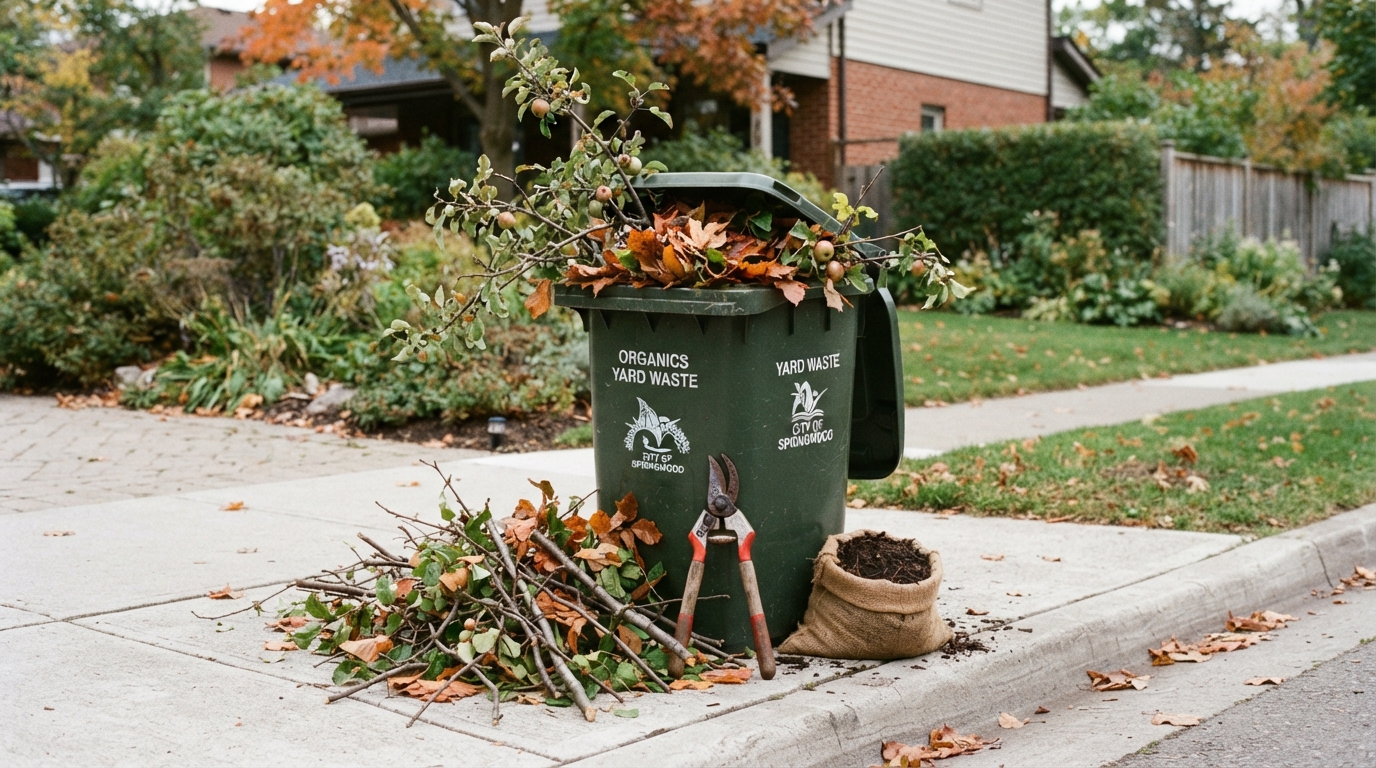
Every year, municipal and commercial composting operations across North America process over thirty million tons of curbside green waste into STA-certified (Seal of Testing Assurance) compost. These finished biological amendments nourish municipal parks, re-establish native riparian buffers, and fortify soil beds across regional organic fruit orchards. Yet this vital biological infrastructure relies entirely on residential sorting hygiene.
When homeowners treat curbside organic carts as universal biological dumpsters—tossing in systemic bacterial blights, synthetic pyralid herbicides, unchippable hardwood trunks, and treated lumber—the downstream ecological consequences ripple across entire agricultural watersheds. Understanding biological pathogen thresholds and strict mechanical requirements is vital to preserving circular organic recycling.
“A single diseased orchard limb or herbicide-soaked grass batch dumped into a curbside bin doesn't vanish—it multiplies across twenty tons of municipal compost destined for community food gardens.”
The Anatomy of Municipal Windrow Composting: Thermophilic Realities
To understand why certain garden debris is prohibited from residential green containers, homeowners must understand the industrial biome awaiting their organic waste. Unlike backyard compost tumblers that rely on slow mesophilic digestion (typically 70°F to 110°F), industrial aerated static piles (ASP) and large-scale turned windrows are rigorously engineered to achieve and sustain thermophilic cycles.
Under EPA 503 standards and state organic diversion mandates, commercial facilities must maintain core windrow temperatures of at least 55°C (131°F) for a minimum of 15 consecutive days, during which windrows must be turned at least five times using industrial mechanical turners. In aerated static vessels, temperatures must hold above 55°C for three consecutive days. This thermal intensity denatures cellular enzymes, killing human enteric pathogens (such as Salmonella and E. coli) and sterilizing fragile weed seeds.
- 105°F – 120°F (Early Mesophilic Stage): Rapid breakdown of simple sugars and amino acids by native actinomycetes.
- 131°F – 145°F (Sanitization Phase): Pathogen inactivation, weed seed deactivation, and fly larva eradication.
- 150°F – 160°F (Lignocellulosic Digestion): Intense breakdown of cellulose and wood fibers by thermophilic fungal strains (Thermomucor and Chaetomium).
- Above 165°F (Sterilization Hazard): Beneficial microbes die off, inviting anaerobic pockets and spontaneous smoldering risks.
However, industrial windrows are biological ecosystems, not incinerators. Cold air pockets along windrow toes, moisture differentials, and uneven bucket turns create cooler micro-zones where resilient bacterial spores, melanized fungal sclerotia, and viral capsids endure. When an aggressively infected tree branch enters the high-speed tub grinder, it can spread viable inoculants across dozens of finished tons.
The Threat of Bacterial Fire Blight (Erwinia amylovora) & Fungal Cankers
Among tree pathologies, Fire Blight—caused by the destructive Gram-negative enterobacterium Erwinia amylovora—is the most dangerous threat to commercial apple and pear orchards, landscape crabapples, hawthorns, quinces, and cotoneasters. The bacterium travels systemically through internal vascular xylem tubes, turning fresh growth into withered, charred-looking shoots commonly referred to as "shepherd's crooks."
In moist spring conditions, blighted bark crevices exude amber, sweet bacterial droplets containing trillions of living cells. When homeowners prune these infected branches and discard them in municipal green carts, severe logistical contamination occurs:
Mechanical Aerosolization in Tub Grinders
When uninspected orchard or garden trimmings enter commercial tub grinders rotating at 1,200 RPM, the violent impact generates fine wood aerosols coated in viable bacteria. These clouds drift across sorting yards, settling onto finished compost curing piles and contaminating organic compost distributed to regional farms.
The Mandated Handling Protocol: Branches actively weeping bacterial ooze or showing black shepherd's crooks must never enter green collection carts or backyard mulch tumblers. Seal blighted material inside heavy black contractor trash bags for landfill disposal or incineration, or perform regulated on-site burning where municipal fire regulations permit.
Similar concerns apply to fungal cankers like Cytospora, Nectria, and Black Knot (Apiosporina morbosa) found on plums and cherries. These fungi produce dense, melanin-encased spore structures that easily survive peripheral windrow temperature drops. Tool hygiene is vital: prune diseased limbs 12 to 14 inches below visible margins and soak shears in 70% isopropyl alcohol for 30 seconds between every cut.
Dimensional Requirements: The 4-Foot Length and 4-Inch Diameter Rule
A frequent point of frustration for property owners is the strict enforcement of curbside branch dimensions. Collection drivers routinely affix orange non-compliance tags to oversized trimmings left on tree lawns. These specifications are engineered around the physical limits of municipal collection vehicles and industrial grinding equipment:
Maximum 4 Feet in Length
Branches longer than 48 inches bridge the intake hopper of automated side-loader (ASL) trucks. When the hydraulic compactor blade cycles, rigid long boughs jam between the hopper wall and packing plate, puncturing hydraulic lines and delaying collection routes.
Maximum 4 Inches in Diameter
Industrial hammermills and wood hogs are designed to shatter branches, not primary tree trunks. Heavy timber fragments break tungsten-carbide teeth on processing machinery, causing thousands of dollars in mechanical downtime and dangerous shrapnel hazards.
50-Pound Bundle Weight Limit & Natural Twine Only
Bundles must be tied exclusively with compostable sisal, jute, or hemp twine. Synthetic tie-downs—such as nylon rope, metallic wire, or plastic zip-ties—wrap around intake trommel shafts, sparking friction fires and contaminating organic compost with microplastics.
Chemically Treated Turf, Herbicides, and Persistent Pyralid Contamination
Among modern chemical threats to green waste systems, none are more pervasive than persistent pyridine carboxylic acid herbicides—specifically clopyralid, aminopyralid, and picloram. Frequently used by commercial lawn care operators and golf course managers, these selective weed killers eliminate broadleaf plants (clover, dandelions, thistle) while leaving turfgrass unharmed.
The underlying issue is their chemical stability. Unlike older herbicides that break down within days, pyralids bond tightly to plant cellulose. They survive the mammalian digestive tract unharmed, pass through commercial windrow composting at 150°F untouched, and persist in cured compost for years.
The 1-3 Parts Per Billion Phytotoxicity Threshold
When community gardeners or nursery growers use municipal compost contaminated with clopyralid at levels as low as 1 to 3 parts per billion (ppb), susceptible garden crops—including tomatoes, bell peppers, eggplants, beans, and peas—suffer severe epinasty, cupped foliage, twisted growing stems, and complete loss of crop yield.
Similarly, aggressive botanical rhizomes must be excluded from curbside carts unless local facilities utilize certified aerobic digestors. Invasive species like Japanese knotweed (Fallopia japonica), Bermuda grass stolons (Cynodon dactylon), and field bindweed roots can regrow from fragments smaller than one gram, spreading invasive infestations through finished compost distributions.
On-Site Sheet Mulching & Hugelkultur: Diverting Tree Trimmings
The most sustainable yard trimming is the one that never leaves the property. Hauling green waste requires diesel consumption, heavy vehicle road wear, and complex sorting operations. Embracing regenerative permaculture practices allows homeowners to transform clean yard waste into beneficial soil biology right on site:
Sheet Mulching (Lasagna Gardening)
Clean branches shredded with a residential 5-hp woodchipper make excellent carbon covers. Layer non-waxed cardboard over turf grass, add 3 inches of green nitrogen clippings, and top with 4 inches of coarse woodchips. This suppresses weeds, cuts irrigation demand by up to 70%, and feeds fungal mycorrhizal networks.
The Hugelkultur Technique
For tree logs and branches exceeding the 4-inch curbside limit, build a hugelkultur raised bed. Excavate a shallow trench, stack hardwood logs, and backfill with turf sod, compost, and soil. As logs slowly decompose over 5 to 15 years, they act as underground sponges, holding rainwater and moderating soil temperature.
Frequently Asked Questions (FAQ)
Can I put diseased tomato plants with early blight in my municipal green bin?
Why won't the city pick up branches longer than 4 feet?
Can I use plastic garbage bags for my lawn clippings?
What should I do with branches infested with fire blight or tent caterpillars?
verified_user
Key Takeaways
5 Actionable Rules for True Curbside Organics Circularity
Key Takeaways
5 Actionable Rules for True Curbside Organics Circularity
1
2
3
4
5
Rinsing Recyclables: How Clean Do Jars & Cans Actually Need to Be?
Debunking the spotless jar myth. How much water you should spend rinsing peanut butter containers before hauler optical sorters can process them.