Every year across North America and Europe, an estimated 11.3 million tons of municipal textile waste is funneled directly into regional landfills and municipal waste-to-energy incinerators. While over 70% of households conscientiously drop garments into charitable donation bins or retail intake centers operating under the comforting belief that their discarded sweaters and jeans will directly clothe a neighbor in economic need, the industrial reality of post-consumer secondary textiles is dramatically different.
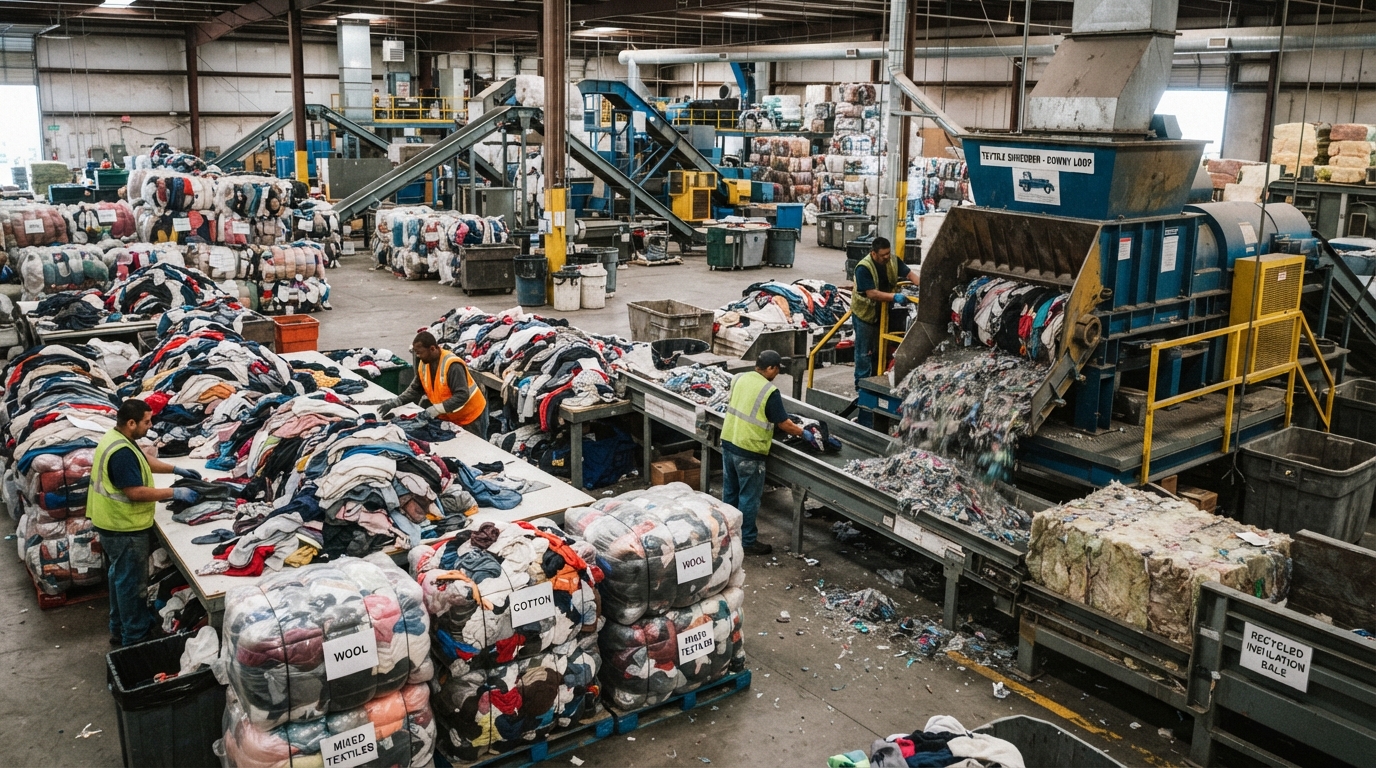
The modern apparel stream is governed by intense supply-demand imbalances driven by fast-fashion consumption cycles. Thrift organizations do not operate as personal wardrobe curators; they act as the initial collection and sorting nodes in an expansive, multi-tiered international commodities market. When you part with a garment, you are entering it into an unforgiving logistical funnel governed by optical sortation thresholds, mechanical polymer tearing physics, and hyper-segmented downstream processing capabilities.
“Donating used clothing with the assumption that every piece will be hung on a local thrift rack is municipal wishcycling. Understanding the four-tier sorting pyramid is the only way to make informed, responsible diversion choices.”
The Myth of the Local Thrift Store: Where Donated Clothes Actually Go
When a citizen pulls up to a donation drop-off at Goodwill Industries, The Salvation Army, St. Vincent de Paul, or an independent community depository, there is an unspoken assumption that volunteers meticulously inspect each article, iron it, tag it, and place it directly on retail racks. In actual industrial operation, thrift facilities are overwhelmed by a torrential inflow of low-value, fast-fashion garments that vastly outstrips the physical square footage of their storefronts and the purchasing capacity of local thrift shoppers.
Intake associates work under rigorous throughput metrics. At major municipal intake docks, sorting technicians have between three and eight seconds per garment to execute a visual and tactile triage. They assess fabric integrity, check for armpit discoloration, collar wear, missing buttons, broken zippers, and search for recognizable premium brand labels. Because floor space must be optimized for items with high inventory turnover, less than 15% to 20% of donated apparel ever makes it onto retail sales floors.
Tier 1: Domestic Retail (15–20%)
Only items in pristine, stain-free condition with contemporary styling, intact hardware, and recognizable tags reach the sales floor. Items that remain unsold after a strict 3-to-4-week clearance cycle are pulled and directed into wholesale consolidation bins.
Tier 2: Global Secondary Export (45–50%)
Unsold store garments and excess warehouse intake are compressed into massive 1,000-pound bales. These are sold by the ton to international brokers and shipped via container freight to secondary reuse hubs across Sub-Saharan Africa, Latin America, and Southeast Asia.
Tier 3: Industrial Wiping Rags (20%)
Wearable-grade garments that are heavily worn, torn, or stained—yet composed of high-absorbency natural fibers like pure cotton jersey, terry cloth, and flannel—are mechanically destamped of zips and buttons and converted into grease-absorbing wiping cloths for machine shops and maritime maintenance.
Tier 4: Mechanical Shoddy Downcycling (15–20%)
Synthetic knits, acrylic fleeces, heavily blended garments, and worn bedding that cannot absorb oils are fed into high-speed rotary garnetting machines. Teeth tear them into loose unaligned fibers for automotive acoustic insulation, carpet underlay, and soundproofing panels.
Charitable non-profits rely on selling wholesale bales of Tiers 2 through 4 to cover the payroll, fleet logistics, and operational overhead required to run their social missions. Donors must recognize that secondary textile triage is an industrialized commodity sorting engine, not a direct wardrobe pass-through.
The Global Secondary Market: Baling, Grading, and Export Dynamics
The scale of the global trade in second-hand apparel is vast. Every week, millions of pounds of post-consumer clothing leave North American and Western European ports packed inside standard 40-foot intermodal shipping containers. Once these giant bales arrive at major logistics terminals such as Tema, Ghana, or Mombasa, Kenya, they enter a hyper-specialized merchant ecosystem.
Wholesale container lots are bought blind by local market concessionaires. In sprawling secondary textile centers like Accra’s Kantamanto Market, hundreds of thousands of individual retailers split open 120-pound bales with box cutters, frantically inspecting the contents. Inside each bale lies an unpredictable gamble:
Grade A (First Selection)
Immaculate condition, modern youth cuts, recognizable sportswear tags (Nike, Adidas, Carhartt). These items command premium prices and are resold within hours to regional urban consumers.
Grade B (Standard Utility)
Functional but visibly worn garments with minor wash fading or outdated sizing. Repaired or washed by local tailors and sold at narrow margins in rural provincial markets.
Grade C & Residual Waste (The Ecological Crisis)
Stretched synthetic polyester tops, micro-short fast-fashion party dresses inappropriate for local cultural climates, and unwearable torn scraps. Due to severe lack of municipal waste infrastructure, an estimated 40% of garments entering these ports end up in open-air burning pits or washed into marine wetlands.
This export dynamic highlights why high-consumption nations cannot simply donate their way to environmental sustainability. Exporting low-quality, poly-blend textiles shifts the burden of municipal waste management onto nations least equipped with advanced MRFs, high-temperature thermal incinerators, or engineered sanitary landfills.
Mechanical Downcycling vs. True Fiber-to-Fiber Circularity
Public relations campaigns from retail apparel brands frequently showcase visionary diagrams of closed-loop circularity: an old cotton shirt tossed into a collection kiosk, chemically separated, and re-spun into a brand-new, silky garment. In reality, less than 1% of post-consumer clothing is recycled back into clothing. The vast majority of recycled textiles undergo mechanical downcycling into drastically downgraded industrial insulation.
The Mechanical Garnetting Reality (The "Shoddy" Process)
When discarded clothes arrive at an industrial downcycling plant, they pass through a hardware extraction phase: automated slicers remove thick waistbands, heavy metal zippers, steel rivets, and plastic buttons. The remaining swatches are fed into high-speed rotary tearing drums outfitted with rows of hardened, hooked steel pins—a process known historically as garnetting.
These spinning teeth violently rip, pull, and dissect woven and knit structures back into loose, fluffy staple fibers. While this process recovers raw bulk material, it devastates the physical integrity of the polymer filaments. Virgin organic cotton boasts an average staple fiber length of 28 to 34 millimeters, which grants it tensile flexibility and structural strength during spinning. Mechanically torn cotton fibers, by contrast, drop to less than 8 to 10 millimeters.
The Downstream Result: These severely shortened, fractured fibrils lack the tensile strength needed to be spun back into fine yarn for wearable apparel without adding a massive carrier matrix (over 65–80%) of virgin synthetic filament. Consequently, post-consumer mechanical shredding is fundamentally downcycling into lower-tier functional products: acoustic deadening mats inside vehicle doors, subfloor carpet cushioning, trunk liners, structural acoustic insulation panels, and furniture padding.
Synthetic Blends, Elastane, and the Chemical Recycling Bottleneck
If mechanical shredding damages fiber length, why can't we simply melt plastic fibers down or dissolve fabrics chemically back into virgin monomers? The insurmountable hurdle facing modern recycling engineers is polymer contamination—specifically, the widespread use of synthetic blends and elastane (spandex/Lycra).
Modern consumers demand comfort, stretch, and shape retention. An average pair of modern jeans is no longer 100% rigid cotton denim; it is woven with 72% cotton, 25% polyester, and 3% elastane. Athletic leggings, winter fleece jackets, and everyday socks frequently blend four or more distinct synthetic polymers together in intimate yarn matrices.
The Elastane Chemical Sabotage
Advanced chemical depolymerization methods—such as enzymatic hydrolysis for natural fibers and glycolysis for polyester—rely on precise biochemical reactions that break plastic polymers into pure dimethyl terephthalate (DMT) or bis(2-hydroxyethyl) terephthalate (BHET). However, polyurethane-based elastane does not melt or dissolve cleanly at the same temperature and pressure curves as pure polyester or nylon.
Under standard chemical recycling conditions, elastane turns into an intractable, tar-like sludge that coats catalytic reaction chambers, clogs micron-scale filter membranes, and fouls solvent baths. Even a tiny 2% elastane inclusion can render an entire commercial 20-ton chemical reactor run unusable.
Engineering Benchmark: Until automated sorting facilities deploy high-speed Near-Infrared (NIR) optical sensors capable of detecting and sorting elastane-free textiles at sub-second speeds, true fiber-to-fiber chemical circularity will remain confined to specialized pilot facilities handling pre-consumer manufacturing scrap.
Municipal Textile Diversion: Protocols for Soiled, Ripped, or Unwearable Items
One of the most dangerous and costly residential sorting errors is tossing worn-out, ripped, or holy clothing into the blue or green municipal recycling bin. Municipal Materials Recovery Facilities (MRFs) are strictly calibrated to sort rigid containers (aluminum cans, PET plastic bottles, HDPE jugs) and flat paperboards.
In MRF operations, clothing is labeled a high-hazard tangler. Flexible textiles wrap tightly around rotating steel axles and high-speed star-screens. Within minutes, wrapped jeans and sweaters create extreme motor friction, trigger electrical fires, and cause facility shutdowns where workers must crawl into hazardous shafts with utility knives to manually slice away shredded garments.
100% Bone-Dry Rule
Never place damp, wet, or mildewed clothing into any donation box or textile drop bin. A single moist towel packed into an airtight 1,000-lb bale will cultivate invasive black mold throughout hundreds of pounds of surrounding dry garments in 48 hours, condemning the entire bale to landfill incineration.
Transparent Bagging & Labeling
When dropping off unwearable items at certified non-profit depots (such as Goodwill, Salvation Army, or SMART-affiliated bins), pack torn, holy, or stained items in a separate transparent bag labeled "Scrap Textiles for Downcycling". This saves sorters valuable seconds and routes items straight to the industrial baler.
Zero Hazardous Solvent Contamination
Rags and garments soaked in gasoline, motor oil, paint thinner, polyurethane varnish, or strong pesticides must never enter secondary textile channels. Spontaneous combustion of solvent-soaked fabrics during hydraulic baling is a documented catastrophic fire risk. Route these directly to your municipal Household Hazardous Waste (HHW) site.
Domestic Tier-3 Upcycling First
Before donating worn-out 100% cotton bath towels, flannel shirts, or torn denim jeans, cut them into kitchen rags, shop wipes, and car-washing cloths. Domestic upcycling directly displaces single-use virgin paper towels and keeps textiles in active use for years.
Frequently Asked Questions (Real-World Textile Logistics)
Do thrift stores throw unsold clothes into dumpsters?
Why can't old clothes go into the blue municipal recycling bin?
What is "shoddy" fiber, and what is it used for?
Can ripped, stained, or holy clothes still be dropped off for recycling?
Are brand in-store textile take-back boxes better than thrift bins?
verified_user
Key Takeaways
5 Actionable Rules for Circular Textile Stewardship
Key Takeaways
5 Actionable Rules for Circular Textile Stewardship
1
2
3
4
5
Grease, Fats & Cooking Oils: Stopping the “Fatberg” in Home Plumbing
Never pour grease down the drain: cool-and-can methods, commercial biofuel drop-off stations, and neighborhood grease recycling bins.